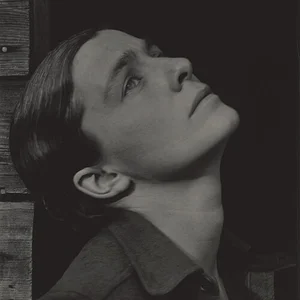

Rebecca Salsbury Strand (1891-1968) was an American painter and artist, wife of the photographer Paul Strand. Close to Georgia O'Keeffe, she accompanied her on her first stay in New Mexico in 1929 and developed a body of work marked by glass painting (reverse painting).
Rebecca Strand
Rebecca Strand
4 min read
Frequently asked questions
Key Facts
- Born in 1891 in New York, daughter of the impresario Nate Salsbury
- Married the photographer Paul Strand in 1922 and posed for his portraits and nudes
- Accompanied Georgia O'Keeffe on her first trip to New Mexico in 1929
- Developed a reverse glass painting technique in the 1930s
- Settled permanently in Taos (New Mexico) and died in 1968
Works & Achievements
A body of floral works and still lifes painted on the back of glass plates, her most original contribution to American art.
Compositions of flowers rendered in tight framing, in dialogue with the art of her friend Georgia O'Keeffe.
Embroidery work inspired by the Hispanic traditions of New Mexico, which she helped revive in Taos.
Motifs of crosses, objects, and New Mexico landscapes incorporated into her glass paintings.
Anecdotes
Rebecca Salsbury was born in London in 1891: her father, Nate Salsbury, was Buffalo Bill Cody's business partner and managed his famous Wild West show, which was then touring England. She thus grew up surrounded by the most popular American entertainment of her time.
In 1922, she married the photographer Paul Strand. For years, Alfred Stieglitz used her as a model for a long series of portraits, some of them very intimate, much as he did for Georgia O'Keeffe.
Rebecca and Georgia O'Keeffe became very close friends. In 1929, the two women set off together for their first extended stay in Taos, New Mexico, a trip that transformed the art of both of them.
She revived an old and delicate technique: reverse painting on glass. The artist paints in reverse, directly on the back of a glass plate, starting with the details that will be seen first — so everything has to be planned backwards.
After her divorce from Paul Strand, she settled permanently in Taos and in 1937 married William James, a local rancher. She became an active figure in the artistic community of New Mexico.
Primary Sources
In her correspondence, O'Keeffe describes the light and landscapes of New Mexico that she discovered with her friend Rebecca during their 1929 stay.
A series of silver gelatin prints made by Stieglitz using Rebecca as his model, now held in American public collections.
The letters exchanged by the couple bear witness to their life together and their travels in New Mexico in the early 1930s.
Key Places
Birthplace of Rebecca Salsbury in 1891, while Buffalo Bill's Wild West show was on tour.
Center of the modernist avant-garde where Alfred Stieglitz's circle moved and where she lived with Paul Strand.
Artists' colony where she stayed with O'Keeffe in 1929 and then settled; the place of her mature work and of her death in 1968.
Artistic hub near Taos, important to the community of artists of the American Southwest.
Typical Objects

A glass support on which the artist paints in reverse, the image being viewed through the transparency. Rebecca Salsbury's favourite technique.

Small brushes needed for the painstaking work on details, which are laid down first in reverse painting on glass.

The view camera used by her husband Paul Strand and by Stieglitz, ever-present in her world as a model and a wife.

A traditional Hispano-American embroidery technique that Rebecca practised and helped revive in Taos.

Recurring motifs in her glass paintings, rendered in close-up in a spirit close to that of Georgia O'Keeffe.
School Curriculum
Vocabulary & Tags
Key Vocabulary
Daily Life
Morning
In Taos, Rebecca enjoys the clear, bright morning light, ideal for painting. She prepares her glass plates and fine brushes before beginning work that demands patience and precision.
Afternoon
The afternoon is split between the studio and exchanges with the other artists of the colony. She receives friends like Georgia O'Keeffe or corresponds with the New York circle left far behind.
Evening
In the evening, she reads, writes letters, and discusses art and techniques with those close to her. The social life of Taos sets the rhythm of her evenings, among artists, writers, and passing collectors.
Food
In New Mexico, the cuisine blends American and Hispanic traditions: corn, beans, chili peppers, and bread. The meals reflect the cultural blending of the region where she has chosen to live.
Clothing
She happily adopts the style of Southwestern artists, influenced by Hispanic and Native American cultures: loose-fitting garments, shawls, and silver and turquoise jewelry.
Housing
She lives in an adobe-style house, made of sun-dried earthen brick, typical of Taos. These low dwellings with thick walls keep the interior cool and blend into the desert landscape.
Historical Timeline
Period Vocabulary
Liens externes & ressources
Références
Œuvres
Peintures sous verre (reverse paintings)
années 1930-1940
Tableaux de fleurs en gros plan
années 1930
Broderies colcha
années 1930-1950