
Rembrandt van Rijn was a Dutch painter and etcher of the 17th century, considered one of the greatest masters of Western painting. A virtuoso of chiaroscuro, he excelled in portraits, biblical scenes, and self-portraits. His work, marked by profound humanity, has had a lasting influence on the history of art.
Rembrandt(1606 — 1669)
Rembrandt
Provinces-Unies
8 min read
Frequently asked questions
Key Facts
- 1606: born in Leiden (Dutch Republic)
- 1632: The Anatomy Lesson of Dr. Nicolaes Tulp, which brought him immediate fame in Amsterdam
- 1642: The Night Watch, a monumental masterpiece commissioned by a bourgeois militia in Amsterdam
- 1656: bankruptcy and auction of his belongings, a sign of the financial precarity artists faced in the marketplace
- 1669: died in Amsterdam, leaving a body of work comprising over 300 paintings, 300 etchings, and 2,000 drawings
Works & Achievements
A group portrait commissioned by the Amsterdam Surgeons' Guild, depicting a public dissection. This work revolutionized the collective portrait by infusing it with dramatic tension and a new narrative unity.
A monumental painting depicting a bourgeois militia company in motion, bathed in brilliant artificial light. A masterpiece of Dutch Baroque, it showcases Rembrandt's absolute mastery of composition and chiaroscuro.
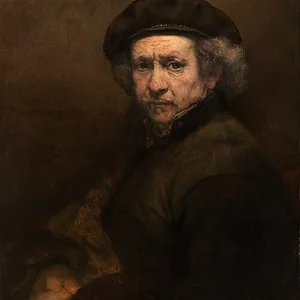
One of Rembrandt's last and most powerful self-portraits, painted near the end of his ruined life. He portrays himself with a striking serenity and dignity, holding his brushes before a mysterious canvas adorned with two circles.
A monumental biblical painting considered Rembrandt's spiritual testament. The embrace between the father and his repentant son, rendered with infinite tenderness, is regarded as one of the most moving scenes in the entire history of painting.
A collective portrait of five inspectors of the Amsterdam Drapers' Guild, commissioned by the guild. Rembrandt succeeds in giving the impression that the figures are looking directly at the viewer, creating a striking illusion of living presence.
A monumental etching depicting the Crucifixion, considered the pinnacle of his printmaking art. Rembrandt reworked the plate over several years to introduce a ray of divine light of exceptional dramatic intensity.
Anecdotes
Rembrandt was one of the first artists to use the self-portrait in a systematic way: more than a hundred are attributed to him, created throughout his life. These works form a genuine visual diary, tracing the evolution of his face from ambitious young man to ruined old age, with striking psychological honesty.
In 1656, Rembrandt was declared insolvent and forced to auction off his entire impressive personal collection. He had amassed hundreds of works of art, suits of armor, exotic curiosities, and Japanese prints — a testament to his insatiable intellectual curiosity and passion as a collector.
The Night Watch, commissioned in 1642 by a group of militiamen who had paid to be depicted in it, caused astonishment: some figures were shown half-hidden or seen from behind, which was highly unusual for an official group portrait. It is said that some dissatisfied patrons demanded their money back.
Rembrandt almost never traveled outside the Dutch Republic, yet his Amsterdam studio was frequented by merchants from around the world who brought him precious fabrics, oriental costumes, and exotic objects. He used these as props to lend remarkable visual authenticity to his biblical scenes.
Unlike court painters who worked for princes, Rembrandt practiced his art in a bourgeois, Protestant city where the art market was open and competitive. He built a true school of painting, teaching dozens of students whose works he sometimes sold as his own — a common practice at the time, though one that occasionally stirred controversy.
Primary Sources
The two paintings that Your Lordship commissioned are now completed through my diligent efforts and particular study... I believe you will find in them the greatest and most natural emotion.
Rembrandt Harmenszoon van Rijn, painter, acknowledges having purchased this house for the sum of thirteen thousand florins, of which four thousand two hundred and twenty were paid in cash.
A large number of paintings, sketches, and drawings by Rembrandt's hand; a collection of armor, helmets, and Japanese swords; print books by Lucas van Leyden, Raphael, Michelangelo, and other masters.
Rembrandt was very miserly and kept his pupils in separate attic rooms divided by partitions so that they would not copy one another. He liked to mix with common people and frequented auctions to buy clothing and props.
Each of the eighteen militiamen contributed according to his rank to the payment of painter Rembrandt van Rijn for the execution of a large painting depicting their company in arms.
Key Places
Rembrandt's birthplace, a thriving university and textile center. It was here that he was born in 1606, received his education, and began his career as a painter before moving to Amsterdam.
Rembrandt purchased this house on the Sint Anthonisbreestraat in 1639 for 13,000 guilders. It housed his studio and collection until his bankruptcy in 1656; it is now a museum.
This national museum holds Rembrandt's greatest masterpieces, including The Night Watch (1642), considered the most famous painting in the Netherlands.
A large Protestant church in the Jordaan district where Rembrandt was buried in a pauper's grave in 1669. It is also the resting place of Saskia, his beloved wife.
This royal museum holds several major works by Rembrandt, including The Anatomy Lesson of Dr. Nicolaes Tulp (1632), his first major commission, which brought him fame in Amsterdam.
Typical Objects

The central tool of his craft, Rembrandt's palette was loaded with ochres, earth pigments, blacks, and lead whites. His technique of successive glazes and bold impasto required brushes of many different sizes.

Rembrandt was an exceptional printmaker, producing more than 300 etchings and drypoints. The engraved copper plate, inked and pressed onto paper, allowed him to spread his art across all of Europe.

Rembrandt collected exotic garments and accessories acquired from Amsterdam's markets. He used them as costumes in his paintings on biblical or historical subjects to create an atmosphere of authentic Eastern settings.

For his countless self-portraits, Rembrandt used a mirror placed in his studio. This simple object allowed him to spend his entire life exploring human facial expressions and the effects of light on the features.

Rembrandt's mastery of chiaroscuro rested on the careful observation of a single, directional light source. A simple candle or oil lamp was enough to create the dramatic contrasts that define his work.

The 1656 bankruptcy inventory explicitly lists Japanese prints among Rembrandt's collection. These works from Asia, imported through the VOC, reflect the painter's broad intellectual openness to the wider world.
School Curriculum
Vocabulary & Tags
Key Vocabulary
Tags
Daily Life
Morning
Rembrandt rose early to make the most of the natural north light that streamed through the large windows of his first-floor studio. He would begin by supervising his pupils, checking their colour mixtures and reviewing drawing exercises done from plaster casts or live models.
Afternoon
The afternoon was devoted to painting proper or to copper engraving — work that called for fading but steady light. Rembrandt occasionally received clients or dealers who came to negotiate portrait commissions, and he regularly walked the flea markets and auction houses of Amsterdam to add to his collection.
Evening
In the evenings, by candlelight, Rembrandt would draw or study his prints and art books. He lived simply despite his former wealth, sharing meals with Hendrickje Stoffels, his companion in his later years, and his son Titus.
Food
Dutch cuisine in the seventeenth century was hearty and unpretentious: rye bread, salted herring, cheeses, vegetable soups, and boiled meats. Spices imported by the VOC (pepper, nutmeg, cinnamon) enlivened the meals of wealthier households, and Rembrandt counted himself among them during his years of prosperity.
Clothing
In his studio, Rembrandt wore a simple smock or paint-stained working robe, often topped with a velvet beret as seen in several of his self-portraits. For outings and social occasions, he dressed in good-quality dark woollen cloth, in keeping with the bourgeois and Protestant customs of Amsterdam.
Housing
From 1639 to 1656, Rembrandt lived in a large four-storey townhouse on the Sint Anthonisbreestraat, in Amsterdam's Jewish quarter. The studio occupied the first floor, lit by broad north-facing windows; the upper rooms served as a warehouse for his vast collection. After his bankruptcy, he had to make do with a modest dwelling in the Jordaan.
Historical Timeline
Period Vocabulary
Visual Style
Une esthétique baroque sombre et chaleureuse, dominée par le clair-obscur : des fonds bruns presque noirs d'où émergent des visages éclairés par une lumière dorée, avec des matières picturales généreuses et expressives.
Sound Ambience
L'atelier silencieux d'Amsterdam : le crépitement du feu, le grattement de la pointe sur le cuivre et les cloches lointaines de la Westerkerk composent l'univers sonore quotidien de Rembrandt.
Liens externes & ressources
Références
Œuvres
La Leçon d'anatomie du docteur Tulp
1632
Autoportrait aux deux cercles
vers 1665-1669
Les Syndics des drapiers (De Staalmeesters)
1662
Les Trois Croix
1653