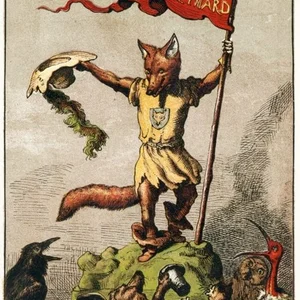

Renart is an anthropomorphic character from the Roman de Renart, a celebrated cycle of satirical tales from the Middle Ages. This cunning and mischievous fox embodies trickery and deception through picaresque adventures that critique the customs and social order of the time.
Frequently asked questions
Key Facts
- The Renart cycle was created in the 12th–13th centuries by several anonymous authors
- Renart gradually becomes the central hero of a series of satirical tales known as 'branches'
- The character indirectly critiques the nobility, the clergy, and the feudal system through animal fables
- The name 'Renart' became so popular that it replaced the older French word 'goupil' as the common word for fox
- The work profoundly influenced European literature and inspired numerous adaptations
Works & Achievements
The first branch of the narrative cycle in which Renard tricks Isengrim the wolf and other animals at the court of King Noble. This work lays the foundations for the character and his satirical world.
Renard disguises himself as a pilgrim to deceive his enemies, showcasing his talent for disguise and trickery. This adventure became one of the most celebrated tales in the cycle.
Renard stands trial before his accusers, most notably Isengrim. These courtroom branches offer a sharp critique of medieval justice and corruption.
Renard tricks Isengrim into believing he can catch fish by dipping his tail through the ice. This misadventure became emblematic of the fox's cruelty toward his rivals.
Renard sets fire to Isengrim's lair, illustrating the escalating nature of the fox's misdeeds. This branch heightens the brutal tone and chaotic scheming that define his character.
Renard courts and lives alongside Hermeline, his mate, revealing a more intimate side of the character while preserving his essentially deceitful and malicious nature.
The full collection of narrative branches forming a coherent cycle of approximately 30,000 lines of verse, parodying epic and courtly literature while critiquing the social structures of medieval society.
Anecdotes
Renart was born in the 12th century as part of a cycle of anonymous tales written in Old French, known as the 'Roman de Renart' (Romance of Reynard). These stories, composed between 1170 and 1250, were originally separate poems called 'branches' that wandering performers recited in noble courts. The character became so popular that his name eventually replaced the old French word 'goupil' as the common word for fox.
In one of the most famous branches, Renart tricks the wolf Isengrin into fishing with his tail through a hole in the ice, then seals the hole shut to trap him. This adventure illustrates how the Roman de Renart mocked the powerful by showing a weaker animal outwitting a stronger one through cunning and wit.
The Roman de Renart was a sharp piece of social satire aimed at the feudal nobility, the clergy, and royal authorities. Through the animal misadventures of Renart and his victims, the authors criticized the corruption, abuse of power, and hypocrisy of the medieval elite — which explains its enormous popularity with audiences of all backgrounds.
The success of the Roman de Renart reached far beyond medieval France: versions were translated into German, Italian, Dutch, and English. This rapid spread across 13th-century Europe proves that its themes of trickery and mockery of the powerful resonated with readers across every kingdom.
Renart embodies the literary archetype of the 'trickster': a character who survives by his wits rather than his strength. This tradition of the cunning hero recurs throughout world literature, from medieval comic tales to modern folk stories, making Renart a distant ancestor of countless fictional characters.
Primary Sources
Lords, hear of Reynard. It was in that time when King Noble held his court. Reynard the fox was most courtly and most wise, and most deceitful and most treacherous.
Reynard appears before King Noble and defends himself against all the crimes of which he is accused. He employs trickery and honeyed words to justify himself, revealing his deceitful nature.
Reynard the fox laid a trap for Isengrim the wolf to deceive and harm him. Through his cunning and craft, he caused him to fall into the pit he had dug.
Reynard set about becoming a dyer in order to swindle merchants and nobles alike, showing that his malice knows no bounds when it comes to fraudulent schemes.
Key Places
Renart's fortified castle and estate, located in Flanders. It is the fox's main residence, where he plots his schemes and where several adventures of the Roman de Renart take place.
The royal court where Renart stands trial and where the political intrigues of the story unfold. It is the place of confrontation between the fox and his adversaries, most notably Isengrin the wolf.
The main geographical setting of the Roman de Renart, where most of the adventures take place. The Flemish and northern medieval context provides the backdrop for these satirical tales.
A memorable location in the Roman de Renart and the setting of one of its most famous scenes: Renart lures Isengrin into a perilous trap here, symbolizing the fox's triumphant cunning.
A French region connected to certain versions of the Roman de Renart. Several manuscripts place episodes of the cycle in this area, which holds an important place in medieval French literature.
Typical Objects

A medieval codex adorned with historiated initials and colorful illustrations depicting the fox's adventures. This object embodies the written transmission of satirical tales from the 12th–13th centuries.

A hunting device used by medieval peasants. Renart, despite his cunning, often falls into these traps, symbolizing the vanity and backfiring nature of malicious schemes.

A visual representation of the character as an anthropomorphic animal with russet fur. This physical attribute embodies the natural cunning associated with the fox in medieval literature.

The colorful, patchwork clothing typical of comic characters in the Middle Ages. Renart wears it during his disguises and schemes to deceive the other animals.

An eccentric headpiece symbolizing the character's buffoonish and satirical role. It represents his status as a parodic figure who mocks and subverts the established medieval order.

A primitive medieval weapon used in brawls and fights. Renart wields it during his violent confrontations with enemies such as Isengrin the wolf.

A medieval fortified dwelling symbolizing feudal power. Renart's den at Maupertuis stands in sharp contrast to these imposing structures, highlighting the cunning of the weak against the strong.

A fake scroll or letter that Renart fabricates for his swindles. This object illustrates his shrewd intelligence and his ability to deceive even ecclesiastical and feudal authorities.
School Curriculum
Vocabulary & Tags
Key Vocabulary
Tags
Lieu
Mythologie
Daily Life
Morning
Renart wakes in his den, ready to plot the day's schemes. He scans his surroundings to spot potential prey — farmers and animals of the feudal farmyard above all. From dawn, he sets about his tricks and deceptions to secure food and advantage.
Afternoon
Renart puts his elaborate plans into action: seducing hens, stealing harvests, mocking the other fable animals and the representatives of established power. His afternoons are filled with intrigue, taunts, and confrontations where he uses his cunning to outwit his rivals — especially Isengrin the wolf.
Evening
As dusk falls, Renart returns to his den with his spoils, triumphant over the day's exploits. He savors his gains at rest, pleased with himself and his deceits, before hatching new plans for the morrow. Evening is the time when he revels in his own malicious cleverness.
Food
Renart feeds mainly on stolen poultry, game, and scraps he pilfers from farmhouses and noble kitchens. His diet also includes fruit, eggs, and whatever else he can filch through trickery. As a carnivore at heart, meat remains his preferred food — obtained more often through deception than through direct hunting.
Clothing
Although depicted as an anthropomorphic animal, Renart is sometimes shown without clothing, yet the literary tradition gives him distinctly human attributes. His appearance remains that of a sly fox with expressive features — a literary symbol of malice and calculating intelligence, with no fixed wardrobe but a thoroughly human personality.
Housing
Renart lives in a forest den, the underground refuge typical of foxes, strategically positioned close to human settlements and farms. His dwelling allows him to hide after his misdeeds and plan his next moves in safety. It is a modest but functional space, serving as the base of operations for his schemes of deceit and theft.
Historical Timeline
Period Vocabulary
Visual Style
Un style graphique inspiré des enluminures médiévales du XIIe-XIIIe siècle, alliant le détail minutieux des manuscrits gothiques à une ambiance picaresque et satirique. Les illustrations combinent trait fin et rehauts d'or, évoquant les marges fantaisistes des textes médiévaux.
Sound Ambience
Une ambiance forestière médiévale empreinte de ruse et de malveillance, mêlant bruits naturels de sous-bois, instruments anciens jouant sur un mode espiègle, et voix lointaines de villageois. L'atmosphère capture l'essence picaresque et satirique du goupil trickster, entre menace silencieuse et comédie morale.
Liens externes & ressources
Références
Œuvres
Le Roman de Renart (branche I)
XIIe siècle
La Ruse du faux pèlerinage
XIIe-XIIIe siècles
Le Procès de Renart à la cour du Roi Noble
XIIe-XIIIe siècles
La Pêche à la queue
XIIe-XIIIe siècles
L'Incendie de la maison d'Isengrin
XIIe-XIIIe siècles
Les Aventures amoureuses avec Hermeline
XIIe-XIIIe siècles
Le Cycle complet du Roman de Renart
XIIe-XIIIe siècles