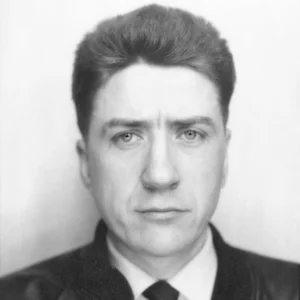

René Magritte was a Belgian surrealist painter. Famous for his enigmatic images that question the relationship between objects, their representations and language, he is the author of the painting *The Treachery of Images* (“This is not a pipe”).
René Magritte(1898 — 1967)
René Magritte
Belgique
5 min read
Frequently asked questions
Famous Quotes
« This is not a pipe.»
Key Facts
- Born in 1898 in Lessines (Belgium) and died in 1967 in Brussels.
- Painted *The Treachery of Images* in 1929, bearing the inscription “This is not a pipe”.
- A major figure of Belgian surrealism, connected to André Breton's Parisian surrealist group.
- Created iconic works such as *The Son of Man* (1964) and *The Empire of Light*.
- His work had a lasting influence on conceptual art and the pop art of the second half of the 20th century.
Works & Achievements
Considered his first Surrealist painting, it marks the beginning of his language of enigmatic images.
The famous “This is not a pipe,” a reflection on the gap between an object, its image and its name.
A canvas set in front of a window continues the landscape exactly, blurring reality and representation.
A couple kisses, their faces wrapped in cloth, a disturbing image of love and separation.
A daytime sky sits above a street plunged into night, playing on the impossible coexistence of day and night.
A rain of identical men in bowler hats floats above a town, an image of modern anonymity.
A self-portrait of a man in a suit whose face is hidden by a green apple, which has become a worldwide icon.
Objects are paired with words that do not match them, questioning the link between image and language.
Anecdotes
In 1929, Magritte painted *The Treachery of Images*: a perfectly realistic pipe accompanied by the sentence “This is not a pipe.” The artist explained that he was right, because it was only an image of a pipe: impossible to stuff it with tobacco and smoke it!
To earn a living early in his career, Magritte worked in advertising and catalogue illustration, notably for a fashion house and on posters. This day job shaped his taste for crisp, legible, and striking images.
Magritte led a seemingly very ordinary life in Brussels, in a suburban house, with a bowler hat and a dark suit. Yet this man with the look of a discreet middle-class gentleman painted the most unsettling images of his time.
During the German Occupation, between 1943 and 1947, Magritte briefly adopted a bright, colourful style inspired by the Impressionist Renoir, which became known as his “Renoir period” or “full sunlight” period. He wanted to set joy and light against the darkness of the war.
The face hidden by a green apple in *The Son of Man* is one of his most widely reproduced images. Magritte explained that everything we see hides something else, and that we always want to see what is concealed.
Primary Sources
This is not a pipe.
An object is never so attached to its name that we cannot find another that suits it better.
Painting allowed me to see, in a sense, behind things, behind the bars of their presence.
Everything we see hides another thing; we always want to see what is hidden by what we see.
Key Places
Town in Hainaut where René Magritte was born in 1898.
School where Magritte studied painting from 1916 onwards.
Belgian capital where Magritte lived and worked for most of his life, in the Jette district.
Parisian suburb where Magritte lived from 1927 to 1930 and mingled with the French Surrealists.
Industrial town where Magritte spent part of his youth after his mother's death.
Typical Objects

A round, rigid head covering, symbol of the anonymous bourgeois. Magritte wore one himself and depicted it on countless faceless figures.

An everyday object made famous by *The Treachery of Images*. Magritte uses it to show the difference between an object and its representation.

An ordinary fruit that Magritte enlarges or places in front of a face. It both conceals and intrigues, as in *The Son of Man*.

The painter's basic tools, which he stages in paintings such as *The Human Condition*, where the canvas blends into the landscape.

A commonplace object subverted in works such as *Hegel's Holiday*, where it balances a glass of water on top. It embodies the strange juxtaposition of two objects.

The formal attire of a respectable man that Magritte wore and reproduced on his figures. It heightens the sense of strangeness when the face is hidden or replaced.
School Curriculum
Vocabulary & Tags
Key Vocabulary
Daily Life
Morning
Magritte would get up in his ordinary house in Brussels and have breakfast with his wife Georgette. Rather than going up to an isolated studio, he often painted in a corner of the dining room or living room, in a suit.
Afternoon
In the afternoon, he worked on his canvases with a great, thoughtful slowness, searching for the right idea before painting. He also welcomed his fellow Belgian Surrealists to discuss art, wordplay and images.
Evening
In the evening, Magritte played chess, walked his Pomeranian dog and spent time with Georgette. The couple led a quiet, stay-at-home life, far from any bohemian scene.
Food
Magritte ate simple, middle-class Belgian food, with nothing particularly refined about it. He preferred the routine of meals taken at home over fashionable outings.
Clothing
He dressed like a respectable office clerk: dark suit, shirt, tie and sometimes a bowler hat. This everyman appearance deliberately contrasted with the strangeness of his paintings.
Housing
He lived in a modest terraced house in the Brussels suburbs, notably on rue Esseghem in Jette. The middle-class interior, with its fireplace and windows, reappears often in his paintings.
Historical Timeline
Period Vocabulary
Liens externes & ressources
Références
Œuvres
La Trahison des images
1929
La Condition humaine
1933
Les Amants
1928
L'Empire des lumières
1954
Golconde
1953
Le Fils de l'homme
1964