
A Welsh goddess from Celtic mythology, Rhiannon appears in the Mabinogion, a collection of Welsh prose tales compiled around the 11th–12th centuries from older oral traditions. A figure of the Otherworld (Annwn), she is associated with white horses, magic, and sovereignty.
Rhiannon
Rhiannon
8 min read
Frequently asked questions
Key Facts
- Rhiannon appears primarily in the First and Third Branches of the Mabinogion, Welsh written sources from the 11th–12th centuries.
- Linguists link her name to *Rigantona*, a Gaulish term meaning 'great queen', pointing to a pre-Christian divine origin.
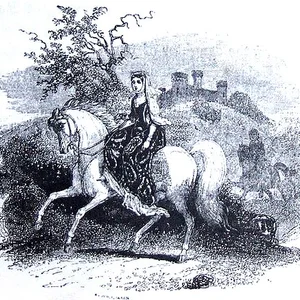
- She rides a white horse that no rider can overtake, a symbol of her belonging to the Otherworld.
- Falsely accused of killing her own son, she endures a humiliating penance before being cleared — a recurring motif of the unjustly punished woman.
- She is often compared to the Gaulish goddess Epona, deity of horses, suggesting a shared mythological substrate across the Celtic world.
Works & Achievements
A collection of four Welsh prose tales forming the primary source of the Rhiannon myth. The First and Third Branches are directly devoted to her, portraying her as a figure of sovereignty, an unjustly accused mother, and a faithful wife.
The first major Welsh manuscript to preserve the complete text of the Mabinogi. Its survival is crucial to the transmission of the Rhiannon myth through to the modern era.
The second major medieval Welsh manuscript and the key textual source for the tales of Rhiannon. Held at the Bodleian Library in Oxford, it contains the most complete copy of the Mabinogi.
The first complete English translation of the Mabinogi, which spread the tales of Rhiannon across educated Europe and sparked a widespread Romantic interest in Celtic mythologies.
Archaeological evidence (bas-reliefs, votive inscriptions) of the Celtic horse goddess, an iconographic cousin of Rhiannon, whose worship spread throughout the Empire. These remains attest to the antiquity and reach of the Celtic equestrian goddess tradition.
Anecdotes
At their first meeting, Pwyll, Prince of Dyfed, spots Rhiannon riding a white horse at a mysterious, unhurried pace. He sends his fastest riders to catch up with her, but despite their best efforts, none can ever reach her. It is only when he calls out to her directly that Rhiannon stops — revealing that she had been waiting all along for someone to speak to her.
Falsely accused of killing her own newborn son, Rhiannon was sentenced to a humiliating penance: to stand at the palace gate, confess her supposed crime to every visitor, and offer to carry them on her back like a beast of burden. She carried out this punishment with remarkable dignity and serenity, never complaining or losing her nobility.
Rhiannon's son Pryderi was snatched at birth by a giant hand that reached out of the darkness. Greyhound pups were found beside the sleeping mother, which jealous handmaidens used to falsely accuse her. Pryderi was eventually found years later and recognized his mother, finally putting the injustice to rest.
Rhiannon is associated with three magical birds whose song has the power to wake the dead and lull the living to sleep. These 'Birds of Rhiannon' embody the blurry boundary between the world of the living and the Otherworld (Annwn), highlighting the divine and ambivalent nature of this goddess of sovereignty.
The name Rhiannon most likely derives from the Gaulish *Rigantona*, meaning 'Great Queen.' Some scholars link her to Epona, the Gaulish horse goddess venerated throughout the Roman Empire. This linguistic and iconographic kinship illustrates the deep unity of Celtic mythology across geographical boundaries.
Primary Sources
And he saw a woman dressed in a garment of shining golden silk, riding a great pale white horse, advancing at a slow and steady pace along the road that passed before them.
Rhiannon and Manawydan, sitting upon the mound of Gorsedd Arberth, heard a peal of thunder, and a thick mist descended upon them, and when the light returned, they could see not a living soul.
A Welsh manuscript containing the earliest written versions of the Mabinogi tales, copied around 1350, preserving oral traditions dating back to the pre-Christian period.
The second major medieval Welsh manuscript preserving the Four Branches of the Mabinogi, written between 1382 and 1410, constituting alongside the White Book the primary textual source for the tales of Rhiannon.
Key Places
The main residence of Pwyll and royal court of Dyfed where Rhiannon arrives and where the central episodes of her myth unfold. The mound of Gorsedd Arberth, a magical site where wonders appear, is the geographical heart of the story.
A sacred mound on the outskirts of Arberth where anyone who sits upon it will either witness a wonder or receive wounds. It is from this mound that Pwyll first catches sight of Rhiannon, and it is here that the enchanted mist of the Third Branch descends.
The supernatural realm from which Rhiannon originates, conceived as a world running parallel to that of the living, free from sickness and death. Annwn has no fixed geographical location in Welsh mythology, but is often associated with islands to the West or with the world beneath the earth.
The land of which Rhiannon is the tutelary mythological figure, heir to pre-Roman Celtic traditions. Medieval Welsh mythology, compiled in the Mabinogi, was born from this distinctive cultural context.
Typical Objects

Rhiannon's emblematic animal, the white horse she rides at her first appearance symbolizes both her divine nature and her connection to the Otherworld. In Celtic mythology, the white horse is the animal of sovereignty and deities of the afterlife.

The garment Rhiannon wears at her first encounter with Pwyll, a sign of her royalty and her origins in the Otherworld. Silk and gold evoke the supernatural wealth associated with Celtic deities.

Three birds with enchanting songs capable of waking the dead and lulling the living to sleep. They embody Rhiannon's power over the boundary between life and death, and are cited in the Mabinogi tales as attributes of her divine nature.

In the tale, Gwawl, Pwyll's rival, is trapped in a magic bag that Rhiannon cleverly hands to her lover. This object illustrates the goddess's cunning and intelligence — she relies on strategy rather than force.

Medieval and modern depictions of Rhiannon frequently associate her with torques and gold ornaments, ceremonial jewelry typical of Celtic aristocracy that signaled rank, power, and belonging to the divine world.

A symbol of the unjust penance imposed on Rhiannon, who was forced to carry visitors on her back. This object illustrates the tragic dimension of her myth and the theme of the innocent woman wrongly accused, bearing her punishment with dignity.
School Curriculum
Vocabulary & Tags
Key Vocabulary
Tags
Daily Life
Morning
In the mythological setting, Rhiannon awakens in the great halls of the palace of Arberth, where Pwyll holds court. She dresses in silk and gold, adornments befitting her rank as queen and her divine origins in the Otherworld. Her presence fills the court with quiet authority and supernatural grace.
Afternoon
Rhiannon receives visitors and manages the affairs of the estate with wisdom and dignity. She sometimes rides her white horse through the lands around Arberth, a recognizable and venerated figure. During her period of disgrace, she performs her penance at the palace gate, offering to carry guests on her back without ever bowing her head.
Evening
At dusk, Rhiannon joins the court banquets — gatherings of storytelling and music typical of medieval Celtic societies. Her magical birds, whose songs weave a haunting spell, can be heard in the distance, suspending time between waking and sleep, between the world of the living and the Otherworld.
Food
At the Celtic feasts described in the Mabinogi, the royal table at Arberth overflows with roasted meat (pork, beef, game), bread, barley ale, and mead. As a divine figure from the Otherworld, Rhiannon is sometimes associated with supernatural abundance: Celtic tales describe the Otherworld as a place of endless feasting.
Clothing
Rhiannon appears clothed in a mantle of shining gold silk at her first appearance — a clear signal of her exceptional rank. High-ranking Celtic women wore robes of linen or fine wool, fastened with bronze or gold brooches, and torque necklaces — symbols of nobility and a connection to the divine.
Housing
Rhiannon dwells in the timber-and-stone palace of Dyfed at Arberth (present-day Narberth in Pembrokeshire). Medieval Welsh royal courts were centers of power, justice, and culture, surrounded by farmland. The Otherworld from which she originates is described as a palace of light and eternity, free from sickness and old age.
Historical Timeline
Period Vocabulary
Visual Style
Style entre enluminure médiévale galloise et romantisme préraphaélite : femme majestueuse en soie dorée chevauchant un cheval blanc dans une lumière crépusculaire, entourée d'oiseaux magiques, avec décor de collines galloises brumeuses et entrelacs celtiques.
Sound Ambience
Paysage sonore des collines galloises à la tombée du jour, entre bruissements de forêt de chênes, sabots d'un cheval blanc et chant envoûtant des oiseaux de l'Autre Monde, soulignant le caractère mystérieux et frontalier de Rhiannon.
Liens externes & ressources
Références
Œuvres
Les Quatre Branches du Mabinogi
XIe-XIIe siècle (écrit), origines orales plus anciennes
Llyfr Gwyn Rhydderch (Livre Blanc de Rhydderch)
vers 1350
Llyfr Coch Hergest (Livre Rouge de Hergest)
1382-1410
The Mabinogion (traduction Lady Charlotte Guest)
1838-1845
Culte d'Épona dans l'Empire romain
Ier-IVe siècle ap. J.-C.