
King of England from 1189 to 1199, Richard the Lionheart was a medieval monarch renowned for his leading role in the Third Crusade (1191–1192). He embodied the chivalric ideal of his era, though he spent very little time in England during his reign.
Frequently asked questions
Key Facts
- 1189: Richard becomes King of England following the death of his father Henry II
- 1191–1192: Takes part in the Third Crusade in the Holy Land, winning the Battle of Arsuf (1191)
- 1192: Captures Acre and attempts to retake Jerusalem; signs a truce with Saladin
- 1192–1194: Held captive in Germany on his return from the East, before being released for a ransom
- 1199: Dies at Châlus-Chabrol in the Limousin, from a wound sustained during a siege
Works & Achievements
Military expedition led by Richard I to recapture Jerusalem after its fall to Saladin. Although Jerusalem was not retaken, the campaign resulted in the Treaty of Jaffa and secured Christian access to the Holy Sites.
Fortress built in under two years on the cliffs above the Seine, incorporating the latest innovations in military architecture. It stands as a testament to Richard's strategic genius and his mastery of siege warfare.
Lyric song composed by Richard himself during his imprisonment, written in Occitan and French, expressing the sense of abandonment he felt and calling upon his vassals. A remarkable document on the courtly culture of the Plantagenets.
Diplomatic agreement reached between Richard I and Saladin, guaranteeing free access for Christian pilgrims to Jerusalem for three years. It illustrates the political as much as the military dimension of the king's actions.
To finance his crusade, Richard sold offices, titles, and lands on a large scale — which paradoxically helped strengthen local liberties and English institutions.
Anecdotes
During the Siege of Acre in 1191, Richard I fell ill but continued to direct operations from his litter. Legend has it that he had his weapons brought to him so he could fire his crossbow at the city's defenders, refusing to give in to the fever that was weakening him.
During the Third Crusade, Saladin, upon hearing that Richard was unwell, sent him fresh fruit and mountain snow to cool him. This exchange illustrates the mutual respect between the two enemy commanders, often cited as a symbol of medieval chivalry.
On his way back from the Crusade in 1192, Richard was captured by Duke Leopold of Austria, whom he had humiliated at Acre. He was imprisoned in Dürnstein Castle, and the legend of the troubadour Blondel searching for him by singing a song known only to the two of them — though romantic in nature — speaks to the fame of the knight-king.
Richard spent nearly all of England's resources financing his crusades and his ransom. He is credited with the quip: "I would have sold London itself if I could have found a buyer rich enough."
Richard died in 1199 from a minor shoulder wound inflicted by a crossbow bolt during the siege of Châlus-Chabrol castle in the Limousin. According to the chronicle, he forgave the young archer before succumbing to gangrene — a gesture in keeping with the chivalric ideal he embodied.
Primary Sources
King Richard, clad in his coat of mail, rode along the lines, encouraging his men by word and gesture, indifferent to the arrows whistling around him.
In the year of the Lord 1191, King Richard took the city of Acre after a long siege, and had the Saracen prisoners beheaded who could not be ransomed within the agreed time.
It was agreed that Christians would have free access to the Holy Places of Jerusalem, and that peace would be observed between both parties for a period of three years, three months, and three days.
Never will a prisoner speak his mind rightly unless he speaks as one who is grieved; but for his own comfort he may compose a song. I have many friends, but poor are their gifts.
Richard, king of the English, was struck by a crossbow bolt at the castle of Châlus, and eleven days later gave up his soul, leaving behind an exhausted kingdom but an imperishable glory.
Key Places
Strategic port in the Holy Land, besieged and retaken by Richard I in 1191. It was the greatest military victory of the Third Crusade.
Fortress on the banks of the Danube where Richard was imprisoned by Duke Leopold of Austria from December 1192 to March 1193, before being transferred to Emperor Henry VI.
Coastal city where Richard won a defensive victory in August 1192 and where the peace treaty with Saladin was signed, bringing the Third Crusade to an end.
Fortress built by Richard I in 1196–1198 on the cliffs above the Seine to defend Normandy against Philip II of France — a masterpiece of medieval military architecture.
Small castle in the Limousin where Richard was fatally struck by a crossbow bolt on 26 March 1199 during a minor siege.
Royal Plantagenet abbey where Richard I's effigy tomb rests. It is the symbolic heart of the dynasty's funerary memory.
Typical Objects

Steel mail armor covering the knight's body, worn by Richard during his campaigns in the Holy Land. It was the primary protection of the medieval warrior.

Symbol of chivalric status, Richard's sword was reputed to be of exceptional quality. His mastery of the blade is frequently praised by chroniclers of the Third Crusade.

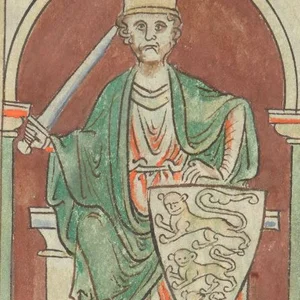
Shield bearing the three leopards (or lions passant) of England, the heraldic emblem that Richard I helped establish as the English royal arms.

A siege and precision weapon used extensively during the Crusades. It was a crossbow bolt that fatally wounded Richard at Châlus in 1199.

A wax matrix bearing the image of the king on horseback, used to authenticate charters and treaties. The seal of Richard I is among the first to depict the three lions of England.

A stringed instrument associated with the troubadour culture that Richard encountered at his court in Aquitaine. Richard himself composed songs in Occitan and French.
School Curriculum
Vocabulary & Tags
Key Vocabulary
Tags
Daily Life
Morning
Richard rose at dawn, attended Mass in the camp or castle chapel, then held council with his barons and officers to plan military operations or the movements of his itinerant court.
Afternoon
Afternoons were devoted to military exercises, combat training, or directing sieges and troop maneuvers. Richard personally supervised the placement of siege engines and inspected fortifications.
Evening
In the evenings, within the itinerant court, banquets brought together knights, troubadours, and clergy. Richard, himself a poet and music lover steeped in the Occitan culture of Aquitaine, took great pleasure in poetic jousts and tales of chivalric deeds.
Food
The crusading king's diet centered on roasted meat (game, pork, mutton), white bread, wine, and spices imported from the East. On campaign, fare was more frugal: hardtack, dried fish, and often impure water — frequent sources of illness.
Clothing
On campaign, Richard wore a chainmail hauberk, mail chausses, a cylindrical helm, and a red surcoat emblazoned with the three golden lions of England. In peacetime, he displayed rich silk and brocade tunics befitting a Plantagenet king shaped by southern influence.
Housing
Richard resided in fortified castles during his stays in England or Normandy, and in a royal tent during campaigns. The itinerant court moved constantly between Plantagenet domains, from the Loire Valley to the Scottish border.
Historical Timeline
Period Vocabulary
Visual Style
Un style visuel inspiré des enluminures médiévales et de l'épopée chevaleresque, mêlant ors héraldiques, rouges éclatants et ocres des paysages de Terre sainte.
Sound Ambience
Un paysage sonore dominé par le fracas des armes, le grondement des machines de siège et les chants de guerre des croisés, ponctué par les appels à la prière des villes assiégées en Orient.
Liens externes & ressources
Références
Œuvres
Troisième Croisade (1189-1192)
1189-1192
Construction de Château-Gaillard
1196-1198
Ja nus hons pris (Chanson de la captivité)
vers 1193
Traité de Jaffa avec Saladin
2 septembre 1192
Réorganisation administrative de l'Angleterre avant la Croisade
1189-1190