
Guatemalan political activist and human rights defender
Rigoberta Menchú(1959 — )
Rigoberta Menchú
Guatemala
7 min read
Frequently asked questions
Key Facts
Works & Achievements
Autobiography dictated to Elisabeth Burgos, translated into more than twelve languages. This raw and deeply moving testimony revealed to the world the reality of the Mayan genocide and established Menchú's international reputation.
A second autobiographical book, written after the end of the civil war, in which Menchú reflects on her struggle and her hopes for post-conflict Guatemala.
International organization created with the Nobel Prize endowment, dedicated to defending the rights of indigenous peoples, promoting peace, and ensuring access to justice in Guatemala and Latin America.
Filing before the Spanish courts of a complaint for genocide, torture, and terrorism against former Guatemalan military leaders. A landmark legal act in the pursuit of justice for Mayan victims.
The first indigenous woman to run for president in the history of Guatemala. A powerful symbolic moment for Mayan political representation, even if the electoral result was modest.
Anecdotes
At the age of eight, Rigoberta Menchú was already working on the coffee and cotton plantations along the Guatemalan coast. Every year, she watched children from her community die of exhaustion or pesticide poisoning, with no one ever held accountable.
In 1980, her father Vicente Menchú perished in the fire at the Spanish Embassy in Guatemala City, where Maya peasants had occupied the building to denounce the army's massacres. A few weeks later, her mother was abducted, tortured, and killed. Rigoberta, then twenty years old, chose to continue the struggle regardless.
As a refugee in Mexico, Rigoberta Menchú dictated her testimony to Venezuelan anthropologist Elisabeth Burgos in 1982. She had not yet fully learned to read or write in Spanish — a language she had taught herself in order to speak to other peoples of her country.
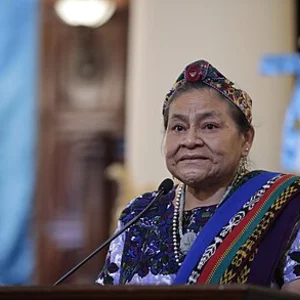
When she received the Nobel Peace Prize in 1992 in Oslo, she wore traditional Maya-K'iche' dress: an embroidered huipil and a colorful corte. This powerful symbolic gesture was seen around the world as an assertion of indigenous peoples' dignity, five centuries after the arrival of the conquistadors.
In 2007, Rigoberta Menchú ran for president of Guatemala, becoming the first indigenous woman to stand as a presidential candidate in the country's history. Although she received only 3% of the vote, her candidacy marked a historic milestone for Maya political representation.
Primary Sources
My name is Rigoberta Menchú. I am twenty-three years old. I'd like to give this living testimony, which I didn't learn from a book, and which I didn't learn on my own either, since everything I know was taught to me by my parents and my community.
I dedicate this Nobel Prize to the Mayan community, to all indigenous peoples of the world, to those who have died, to those who are still alive and carry the hopes of a more just world.
Guatemalan state forces are responsible for acts of genocide against Mayan communities, particularly during the period 1981–1983.
Indigenous peoples have the right to self-determination. By virtue of that right, they freely determine their political status and freely pursue their economic, social and cultural development.
Key Places
A mountainous Maya-Quiché village where Rigoberta Menchú was born in 1959. It was in this poor and isolated region that her family endured the violence of the civil war.
Site of the tragic fire on January 31, 1980, in which Vicente Menchú, Rigoberta's father, died along with 36 other peasant protesters. This event galvanized her commitment to international activism.
The city where Rigoberta Menchú found refuge after fleeing Guatemala in 1981. It was here that she built her international solidarity network and dictated her testimony.
The place where Rigoberta Menchú brought the voice of indigenous peoples before international bodies from the 1980s onward, before the creation of the UN Permanent Forum on Indigenous Issues.
The venue where she received the Nobel Peace Prize on December 10, 1992. Her speech, delivered in traditional Maya dress, resonated around the world and marked a turning point in the international recognition of indigenous rights.
Liens externes & ressources
Références
Œuvres
Moi, Rigoberta Menchú
1983
Rigoberta : la nieta de los mayas
1998
Fondation Rigoberta Menchú Tum
1993
Plainte pénale contre les militaires guatémaltèques (Espagne)
1999
Candidature à la présidence du Guatemala
2007