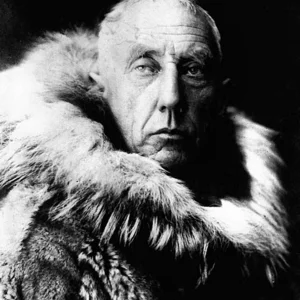

Norwegian polar explorer, Roald Amundsen was the first person to reach the South Pole on December 14, 1911, beating Robert Falcon Scott's British expedition. He was also the first to navigate the Northwest Passage by ship.
Roald Amundsen(1872 — 1928)
Roald Amundsen
Norvège
8 min read
Frequently asked questions
Famous Quotes
« Victory awaits those who have everything in order. People call it luck.»
« I would rather be judged as having gone too far than not far enough.»
Key Facts
- 1872: Born in Borge, Norway
- 1903–1906: First to navigate the Northwest Passage by ship (Gjøa expedition)
- December 14, 1911: First person to reach the South Pole, beating Scott by five weeks
- 1926: First crossing of the North Pole by airship (Norge), with Umberto Nobile and Lincoln Ellsworth
- 1928: Disappears over the Barents Sea during a rescue mission for Nobile
Works & Achievements
First complete maritime crossing of the Northwest Passage, from the Atlantic to the Pacific along the Arctic coastline of North America. This three-year expedition remains one of the greatest achievements in Arctic navigation.
The first human being to reach the geographic South Pole, arriving a month ahead of Robert Falcon Scott's British expedition. This victory is considered the pinnacle of “the Heroic Age of Polar Exploration.”
Account of the Antarctic expedition published in two volumes, translated into many languages. A foundational work for understanding the strategy, preparation, and conditions of the conquest of the South Pole.
Crossing of the Russian Arctic from west to east aboard the Maud, sailing along Siberia. Though less celebrated than his other achievements, this expedition completed his mastery of both polar sea passages.
Together with Umberto Nobile and Lincoln Ellsworth, Amundsen flew over the North Pole aboard the airship Norge, completing a crossing of the Arctic from Norway to Alaska. This was the first time the position of the North Pole was reached and documented beyond dispute.
Anecdotes
From adolescence, Amundsen secretly trained by sleeping with his windows open in the depths of the Norwegian winter, hardening his body against the polar cold. His mother, who hoped to see him become a doctor, knew nothing of these preparations. It was only after her death that he abandoned his medical studies to devote himself entirely to exploration.
To navigate the Northwest Passage (1903–1906), Amundsen chose a tiny 47-ton vessel, the Gjøa, capable of sailing in shallow waters. His crew spent two winters among the Netsilik Inuit, from whom he adopted arctic survival techniques: caribou-fur clothing, dog sledding, and igloo construction. This knowledge would prove decisive at the South Pole.
Before setting off for Antarctica
Amundsen kept his change of destination secret from everyone — including his sponsors and Robert Falcon Scott. He had announced an expedition to the North Pole. It was only en route
off the Canary Islands
that he revealed the truth to his crew and sent Scott a terse telegram:
Beg leave to inform you Fram proceeding Antarctic. Amundsen.
On December 14, 1911, when Amundsen's team reached the South Pole, the five men together planted the Norwegian flag in the ice. Amundsen left in the tent a letter to King Haakon VII and a message for Scott, asking him to deliver the news in the event of his own death on the return journey. Scott found this tent a month later, on January 17, 1912.
In June 1928, Amundsen vanished over the Barents Sea during a rescue mission to find survivors of the airship Italia, commanded by Umberto Nobile, which had crashed onto the pack ice. His seaplane was never found. Amundsen was 55 years old and died a hero, searching for a rival with whom he had often clashed.
Primary Sources
On December 14, 1911, at 3 p.m., the goal was reached. Our observations indicated that we were at the South Pole. The time we had taken to cover this distance, the round trip, was 99 days.
After three years of navigation and two winters spent with the Netsilik, we had accomplished what so many explorers had attempted before us: the complete traversal of the Northwest Passage by sea.
Beg leave to inform you Fram proceeding Antarctic. Amundsen.
Exploration has been the great love of my life. I have never known any other passion that consumed me so completely, and I regret none of the sacrifices it demanded of me.
Key Places
Birthplace of Roald Amundsen, on July 16, 1872. He grew up in a family of Norwegian sailors and shipowners, in a country where the sea and wide open spaces shaped one's ambitions.
On December 14, 1911, Amundsen planted the Norwegian flag here alongside his four companions, achieving one of the greatest feats in the history of exploration. No human being had ever set foot there before.
The base camp Amundsen established in January 1911 on the Ross Ice Shelf, at 78°30' South latitude. From here, the depot-laying teams set out and the final dash to the pole began.
Port on King William Island where Amundsen wintered for two consecutive years (1903–1905) during his Northwest Passage, living among the Netsilik Inuit, who shared their Arctic survival knowledge with him.
The capital from which Amundsen organized and financed his expeditions, and where he was welcomed as a national hero upon his return from the South Pole in 1912.
Typical Objects

A lightweight sled made of ash and hickory wood, designed by explorer Nansen and adopted by Amundsen for the polar expedition. He favored this model for its strength and lightness on the Antarctic ice sheet.

Amundsen carefully selected and trained 97 Greenland sled dogs for his South Pole expedition. Unlike Scott, who used ponies, he considered dogs irreplaceable in extreme polar conditions.

Having learned from the Netsilik people during his Northwest Passage voyage, Amundsen wore anoraks, trousers, and boots made from caribou or reindeer fur. These garments were far more effective than wool, allowing him to sweat less and preventing his clothing from freezing.

A concentrated food made from dried meat and animal fat, used as a survival ration on all his expeditions. Amundsen took extreme care in calculating food rations for his teams and dogs.

Essential astronomical navigation instruments for calculating latitude and longitude during polar expeditions. It was thanks to these instruments that Amundsen was able to certify he had reached the exact geographical South Pole.

Amundsen and his companions, all experienced skiers, covered dozens of kilometers daily on skis while being pulled by dogs. This mode of travel proved decisive compared to Scott, who was not skilled at skiing.

A lightweight silk tent designed to withstand Antarctic blizzards. Amundsen left one standing at the South Pole, with a message for Scott and a letter to King Haakon VII.
School Curriculum
Vocabulary & Tags
Key Vocabulary
Daily Life
Morning
On polar expeditions, Amundsen rose early — at dawn or according to weather conditions — to study the sky and decide on the day's march. He held himself to a strict routine: inspecting the dogs, checking the sledges and rations, consulting the meteorological instruments. Morning discipline was, for him, the key to survival.
Afternoon
Expedition afternoons were devoted to advancing across the pack ice, often on skis behind the dog teams, covering distances of 30 to 40 kilometres a day. Amundsen organized his team in orderly columns and kept a steady pace, with short breaks to spare men and animals alike. Each evening, he took the position readings himself with a sextant.
Evening
In camp, the team would pitch the tent and prepare the meal: hot pemmican, biscuits, and chocolate. Amundsen recorded his observations in his logbook with meticulous precision. He read, planned the next day's stage, and kept a close eye on his men's morale — treating them as equals and sharing every task.
Food
On expeditions, the diet centred on pemmican (dried meat and fat), biscuits, chocolate, and powdered milk, carefully rationed to prevent scurvy and maintain caloric intake. Amundsen had learned from the Inuit to eat raw meat and to use animal liver as a source of vitamins. Back in Norway, he enjoyed traditional cooking — simple and hearty.
Clothing
On polar expeditions, Amundsen wore clothing inspired by the Inuit: anoraks and trousers made from reindeer or seal skin, fur boots (*kamiks*), and hide gloves. Aboard the *Fram*, he wore the Norwegian naval uniform. In civilian life in Oslo, he dressed with the understated elegance of an officer and celebrated explorer: dark suit, long coat.
Housing
Between expeditions, Amundsen lived at Uranienborg, his villa overlooking the Oslo Fjord, which he had built with the proceeds from his lectures and books. The house was decorated with polar trophies and mementos. On expedition, he slept in the same tent as his companions, refusing any privilege of rank.
Historical Timeline
Period Vocabulary
Liens externes & ressources
Références
Œuvres
Traversée du passage du Nord-Ouest (expédition Gjøa)
1903-1906
Conquête du pôle Sud (expédition Fram)
14 décembre 1911
Sydpolen (Le Pôle Sud)
1912
Traversée du passage du Nord-Est (expédition Maud)
1918-1921
Premier survol vérifié du pôle Nord (dirigeable Norge)
11-12 mai 1926