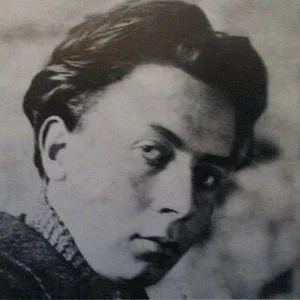

Robert Delaunay was a French painter, a pioneer of abstraction and co-founder of Orphism alongside his wife Sonia Delaunay. His work explores the simultaneous contrasts of pure colors to create rhythm and movement.
Robert Delaunay(1885 — 1941)
Robert Delaunay
France
6 min read
Frequently asked questions
Famous Quotes
« Color alone is both form and subject.»
Key Facts
- Born in 1885 in Paris and died in 1941 in Montpellier.
- Created his famous “Eiffel Towers” series starting around 1909–1912.
- Founded the Orphism movement with Sonia Delaunay around 1912, a name coined by the poet Guillaume Apollinaire.
- Painted “The Windows” (1912) and then the “Circular Forms,” exploring abstraction through color.
- Decorated the pavilions of the 1937 International Exhibition in Paris.
Works & Achievements
A set of canvases in which the monument is fragmented and multiplied, blending Cubism with color. A key work of pictorial modernity.
A large composition bringing together the Three Graces, the Seine and the Eiffel Tower. Apollinaire hailed it as a major painting of the Salon des Indépendants.
A series of canvases in which the subject almost entirely disappears in favor of planes of color. A decisive step toward abstraction.
A fully abstract composition made of colored concentric circles. Considered one of the first purely abstract paintings.
A canvas celebrating the aviator Louis Blériot, mixing propellers, sun and colored circular forms. A hymn to movement and progress.
Series of colored circles exploring the pure rhythm of color. The culmination of Delaunay's Orphism.
Immense abstract decorations for the Palais de l'Air and the Palais des Chemins de fer in Paris. A demonstration of abstract art on a monumental scale.
Anecdotes
In 1912, Robert Delaunay painted a series of canvases inspired by the Eiffel Tower, which he fragmented and multiplied into a thousand colorful pieces, as if the monument were collapsing and exploding at the same time. For him, the tower was the symbol of modernity and of Paris.
The poet Guillaume Apollinaire named Delaunay's style “Orphism,” in reference to Orpheus, the mythological musician, because his paintings made of pure colors evoked for him a kind of visible music. The name stuck.
Robert and his wife Sonia Delaunay formed an inseparable couple of artists who explored the same ideas about color together. Sonia applied these theories to fabrics, clothing, and everyday objects, while Robert stayed with painting.
During the First World War, the Delaunay couple took refuge in Spain and Portugal to escape the conflict. There, the intense light and vivid colors of the South further strengthened Robert's taste for brilliant hues.
In 1937, for the Paris International Exposition, Delaunay created enormous murals decorating the Railway Palace and the Aviation Palace, proving that his abstract art could clothe entire buildings.
Primary Sources
Light in Nature creates the movement of colors. Movement is given by the relationships of uneven measures, of the contrasts of colors among themselves.
Color alone is both form and subject. It is the only theme that develops, that transforms itself outside of any psychological or other analysis.
Orphism is the art of painting new structures out of elements which have not been borrowed from the visual sphere, but have been created entirely by the artist.
Key Places
Delaunay's birthplace and the setting for his research on light, dominated by his beloved Eiffel Tower. He spent most of his life as an artist there.
An iconic monument that Delaunay painted tirelessly, fragmented and full of colour. For him it embodied the energy of the modern city.
A refuge for the Delaunay couple during the First World War. The light of the South strengthened their love of bright colours.
Where the Delaunays stayed during the war, finding inspiration in the local markets and costumes. Robert continued his research on colour there.
A city in the south of France where Robert Delaunay, by then ill, died in 1941. The couple had taken refuge there at the start of the Second World War.
Liens externes & ressources
Références
Œuvres
Série de la Tour Eiffel
1909-1912
Les Fenêtres
1912
Hommage à Blériot
1914
Rythmes sans fin / Formes circulaires
1930-1934
Peintures murales de l'Exposition internationale
1937