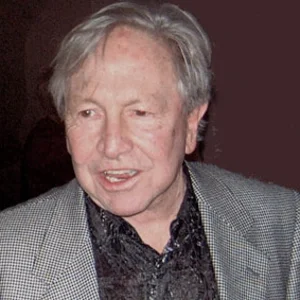

Robert Rauschenberg was an American visual artist and a major figure of post-war art. A pioneer of the “Combines” that blended painting with everyday objects, he paved the way for Pop art and blurred the boundary between art and life.
Robert Rauschenberg(1925 — 2008)
Robert Rauschenberg
États-Unis, Allemagne
5 min read
Frequently asked questions
Famous Quotes
« Painting relates to both art and life. Neither can be made. (I try to act in that gap between the two.)»
Key Facts
- Born in 1925 in Port Arthur, Texas, and died in 2008 on Captiva Island, Florida
- Studied at Black Mountain College in the late 1940s under Josef Albers
- Created “Erased de Kooning Drawing” in 1953, a drawing by De Kooning erased to become an artwork
- Developed his “Combines” from 1954 onward, joining painting with real objects (e.g. “Monogram,” 1955-1959)
- Won the Grand Prize at the 1964 Venice Biennale, marking the triumph of American art
Works & Achievements
Series of entirely white canvases that capture the shadows and light of the room; they inspired John Cage's silent piece 4'33''.
A drawing by Willem de Kooning erased by Rauschenberg, a groundbreaking work that questions the very act of creating.
His first major Combine: a real quilt and pillow splattered with paint, hung on the wall like a painting.
A stuffed Angora goat encircled by a tire, set on a painted canvas: Rauschenberg's most iconic work.
A Combine featuring a stuffed eagle with outstretched wings, which also became famous for the legal questions it raised.
A large silkscreen blending a portrait of President Kennedy with news imagery, a fusion of Pop art and painting.
An installation of bubbling mud that reacts to sound, created with engineers as part of the E.A.T. project.
Anecdotes
In 1953, the young Rauschenberg asked the famous Willem de Kooning for one of his drawings... in order to erase it completely. After weeks of rubbing it out, he exhibited the result under the title “Erased de Kooning Drawing.” A provocative gesture, or a reflection on what it means to create a work by destroying another?
During his military service in the navy in World War II, Rauschenberg worked as a nurse in a psychiatric hospital in San Diego. It was while visiting a museum in California that he saw real paintings for the first time and realized that one could become an artist.
His most famous work, “Monogram,” features a real stuffed goat encircled by a car tire. It took him several years to figure out how to assemble it, reworking the piece through three successive versions between 1955 and 1959.
In 1961, invited to take part in a portrait exhibition in Paris, Rauschenberg sent a telegram saying: “This is a portrait of Iris Clert if I say so.” In this way he turned a simple statement into a work of conceptual art.
Rauschenberg was color-blind, which makes his bold and inventive use of color all the more surprising. He assembled his works by relying on material and contrast as much as on the hues themselves.
Primary Sources
Painting relates to both art and life. Neither can be made. (I try to act in the gap between the two.)
This is a portrait of Iris Clert if I say so.
I don't think a painting should be made only by me. The canvas is never empty; the world comes into it through the window.
Key Places
Oil town in the southern United States where Rauschenberg was born in 1925 into a modest, religious family.
Experimental college where he studied with Josef Albers and met the musician John Cage and the choreographer Merce Cunningham.
Center of the artistic avant-garde where Rauschenberg settled in the 1950s and developed his Combines.
Home of the Biennale, where in 1964 he won the Grand Prize for painting, establishing American art on the world stage.
Island where Rauschenberg set up his studio from 1970 onward and where he died in 2008.
Typical Objects

A hybrid work invented by Rauschenberg, blending painting on canvas with real objects (tires, pillows, stuffed animals). It abolishes the boundary between painting and sculpture.

An ordinary object picked up off the street or salvaged (newspapers, fabrics, trash) and integrated directly into the work. It brings everyday life into art.

A printing tool used to transfer press photographs onto canvas. Rauschenberg began using it in 1962 to combine media images with gestural painting.

A rubber tire encircling the stuffed goat in “Monogram.” It became an emblem of postwar art and of the recycling of industrial objects.

A simple eraser turned into an instrument of creation when Rauschenberg erased a drawing by De Kooning. A tool of destruction transformed into an artistic gesture.

Images and headlines from the daily press pasted or printed onto his canvases. They anchor the work in the current events of 1960s America.
School Curriculum
Vocabulary & Tags
Key Vocabulary
Daily Life
Morning
In his studio in Captiva, Rauschenberg liked to start the day late, his mind fed by the hours of the night. Mornings were often spent sorting the found objects, photographs, and materials that would serve as a starting point.
Afternoon
The afternoon was devoted to intense studio work: assembling Combines, screen printing, and experimenting with his assistants. He liked to work fast, reacting to what the material suggested to him.
Evening
Sociable and generous, Rauschenberg often devoted his evenings to hosting friends, artists, and collaborators. Conversation, music, and alcohol all mingled together, sometimes extending the work late into the night.
Food
A bon vivant, he enjoyed simple Southern American cooking and convivial meals shared with those close to him. His heavy drinking marked a part of his life as an artist.
Clothing
Rauschenberg wore casual work clothes, often smeared with paint, mirroring his studio. Far from the image of the precious artist, he cultivated a simple and practical look.
Housing
From 1970 onward, he lived and worked on the island of Captiva in Florida, on a vast estate spread between a house, studios, and tropical nature. This secluded setting gave him the space needed for his monumental works.
Historical Timeline
Period Vocabulary
Liens externes & ressources
Références
Œuvres
White Paintings
1951
Erased de Kooning Drawing
1953
Monogram
1955-1959
Mud Muse
1968-1971