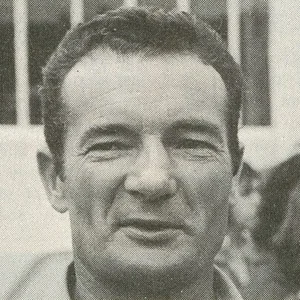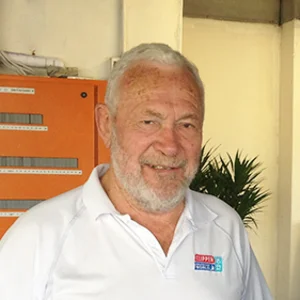

British sailor born in 1939, the first person to complete a solo, non-stop circumnavigation of the globe under sail (1968–1969), aboard his ketch Suhaili. In doing so he won the Golden Globe Race, ushering in the era of the great solo ocean races.
Robin Knox-Johnston(1939 — ?)
Robin Knox-Johnston
Royaume-Uni
6 min read
Frequently asked questions
Key Facts
- Born on 17 March 1939 in Putney (London)
- 14 June 1968: set off from Falmouth aboard the ketch Suhaili for the Sunday Times Golden Globe Race
- 22 April 1969: the only finisher of the race, he completed the first solo, non-stop circumnavigation of the globe in 312 days
- 1996: co-founded the Clipper Round the World Yacht Race
- 2006–2007: at the age of 67, he completed the Velux 5 Oceans, becoming one of the oldest people to finish a solo circumnavigation
Works & Achievements
Aboard the Suhaili, in 312 days, he became the first man to sail around the globe non-stop and unassisted, winning the Golden Globe Race.
An autobiographical account of his voyage, which became a classic of maritime literature.
With Peter Blake, he set the record for the fastest crewed circumnavigation aboard a large catamaran.
He created a round-the-world race allowing amateur sailors to compete against one another on identical monohulls.
At nearly 68 years old, he completed another solo circumnavigation, becoming one of the oldest sailors to do so in a race.
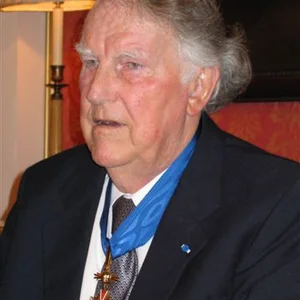
Knighted by the Queen for his achievements, he became Sir Robin Knox-Johnston, a major figure in British sailing.
Anecdotes
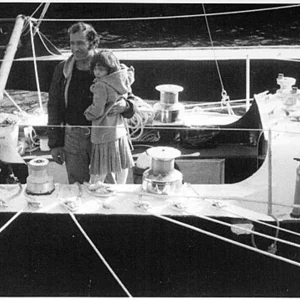
Robin Knox-Johnston's boat, the Suhaili, was a small nine-metre teak ketch built in Bombay (Mumbai) in 1964. A merchant navy officer stationed in India, he had it built there and then sailed it back to England via the Cape of Good Hope, even before he had thought of a round-the-world voyage.
Of the nine competitors who set out in the Golden Globe Race, Knox-Johnston was the only one to finish. The Frenchman Bernard Moitessier, leading on elapsed time, gave up the idea of returning home and carried on towards Tahiti; the Englishman Donald Crowhurst, for his part, falsified his logbook and vanished at sea, a tragedy that left a lasting mark on the race.
During the voyage, the seams of the Suhaili's hull began to leak. Knox-Johnston dived beneath the boat several times, out in the open sea and with a knife within reach for fear of sharks, to recaulk the joints with cotton and oakum.
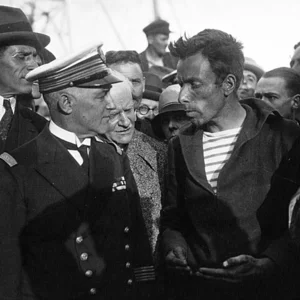
His radio broke down for many long weeks: there was no news of him and some believed he was lost, until a cargo ship spotted him off the coast of New Zealand. On his arrival in Falmouth on 22 April 1969, after 312 days at sea, an officer reportedly asked him where he had come from; he simply replied: “From Falmouth.”
More than thirty-five years later, at nearly 68, Knox-Johnston set off once again to sail solo around the world in the Velux 5 Oceans (2006-2007), becoming one of the oldest sailors to complete an ocean race around the globe.
Primary Sources
The newspaper offers a trophy, the Golden Globe, to the first sailor to complete a solo non-stop circumnavigation of the world under sail, and a £5,000 prize to whoever does it in the shortest time.
An autobiographical account of the voyage aboard the Suhaili, in which the sailor describes his solitude, his breakdowns and the rounding of the three great capes of the southern hemisphere.
Daily navigation notes kept by Knox-Johnston during the 312 days at sea, recording positions, weather, repairs and the state of the provisions.
Key Places
District in south-west London where Robin Knox-Johnston was born in 1939.
Port from which he set sail on 14 June 1968 and to which he returned on 22 April 1969, the start and finish point of his round-the-world voyage.
City where the Suhaili was built of teak in 1964, while he was serving in the merchant navy in India.
First of the three great capes rounded during the voyage, at the southern tip of Africa.
Cape in south-western Australia, the second great cape of the Southern Ocean on his route.
The most feared of the three capes, at the southern tip of America, which he rounded in raging seas before sailing back up the Atlantic.
Typical Objects

Nine-metre teak ketch built in Bombay, aboard which Knox-Johnston completed his non-stop circumnavigation. Sturdy but slow, this sailboat became the icon of his achievement.

Instrument used to measure the altitude of the sun or stars in order to calculate one's position. Knox-Johnston navigated by dead reckoning and sextant, without GPS.

Mechanical device linked to the tiller that holds the course by following the wind, allowing the lone sailor to sleep and handle the boat. His broke down, forcing him to lash the tiller himself.

Precision timepiece essential for determining longitude during celestial fixes. An error of a few seconds threw off the entire position.

Notebook in which he recorded his position, weather and damage each day. It was the authenticity of these records that set his achievement apart from Crowhurst's fraud.

Oiled waterproof clothing protecting against the cold and breaking waves in the southern seas. Essential for spending hours at the tiller under the squalls.

Long-keeping provisions taken aboard for months at sea, supplemented by the fish he caught. Managing supplies was vital on a voyage this long.
School Curriculum
Vocabulary & Tags
Key Vocabulary
Tags
Daily Life
Morning
On waking, Knox-Johnston would start by pumping out the water that had collected in the bilges of the *Suhaili*, which was taking on water, then check the trim of the sails and that she was holding her course. If the sky allowed, he would take a sextant sight of the sun to fix his position.
Afternoon
Afternoons were spent on constant maintenance: stitching torn sails, repairing the rigging, recaulking the seams. He also devoted time to cooking, reading and looking after his navigation equipment.
Evening
In the evening he would prepare a hot meal, bring his logbook up to date and sometimes allow himself a little alcohol to celebrate reaching a milestone. Sleep came in short stretches, his ear always alert to the slightest change in the sea or the wind.
Food
He lived on tinned food, corned beef, rice and biscuits stowed away for months, supplemented by fish caught along the way. Fresh water, carefully rationed, was partly collected from the rain.
Clothing
In the cold southern seas he wore wool sweaters, oilskins and boots to spend hours at the helm in the spray. In the tropics, by contrast, he sailed in shorts or bare-chested because of the heat.
Housing
His “home” was reduced to the tiny cabin of the *Suhaili*: a narrow bunk, a chart table, a paraffin lamp and chests of provisions. Everything in it was damp, cramped and constantly in motion.
Historical Timeline
Period Vocabulary
Liens externes & ressources
Références
Œuvres
Premier tour du monde à la voile en solitaire et sans escale
1968-1969
A World of My Own
1969
Trophée Jules Verne (Enza New Zealand)
1994
Fondation de la Clipper Round the World Yacht Race
1996
Velux 5 Oceans Race
2006-2007
Titre de chevalier (Sir)
1995