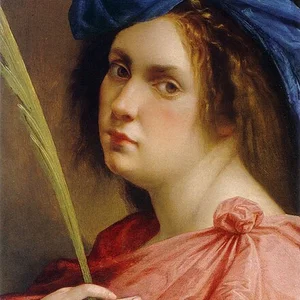

Rosalba Carriera (1675-1757) was a Venetian painter and pastellist, a leading figure of pastel portraiture in Europe. Her stay in Paris in 1720-1721 helped launch the fashion for pastel and the rococo style.
Rosalba Carriera(1675 — 1757)
Rosalba Carriera
république de Venise
5 min read
Frequently asked questions
Key Facts
- Born in Venice in 1675, died in the same city in 1757
- Pioneer of pastel portraiture, a technique she raised to the rank of a major art form
- Admitted to the Royal Academy of Painting and Sculpture in Paris in 1720
- Member of the Accademia di San Luca in Rome from 1705
- Became blind toward the end of her life (around 1746-1749)
Works & Achievements
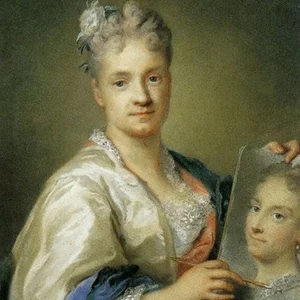
Pastel held at the Uffizi in Florence, a testament to her virtuosity and to her bond with her sister Giovanna.
Created during her stay in Paris; it marked the triumph of pastel at the French court.
An allegorical composition reflecting her erudition and her place among the arts; a recurring theme in her work.
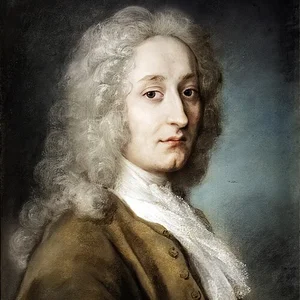
Pastel of the French painter she met in Paris, a precious record of the face of the Rococo artist.
Idealized heads of young women as allegories, much sought after by European collectors.
The Saxon court in Dresden gathered the largest collection of her pastels, famous to this day.
Anecdotes
Rosalba Carriera began by painting tiny portraits on the ivory lids of snuffboxes, which were highly fashionable in Venice. This delicate technique taught her precision and earned her her first wealthy clients before she turned to pastel.
In 1705, she was admitted to the Accademia di San Luca in Rome, one of the most prestigious academies, an honour exceedingly rare for a woman. Her reception piece was an allegory depicting a young girl holding a dove.
During her stay in Paris in 1720–1721, she was given a triumphant welcome: the banker Pierre Crozat hosted her, and the young king Louis XV and the entire court wanted their portraits in pastel. She was admitted to the Royal Academy of Painting that same year.
Rosalba kept a diary during her time in Paris, in which she noted her appointments, her commissions and her impressions. This notebook is a precious source on the artistic life of the Regency.
Near the end of her life, around 1746, a serious eye disease left her almost blind. Two cataract operations failed and she had to stop painting, ending her days in darkness and depression in Venice.
Primary Sources
The artist's daily notes on her commissions, her visits, and the personalities she met at the French court during the Regency.
Exchanges with her patrons and European friends, attesting to her international fame and the organization of her workshop.
The French collector and critic discusses Carriera's mastery of the art of pastel and the enthusiasm she aroused in Paris.
Key Places
Birthplace of Rosalba Carriera, where she lived, ran her renowned studio and died. A major stop on the Grand Tour, she received an international clientele there.
She stayed here in 1720-1721, hosted by Pierre Crozat, and launched the fashion for pastel. She was admitted to the Royal Academy of Painting.
A major artistic center where she was admitted to the Accademia di San Luca in 1705, cementing her reputation.
Imperial capital where she traveled in 1730 to work at the court of Emperor Charles VI, who collected her pastels.
Court of the House of Este where she portrayed the princesses around 1723, illustrating her demand across all the Italian courts.
Typical Objects

Sticks of dry pigment bound with gum, producing powdery, luminous colors applied directly onto paper. Rosalba Carriera made them her instrument of choice and the source of her fame.

A small tobacco box whose lid was adorned with a delicate miniature. Carriera began her career painting these luxury objects sought after by aristocrats.

A small roll of paper or leather used to blend and soften pastel pigments on the surface. A key tool for the velvety sfumato that characterizes her portraits.

A tinted support, often blue-grey, particularly suited to pastel as it enhances skin tones and light highlights. Venetian pastellists prized it.

Because pastel is fragile and crumbly, works were placed under glass as soon as they were finished. This packaging explains the good preservation of her portraits.
School Curriculum
Vocabulary & Tags
Key Vocabulary
Tags
Daily Life
Morning
Rosalba rose early to take advantage of natural light, essential for pastel work. She prepared her colour sticks and welcomed into her Venetian studio the first visitors who came to sit for her or admire her works.
Afternoon
Afternoons were devoted to sitting sessions: nobles, Grand Tour travellers and diplomats came one after another. Her sister Giovanna and her mother assisted her in preparing the supports and managing commissions.
Evening
In the evening, she kept up an extensive correspondence with her European patrons and received friends and art lovers, such as the collector Anton Maria Zanetti, in the refined sociability of Venice.
Food
She shared the diet of well-off Venetians: fish and seafood from the lagoon, polenta, vegetables, accompanied by the wines of the Veneto. Coffee and chocolate, fashionable novelties, enlivened conversations.
Clothing
A woman of the cultivated middle class, she wore silk and lace dresses suited to her station, but protected her clothing with an apron while working, for pastel gives off a fine dust of pigment.
Housing
She lived with her mother and sisters in a Venetian house that also served as a studio, near the Grand Canal. The dwelling combined well-lit workspaces with reception rooms for clients.
Historical Timeline
Period Vocabulary
Liens externes & ressources
Références
Œuvres
Autoportrait tenant un portrait de sa sœur
1715
Portrait de Louis XV enfant (dauphin)
1720-1721
Allégorie de la Peinture
vers 1720
Portrait d'Antoine Watteau
1721
Série des Quatre Saisons / des Éléments
années 1720
Portrait d'une dame de la cour (collection de Dresde)
années 1720-1740