 flip
flipLū pulu
Lū pulu
Why this dish? Lū pulu is the dish for great Tongan occasions — weddings, royal funerals, coronations. When Salote gave feasts to assert her kingdom's dignity in the face of colonial powers, lū was always at the center of the leaf-covered table. Imported corned beef, adopted in Tonga from the early 20th century, became under her reign a festivity ingredient that was paradoxically very Tongan.
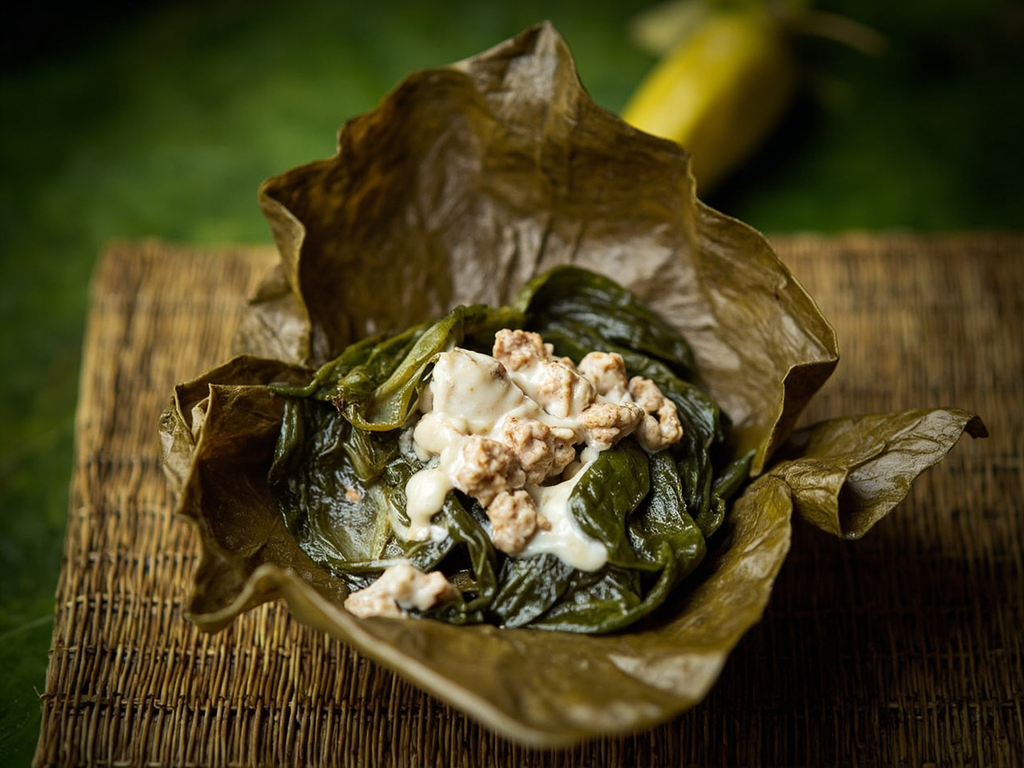
Taro leaf parcels stuffed with meat and coated with thick coconut cream, slow-cooked in the earth oven. The leaves melt into a silky, almost creamy texture, while the lolo permeates the meat. It is the heart of any royal Tongan feast.
When we prepare a kātoanga at the palace in Nukuʻalofa, the lū must be perfect — it is by it that the chef's generosity is judged. I myself oversee the selection of taro leaves: the youngest, the most tender, picked that very morning. We stack them with the meat and the lolo, tie them up, and everything goes down into the ʻumu with the hot stones. When we open the earth three hours later, the scent that rises is the very scent of Tonga. In London, at Her Majesty Elizabeth's coronation, it was this scent I missed most under the English rain.
- •Taro leaves (lou) — Two good handfuls per person (Wrapper and melting vegetable)
- •Corned beef or fresh pork — One good piece per parcel (Main protein)
- •Fresh coconut cream (lolo) — Pressed from two coconuts (Sauce and fat)
- •Onion — One, sliced (Aromatic)
- •Salt — A pinch (Seasoning)
Lū pulu
Taro leaf parcels stuffed with meat and coated with thick coconut cream, slow-cooked in the earth oven. The leaves melt into a silky, almost creamy texture, while the lolo permeates the meat. It is the heart of any royal Tongan feast.
Why this dish? Lū pulu is the dish for great Tongan occasions — weddings, royal funerals, coronations. When Salote gave feasts to assert her kingdom's dignity in the face of colonial powers, lū was always at the center of the leaf-covered table. Imported corned beef, adopted in Tonga from the early 20th century, became under her reign a festivity ingredient that was paradoxically very Tongan.
When we prepare a kātoanga at the palace in Nukuʻalofa, the lū must be perfect — it is by it that the chef's generosity is judged. I myself oversee the selection of taro leaves: the youngest, the most tender, picked that very morning. We stack them with the meat and the lolo, tie them up, and everything goes down into the ʻumu with the hot stones. When we open the earth three hours later, the scent that rises is the very scent of Tonga. In London, at Her Majesty Elizabeth's coronation, it was this scent I missed most under the English rain.
Ingredients (period version)
- Taro leaves (lou) — Two good handfuls per person (Wrapper and melting vegetable)
- Corned beef or fresh pork — One good piece per parcel (Main protein)
- Fresh coconut cream (lolo) — Pressed from two coconuts (Sauce and fat)
- Onion — One, sliced (Aromatic)
- Salt — A pinch (Seasoning)
Ingredients
- Frozen taro leaves (or spinach leaves) — 500 g (Wrapper and vegetable)
- Canned corned beef — 340 g (1 can) (Main protein)
- Coconut cream (canned, thick) — 400 ml (Sauce)
- Yellow onion — 1 medium, sliced (Aromatic)
- Salt — ½ tsp (Seasoning)
- Aluminum foil — 4 large sheets (Replacement for banana leaves)
Method
- If using fresh taro leaves, blanch them in boiling water for 5 minutes to remove calcium oxalate irritation. Drain. If frozen, thaw and press out excess water.
- Crumble the corned beef into a bowl. Add the sliced onion and mix.
- Lay 4-5 taro leaves (or spinach) flat, overlapping them. Place a quarter of the meat mixture in the center.
- Generously pour coconut cream over the meat (about 100 ml per parcel).
- Fold the leaves to form a tight packet. Wrap in aluminum foil, seam side up.
- Bake in the oven at 180°C for 2 hours, or until the leaves are melting and the sauce has thickened.
- Serve each parcel still closed, to be opened at the table, accompanied by boiled yam or taro.
How it was made : Lū was traditionally cooked in the ʻumu, the Polynesian earth oven: a pit lined with volcanic stones heated red-hot, in which banana leaf parcels were placed before covering with earth. Cooking took three to four hours. Imported corned beef (pulu tauki) gradually replaced fresh pork in households from the 1920s, ironically becoming a symbol of celebration.
The contemporary twist : Present the opened parcel on a fresh banana leaf, with a drizzle of warm coconut cream poured at the table and a few slivers of raw spring onion for contrast.
Sources : Helu, I. Futa. « Critical Essays: Cultural Perspectives from the South Seas ». Journal of Pacific History. · Pollock, Nancy J. « These Roots Remain: Food Habits in Islands of the Central and Eastern Pacific since Western Contact ». University of Hawaii Press, 1992.
Salote Tupou III · Charactorium