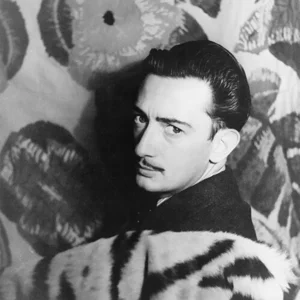

Spanish painter, sculptor, and printmaker, a major figure of Surrealism. Famous for his dreamlike world and his “paranoiac-critical” method, he became one of the most eccentric and publicized artists of the 20th century.
Salvador Dalí(1904 — 1989)
Salvador Dalí
Espagne
6 min read
Frequently asked questions
Famous Quotes
« The only difference between me and a madman is that I am not mad.»
Key Facts
- Born in 1904 in Figueras, Catalonia (Spain)
- Painted The Persistence of Memory in 1931, an iconic work featuring soft watches
- Joined the Surrealist group in Paris in 1929, from which he was expelled in 1939
- Developed the “paranoiac-critical” method to explore the unconscious
- Died in 1989 in Figueras; the Dalí Theatre-Museum there preserves his work
Works & Achievements
Surrealist short film famous for its sliced-eye scene. A cinematic manifesto of the movement.
Dalí's best-known painting, with its melting clocks in a desert landscape. It became a universal icon of Surrealism.
A monstrous body tearing itself apart, foreshadowing the horror of the Spanish Civil War.
A work illustrating the “paranoiac-critical” method: a figure transforms into a hand holding an egg from which a flower springs.
A crucifixion seen from a dizzying overhead angle, emblematic of his mystical period. One of his most famous religious works.
A flamboyant and heavily fictionalized account of his own life. A key document for understanding the construction of his persona.
A museum conceived by Dalí as a total work of art, crowned by his dome and giant eggs. The site of his burial.
Anecdotes
In 1936, Dalí gave a lecture in London dressed in a deep-sea diving suit to symbolise his descent into the unconscious. The helmet jammed and he nearly suffocated; the audience at first thought it was part of the act before the headpiece was hurriedly unscrewed.
Dalí owned a tame ocelot named Babou that he walked on a leash even into fancy restaurants. In a New York café, he reassured a frightened customer by claiming it was just an ordinary house cat that he had painted to look like a leopard.
His famous tapered moustache, waxed and pointing skyward, was inspired by the Spanish painter Diego Velázquez. Dalí made it a true trademark and even devoted an entire book of photographs to it in 1954.
In 1969, Dalí designed the logo for Chupa Chups lollipops, a yellow and red daisy. He also suggested placing the logo on the top of the sweet rather than on the side, so that it would always stay visible: the design is still used today.
To paint, Dalí said he practised “slumber with a key”: he would doze off in an armchair while holding a key over a plate. Just as he was about to truly fall asleep, the key would drop, wake him, and he would immediately note down the images that had surfaced from this half-dream.
Primary Sources
At the age of six I wanted to be a cook. At seven I wanted to be Napoleon. And my ambition has been growing steadily ever since.
Surrealism rests on the belief in the superior reality of certain forms of association heretofore neglected, in the omnipotence of the dream.
The only difference between a madman and me is that I am not mad.
Key Places
Dalí's hometown, where he was born, died, and set up his Theatre-Museum. The emblematic site of his entire life and legend.
Fishing village on the Costa Brava where Dalí set up his house-studio by the sea. Its rocky landscapes inspired the background of many of his paintings.
Fine arts school where Dalí trained and befriended Lorca and Buñuel at the Students' Residence. He was eventually expelled from it.
Capital where Dalí joined Breton's Surrealist group in the late 1920s. The nerve center of the artistic avant-gardes of the time.
City where Dalí enjoyed enormous media success during his exile in World War II. There he multiplied exhibitions, shop windows, and collaborations.
Castle that Dalí gave to Gala and where she is buried. It would earn him his title of Marquis of Dalí de Púbol.
Liens externes & ressources
Références
Œuvres
La Persistance de la mémoire
1931
Construction molle aux haricots bouillis (Prémonition de la guerre civile)
1936
Métamorphose de Narcisse
1937
Le Christ de saint Jean de la Croix
1951
La Vie secrète de Salvador Dalí (autobiographie)
1942
Théâtre-musée Dalí de Figueras
1974