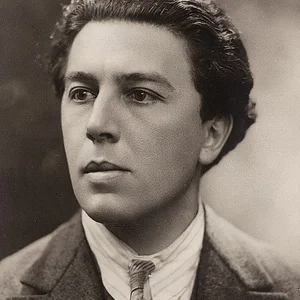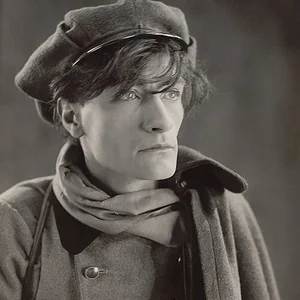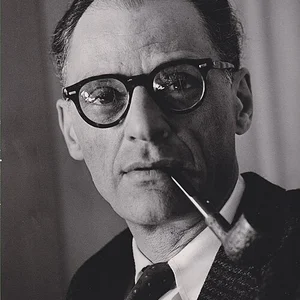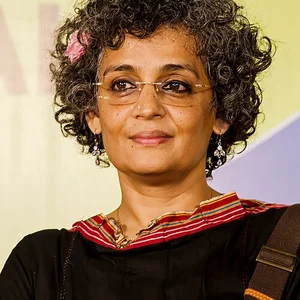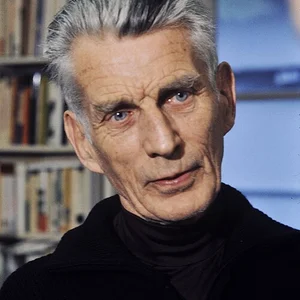

Irish writer, playwright and poet who wrote in both French and English. A leading figure of the Theatre of the Absurd, he revolutionised dramatic writing with Waiting for Godot (1953). Nobel Prize in Literature in 1969.
Samuel Beckett(1906 — 1989)
Samuel Beckett
Irlande
6 min read
Frequently asked questions
Famous Quotes
« Try again. Fail again. Fail better.»
« Nothing is funnier than unhappiness.»
Key Facts
- Born in 1906 in Foxrock, near Dublin (Ireland)
- Settled in Paris in 1937 and from then on often wrote in French
- Premiered Waiting for Godot in 1953 at the Théâtre de Babylone in Paris
- Awarded the Nobel Prize in Literature in 1969
- Died in 1989 in Paris
Works & Achievements
Beckett's first published novel, written in English, blending dark humour with idle, aimless characters. It heralds the themes of wandering and the absurd.
Three novels written in French that dismantle traditional storytelling. They explore a consciousness that speaks endlessly, right up to the famous “you must go on”.
A play in which two men wait for a certain Godot who never comes. A founding masterpiece of the Theatre of the Absurd, performed all over the world.
A one-act play that confines four characters in a sealed room at the end of a world. A stark work about the wait for death.
The monologue of an old man who listens back to the tape recordings of his youth. A poignant meditation on time and memory.
A woman gradually buried in a mound of earth keeps chattering away, ever optimistic. An emblematic play of the tragic absurd.
The supreme honour, hailing a body of work that renewed both the novel and the theatre. Beckett, retiring to the point of shyness, did not collect the prize in person.
A late text of extreme concision about failure and the effort to carry on. In it we read the phrase that became famous: “Fail again, fail better”.
Anecdotes
Samuel Beckett is the only Nobel Prize winner to appear in Wisden, the leading cricket almanac. As a student at Trinity College Dublin, he played well enough to take part in genuine first-class matches. All his life, he kept his passion for this English sport.
After arriving in Paris in 1928, the young Beckett grew close to the famous Irish writer James Joyce, who was nearly blind. He helped him so much with his work that he was long mistaken for his secretary. He would sometimes read aloud to him and join in long literary discussions.
In January 1938, on a Paris street, Beckett was stabbed by a stranger demanding money; the blade narrowly missed his heart. Later, he visited his attacker in prison to understand what had driven him. The man only replied: “I don't know, sir.”
During the Occupation, Beckett joined a Resistance network in Paris, translating and collating intelligence. When the Gestapo broke up the network in 1942, he fled with his partner Suzanne to Roussillon, in the south of France. He would later receive the Croix de guerre for his courage.
For a revival of Waiting for Godot, his friend the sculptor Alberto Giacometti made the single tree that adorns the set. The two artists spent an entire night shaping that spindly plaster tree, never quite satisfied with it.
Primary Sources
ESTRAGON. — Nothing to be done. VLADIMIR. — I'm beginning to come round to that opinion.
Finished, it's finished, nearly finished, it must be nearly finished.
...you must go on, I can't go on, I'll go on.
Ever tried. Ever failed. No matter. Try again. Fail again. Fail better.
Key Places
Residential suburb south of Dublin where Beckett was born in 1906. The Irish landscapes of his childhood would quietly haunt his work.
Prestigious university where Beckett studied French and Italian and excelled at cricket. He briefly returned there to teach before choosing Paris.
Beckett's adopted city from 1928 onward, where he wrote most of his work, in French, and where he died in 1989. He lived on boulevard Saint-Jacques, in the 14th arrondissement.
Village in the south of France where Beckett took refuge from 1942 to 1945 after his Resistance network was betrayed. There he worked the land and began the novel *Watt*.
Norman town flattened by the 1944 bombings where Beckett volunteered in 1945 for the Irish Red Cross. There he came face to face with the misery of the post-war years.
Village where Beckett owned a small country house, a refuge for writing away from the noise of Paris. There he found the calm and solitude he sought.
Typical Objects

The twentieth-century writer's working tool, on which Beckett typed and retyped his texts. He hunted relentlessly for the right word, crossing out entire pages.

Notebooks and loose sheets covered with corrections in which Beckett built his plays and novels. His drafts reveal a stubborn quest for concision.

A round, rigid hat worn by Vladimir and Estragon in Waiting for Godot. Inherited from the music hall and silent cinema, it became a symbol of Beckett's world.

A device that records the voice on magnetic tape, at the heart of the play Krapp's Last Tape. An old man listens again to the recordings of his youth.

Beckett enjoyed the whiskey of his native country, Jameson, during his evenings with friends in Montparnasse. The drink often recurs in the atmosphere of his texts.

An object of Beckett's sporting passion, a recognized cricketer during his student years. To this day he remains the only Nobel laureate to appear in the cricketers' almanac.
School Curriculum
Vocabulary & Tags
Key Vocabulary
Daily Life
Morning
Beckett often rose late, having written or stayed up through part of the night. His mornings were devoted to the abundant mail he received from all over the world, which he answered by hand, with great care.
Afternoon
In the afternoon, in his Paris apartment or his house in Ussy-sur-Marne, he wrote and, above all, endlessly rewrote, crossing out words to reach the right one. He walked a great deal and closely followed rehearsals of the plays he directed himself.
Evening
In the evening, he would meet a few friends at a café in Montparnasse over a drink, speaking little but listening a great deal. A great music lover, he played the piano and cherished Schubert above all else.
Food
Moderate at the table, Beckett enjoyed Irish whiskey and wine during his evenings among friends. He readily smoked small cigars or cigarettes while working.
Clothing
He dressed simply, without affectation: turtleneck sweaters, worn jackets, and round wire-rimmed glasses. His angular face and bristling crew cut became famous.
Housing
Beckett lived in a modest apartment on the Boulevard Saint-Jacques in Paris, and owned a small house in Ussy-sur-Marne where he would withdraw to write in peace.
Historical Timeline
Period Vocabulary
Liens externes & ressources
Références
Œuvres
Molloy, Malone meurt, L'Innommable (trilogie)
1951-1953
En attendant Godot
1952
Fin de partie
1957
La Dernière Bande (Krapp's Last Tape)
1958
Oh les beaux jours (Happy Days)
1961
Prix Nobel de littérature
1969