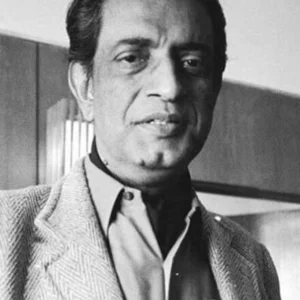

Indian Bengali filmmaker, writer and composer
Satyajit Ray(1921 — 1992)
Satyajit Ray
Inde
7 min read
Frequently asked questions
Key Facts
Works & Achievements
Three landmark films of modern Indian cinema following the life of a Bengali boy from childhood to adulthood. The trilogy is internationally recognized as a masterpiece of world cinema and revolutionized Indian filmmaking by breaking free from the conventions of Bollywood.
A psychological film exploring emotions and relationships in 19th-century Bengali society. Widely regarded as one of Ray's finest works, it showcases his mastery of both narrative and cinematography.
A richly interior drama centered on a declining aristocratic zamindar who finds solace in classical Indian music. The film explores themes of cultural heritage and nostalgia.
A critical portrait of urban life in Calcutta and the impact of modernity on traditional family bonds. It reflects Ray's deep social engagement with the realities of contemporary India.
An experimental film set entirely aboard a train journey, exploring the life of a film actor confronted with the gap between his public image and private self. Groundbreaking in its narrative and temporal structure.
A whimsical musical fantasy adapted from a story Ray himself had written, blending the magical and the humanistic. Beloved by children and adults alike, the film demonstrates Ray's remarkable versatility.
A socially urgent film depicting the job search and alienation of a young graduate in post-independence Calcutta. A major example of Ray's political commitment as a filmmaker.
Ray composed the music for nearly all of his own films, blending classical Indian music with Western influences. His musical work contributed greatly to the poetic atmosphere that defines his cinematic output.
Anecdotes
Satyajit Ray discovered cinema by chance in 1950 when he saw the Italian film 'Bicycle Thieves' by Vittorio De Sica in Calcutta. The experience moved him so deeply that he decided to give up his career as an illustrator and advertising designer to become a filmmaker. This marked the beginning of one of the greatest careers in world cinema.
Ray made his first film 'Pather Panchali' (Song of the Little Road) in 1955 with no professional actors and a very limited budget. The film won the Grand Prix at the Cannes Film Festival in 1956 and was hailed as a masterpiece of world cinema, launching Ray onto the international stage.
The Apu Trilogy — comprising 'Pather Panchali' (1955), 'Aparajito' (1956), and 'Apur Sansar' (1959) — follows the life of a Bengali boy from his village childhood to adulthood in Calcutta. These three films, shot over several years with actors who genuinely aged alongside their characters, are regarded as one of the greatest achievements in cinema.
Satyajit Ray composed the music for his own films, which was exceptional for a director. For 'Pather Panchali', he drew on traditional Indian classical music to create delicate, emotionally resonant soundtracks that revolutionized film music in India.
Though seriously ill and weakened by a heart attack in 1989, Ray continued to create until his death. He received an Honorary Golden Lion at the Venice Film Festival in 1992, just days before he passed away — a recognition of his extraordinary contribution to world cinema.
Primary Sources
Indian cinema must develop its own visual language, rooted in the reality of our land and our people. It is only by remaining true to our environment that we can create something authentic and universal.
I began with the Apu Trilogy because I wanted to show life as it truly is in rural India, without artifice or excessive dramatization. It was a simple story of a boy growing up, but it contains the very essence of the human condition.
The camera must be a patient and honest observer. One must not force the film to say what one wants, but rather let the truth of life express itself through it.
Your work inspires me deeply. You have shown that cinema can be both poetic and grounded in social reality. That is the path I wish to follow in my own films.
Key Places
Satyajit Ray's birthplace in 1921, where he grew up and developed his passion for cinema and the arts. Calcutta was the center of his artistic creation and the base of his work as a filmmaker.
University founded by Tagore where Ray studied and worked as a graphic artist and designer before becoming a filmmaker. It was a formative place for his artistic vision.
An inspiring setting for the Apu Trilogy, particularly for 'Pather Panchali' (1955). This rural Bengali landscape embodies the essence of Ray's realist cinema.
An artistic organization in Calcutta where Ray collaborated and developed his socially engaged, humanist approach to filmmaking.
The international stage where 'Pather Panchali' was awarded the Golden Lion in 1956, bringing Ray's genius to worldwide recognition.
India's filmmaking hub where Ray engaged with the film industry and received several accolades for his work.
Typical Objects

An essential piece of professional filmmaking equipment of the 1950s–1960s, used by Satyajit Ray to shoot his masterpieces. The 35mm camera was the filmmaker's fundamental tool for crafting his poetic and realistic films.

Satyajit Ray composed the soundtracks for his films himself. His handwritten scores are a testament to his musical talent and his holistic approach to cinematic creation.

Ray was also an illustrator and draughtsman. His preparatory sketchbooks reflect his meticulous creative process and his multidisciplinary artistic sensibility.

The film reels containing his masterworks — such as The Apu Trilogy — stand as symbols of his major cinematic achievements and his revolutionary contribution to Indian cinema.

An indispensable tool for Ray as a writer and screenwriter. He wrote his own scripts and dialogue, maintaining complete artistic control over his productions.

The authentic settings of Bengali villages — recreated on set or filmed on location in natural surroundings — are hallmarks of his realist style, which captured everyday Indian life with poetry and grace.

An iconic piece of filmmaking equipment used to mark the beginning of each take. It represents Ray's creative authority and professional rigour on his film sets.

Ray frequently adapted classic Bengali literary works for the screen — most notably Bibhutibhushan Bandyopadhyay's novel for The Apu Trilogy — building a bridge between literature and cinema.
School Curriculum
Daily Life
Morning
Satyajit Ray begins his day early, around 6-7 a.m., at his home in Calcutta. After a light breakfast of tea and toast, he immerses himself immediately in his work: reading scripts, corresponding with producers and technical crew, or composing music for his films.
Afternoon
Afternoons are dedicated to production meetings, editing sessions, or rehearsals with actors. Ray regularly visits film studios or heads to shooting locations, always involved in every aspect of his projects, from the screenplay to the original score.
Evening
At the end of the day, Ray often unwinds by reading Indian or foreign literature, writing critical essays on cinema, or working on his musical compositions. He has dinner with his family, then continues his creative work or meets with Calcutta's intellectuals and artists in the city's cultural circles.
Food
Ray follows a diet typical of Calcutta's intellectual Hindu class: rice, dal (lentils), seasonal vegetables, occasional fish, served with bread (roti). Tea is consumed regularly throughout the day, and he occasionally enjoys traditional Bengali sweets.
Clothing
Ray typically wears classic Western attire: a suit, cotton shirt, and tie — a reflection of his British-influenced education and status as a cultivated urban artist. In private settings and at local formal occasions, he sometimes adopts the kurta or traditional Bengali dhoti.
Housing
Ray lives in a spacious house in Calcutta, a major intellectual and artistic hub in post-colonial India. His home houses an impressive personal library, a workspace for composing and writing, and reflects his standing as a celebrated artist within India's cultural elite.
Historical Timeline
Period Vocabulary
Visual Style
Un style visuel inspiré du néoréalisme cinématographique indien des années 1950-60, combinant la tendresse humaniste de Satyajit Ray avec une photographie documentaire douce et poétique. Éclairage naturel, textures granuleuses et palette terreuse évoquant la beauté du quotidien bengali.
Sound Ambience
Une ambiance sonore immersive évoquant le Bengale du XXe siècle : mélodies classiques indiennes délicates, bruits de rue de Calcutta, et l'atmosphère poétique et intemporelle du cinéma de Satyajit Ray.