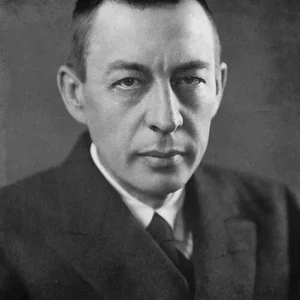

Russian composer, virtuoso pianist, and conductor, one of the last great representatives of late Romanticism. After emigrating in the wake of the 1917 revolution, he continued his career in the United States, where he became one of the most famous pianists of his time.
Sergei Rachmaninoff(1873 — 1943)
Sergei Rachmaninoff
États-Unis, Empire russe
6 min read
Frequently asked questions
Famous Quotes
« Music is enough for a lifetime, but a lifetime is not enough for music.»
Key Facts
- Born in 1873 near Novgorod, Russia, into a family of the nobility
- Composed his Piano Concerto No. 2 in 1901, one of his most famous works
- Left Russia for good after the 1917 revolution
- Pursued an international career as a virtuoso pianist, notably in the United States
- Died in 1943 in Beverly Hills, California, shortly before he was due to receive American citizenship
Works & Achievements
A piano piece that made Rachmaninoff famous from his youth and that audiences demanded of him in concert all his life.
Arguably his most beloved work, a symbol of his creative rebirth after his depression.
Reputed to be one of the most difficult concertos in the repertoire, premiered during his American tour.
A symphonic poem for chorus and orchestra, inspired by a poem by Edgar Allan Poe and by Russian bells.
A masterpiece of Orthodox a cappella sacred music, a pinnacle of the Russian choral repertoire.
A brilliant work for piano and orchestra whose famous 18th variation is known worldwide.
One of his last great orchestral works, imbued with nostalgia for a lost Russia.
His very last composition, a rich and colorful musical testament written in the United States.
Anecdotes
At the premiere of his First Symphony in 1897, the work was an absolute disaster: the conductor Alexander Glazunov, it is said, conducted it while inebriated, and the critics were ferocious. Rachmaninoff then sank into a deep depression that left him unable to compose for nearly three years.
It was thanks to a hypnotist physician, Doctor Nikolai Dahl, that Rachmaninoff regained his confidence and inspiration. He dedicated his Second Piano Concerto to him — which became one of the most famous works in the repertoire — in gratitude for this cure.
Rachmaninoff had gigantic hands, able to span an interval of twelve white keys on the keyboard (a thirteenth). This physical peculiarity partly explains the very wide and difficult chords found in his piano scores.
After the 1917 revolution, Rachmaninoff left Russia for good by sleigh, crossing the Finnish border in the dead of winter with his wife and two daughters, taking only a few pieces of luggage. He never saw his homeland again.
In the United States, Rachmaninoff earned his living mainly as a concert pianist, giving exhausting tours. Nostalgic for Russia, he recreated a Russian atmosphere in his villa in Switzerland, and later in America, even going so far as to employ Russian staff.
Primary Sources
I am not dead, yet I no longer feel any joy in living; I am like a man struck by apoplexy who has lost the use of his arms and his head.
Day after day, as I dozed in his armchair, I heard repeated: “You will begin to write your concerto... You will work with ease... The concerto will be excellent.”
On leaving Russia, I lost the desire to compose. Having lost my homeland, I lost myself.
Key Places
Rachmaninoff's birthplace, on a family estate of the Russian nobility.
The institution where Rachmaninoff trained as a pianist and composer, winning the Great Gold Medal in 1892.
A family estate in the countryside where Rachmaninoff spent his summers and composed a large part of his works, until the revolution.
A house he had built on the shore of Lake Lucerne in the 1930s, recreating a Russian atmosphere.
Rachmaninoff's last home, where he died in 1943 shortly before his 70th birthday.
A prestigious hall where Rachmaninoff regularly performed as a pianist and conductor during his American tours.
Typical Objects

The central instrument of Rachmaninoff's life, both a composition tool and the means of a virtuoso concert performer. He played on Steinway pianos during his American tours.

Sheets of music paper on which Rachmaninoff wrote down his compositions by hand, in a careful script. They bear witness to his creative work.

A tool used by Rachmaninoff when he conducted at the Bolshoi Theatre and later his own works. It allows the conductor to guide the orchestra's tempo and dynamics.

Records on which Rachmaninoff captured his piano performances, a new technology in the early 20th century. They still allow us to hear his playing today.

A small metal instrument that gives the reference note (the A) for tuning the piano. Indispensable to the musician's daily work.

The bells of Orthodox churches deeply marked Rachmaninoff from childhood and inspired many of his works, such as the symphonic poem “The Bells.”
School Curriculum
Vocabulary & Tags
Key Vocabulary
Tags
Daily Life
Morning
Rachmaninoff, a rigorous and punctual man, often began his day with long hours of work at the piano. As a touring pianist, he had to maintain a flawless technique through demanding exercises.
Afternoon
Afternoons were devoted to composing when he had the time, or to rehearsals and travel during concert tours. While vacationing at Ivanovka, he also enjoyed taking walks through the Russian countryside.
Evening
Evenings were frequently filled with concerts, where he performed before packed halls. In private, he relished gatherings among Russian friends, where his native tongue was spoken and the spirit of his homeland could be found again.
Food
Rachmaninoff remained attached to traditional Russian cuisine, which he had prepared even in exile. Like many touring artists, he had to make do with hotel and train meals.
Clothing
As a renowned concert performer, he wore the black evening dress—tailcoat and tie—the mandatory attire of the great soloists of the early 20th century. His tall, austere figure made him instantly recognizable.
Housing
Born into the nobility, he lived on Russian estates such as Ivanovka, then, in exile, in comfortable residences: the Villa Senar in Switzerland and houses in the United States, which he furnished in the Russian style.