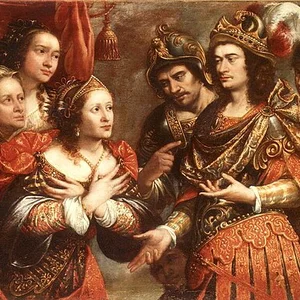

Sisygambis was an Achaemenid princess, the mother of Darius III, the last king of the Persian Empire. Captured by Alexander the Great after the Battle of Issus in 333 BC, she became a symbol of royal dignity in defeat and was treated with a respect that became famous.
Sisygambis(301 av. J.-C. — 322 av. J.-C.)
Sisygambis
Empire achéménide
7 min read
Frequently asked questions
Key Facts
- Mother of Darius III, the last ruler of the Achaemenid Persian Empire
- Captured by Alexander the Great along with her family after the Battle of Issus in 333 BC
- Treated with respect by Alexander, who is said to have preserved her rank and regarded her as a mother
- According to tradition, she died of grief in 323 BC upon learning of Alexander's death
Works & Achievements
During ten years of captivity, Sisygambis upheld the dignity and protocol of the Persian royal family, becoming the last living symbol of the dynasty.
By allowing Alexander to call her “mother,” she embodied the policy of rapprochement between the Macedonian victors and the Persian elites.
In the works of Diodorus, Quintus Curtius, and Plutarch, the treatment of Sisygambis became the classic example of the conqueror's magnanimity toward the vanquished.
A famous painting (National Gallery, London) depicting Sisygambis and the royal women pleading with Alexander after Issus.
A large canvas painted for Louis XIV (Palace of Versailles) illustrating the scene in which Sisygambis mistakenly prostrates herself before Hephaestion.
The story of Sisygambis inspired European poets and playwrights, who made her an emblem of nobility in the face of misfortune.
Anecdotes
In the aftermath of the Battle of Issus in 333 BC, Alexander and his friend Hephaestion entered the tent of the captive women. Since Hephaestion was the taller of the two, Sisygambis prostrated herself before him, mistaking him for the king. Realizing her error, she tried to correct herself, but Alexander reassured her: “You were not mistaken, mother, for he too is Alexander.”
Alexander made a habit of calling Sisygambis “mother” and treated her with the honors due to a queen. He forbade anyone to lay hands on the royal Persian women and let them keep their attendants, their clothing, and their rank. This respect shown to the family of a defeated enemy left a lasting impression on the ancient authors.
Wishing to please her, Alexander had cloth and wool for spinning sent to Sisygambis, thinking he was offering her an honorable occupation, as was customary among Macedonian women. But among the Persians, working with wool was beneath the dignity of a queen, and Sisygambis was wounded by it. When he learned of his mistake, Alexander came in person to apologize for his clumsiness.
When her son Darius III was killed while fleeing by the satrap Bessus in 330 BC, Sisygambis chose to remain in Alexander's camp rather than rejoin the Persians. Her loyalty to the Macedonian conqueror, who had protected her, became a symbol of the shift from the Persian Empire to the new world of Alexander.
Upon Alexander's death in Babylon in 323 BC, Sisygambis was overcome with grief. According to the ancient historians, she veiled her head, refused all food and all light, and died after five days. She wept both for the king who had treated her as a son and for the final collapse of her dynasty.
Primary Sources
“You were not mistaken, mother, for he too is Alexander.” Thus Alexander reassured the queen who had prostrated herself before Hephaestion, wishing to show that he turned her error into a token of friendship.
Alexander had clothing and wool brought to Sisygambis, inviting her to spin as the women of Macedonia did; but this gift, deemed unworthy among the Persians, distressed her, and the king came in person to apologize for it.
Alexander treated the mother, the wife, and the children of Darius with such gentleness and respect that the conquered women seemed to have lost nothing of their royal dignity.
On learning of Alexander's death, Sisygambis, who had survived the loss of her kingdom and of her grandsons, let herself die: she abstained from food and from light, and passed away on the fifth day.
Alexander ordered that the mother, the wife, and the children of Darius be guarded and served with all the honors of their rank, and that they be addressed by the title of queens.
Key Places
Site of the 333 BC battle where Darius III was defeated and where Sisygambis was captured in the Persian camp.
Ancient Achaemenid administrative capital where Alexander settled Sisygambis and the royal family; she spent much of her captivity there.
Great city of Mesopotamia where Alexander died in 323 BC; the news of his death drove Sisygambis to fatal despair.
Ceremonial capital of the Achaemenid Empire, heart of the dynasty to which Sisygambis belonged, burned by Alexander in 330 BC.
City where part of the treasures and baggage of the Persian court was seized after Issus, deepening the loss suffered by the royal household.
Typical Objects

Persian headdress reserved for the Achaemenid royal family. As mother of the Great King, Sisygambis wore one, a distinctive mark of her rank.

Women of the Persian royal house appeared veiled in public. The veil protected their status and signaled that they could not be approached without respect.

An enclosed carriage draped with fabrics in which Persian queens traveled. Sisygambis moved about with the court this way, shielded from prying eyes.

A gift sent by Alexander to keep the queen occupied; but since spinning wool was beneath a Persian sovereign, the object caused a misunderstanding that became famous.

Necklaces, bracelets, and diadems adorned the Achaemenid royal women. Alexander left Sisygambis her ornaments, a sign that he respected her rank.

The vast ceremonial tent of the Persian court, captured at Issus with its luxurious furnishings. There Alexander discovered the splendor of Achaemenid royalty.

A long sleeved coat, the court garment of high-ranking Persians. It was part of the wardrobe of a princess like Sisygambis.
School Curriculum
Vocabulary & Tags
Key Vocabulary
Tags
Daily Life
Morning
An Achaemenid princess's day began in the apartments reserved for the women of the court. Servants helped her dress, style her hair, and adorn herself. The morning might be devoted to prayers and bodily care according to royal protocol.
Afternoon
The afternoon was often spent managing the household: overseeing the servants, receiving relatives, and attending to the upbringing of the royal children. In captivity, Sisygambis watched over her granddaughters and preserved the customs of the Persian court.
Evening
The evening brought the royal family together around carefully prepared banquets, enlivened with music. Women of high rank, however, did not appear there as the men did, but dined separately, according to the Persian customs of separation.
Food
The Persian royal table was renowned for its abundance: breads, roasted meats (mutton, game, poultry), fruits, dates, and fine wines. People prized dishes seasoned with spices and the refinement of the preparations, a sign of the Great King's wealth.
Clothing
Sisygambis wore long robes of precious fabrics, a court mantle (*kandys*), a veil, and a headdress distinctive of her royal rank. Gold jewelry, belts, and ornaments completed an outfit that proclaimed her dignity as mother of the king.
Housing
She resided in the Achaemenid palaces of Susa, Babylon, or Persepolis, vast complexes of columned halls, courtyards, and decorated apartments. On campaign and in captivity, the court lived in luxurious royal tents that recreated this comfort.
Historical Timeline
Period Vocabulary
Liens externes & ressources
Références
Œuvres
Préservation de la maison royale achéménide en captivité
333–323 av. J.-C.
Lien symbolique « mère-fils » avec Alexandre
à partir de 333 av. J.-C.
Modèle de la clémence d'Alexandre
Antiquité
« La Famille de Darius devant Alexandre », Paul Véronèse
vers 1565–1570
« Les Reines de Perse aux pieds d'Alexandre », Charles Le Brun
1660
Postérité littéraire et théâtrale
XVIIe–XVIIIe siècles