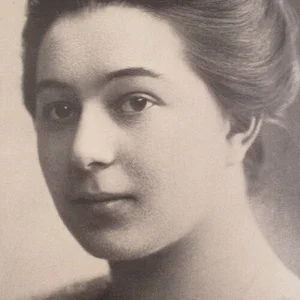

French painter and designer of Ukrainian origin, co-founder with her husband Robert Delaunay of the Orphism movement. She applied colorful abstraction to painting as well as to the applied arts (fashion, textiles, design), erasing the boundary between fine art and decorative art.
Sonia Delaunay(1885 — 1979)
Sonia Delaunay
France, Empire russe
6 min read
Frequently asked questions
Famous Quotes
« Color is the skin of the world.»
Key Facts
- Born in 1885 in Gradizhsk (Ukraine, then part of the Russian Empire) and died in 1979 in Paris.
- Married Robert Delaunay in 1910 and developed with him Orphism and “Simultanism,” based on color contrasts.
- Created in 1913 “Prose of the Trans-Siberian and of Little Jehanne of France” with Blaise Cendrars, a book-object with simultaneous colors.
- Extended abstraction to design: fabrics, fashion, sets and bookbindings in the 1920s.
- In 1964, became the first living woman artist to be exhibited at the Louvre Museum.
Works & Achievements
Assemblage of colorful fabrics that opens her exploration of abstract color and the dissolving of the boundary between art and craft.
Large canvas translating the rhythm and movement of dancers into color, a manifesto of Orphism.
The first “simultaneous book,” created with Blaise Cendrars, fusing poetry and painting on a two-meter foldout.
Canvas celebrating the electric lighting of Parisian boulevards through disks of shattered color.
Fashion and fabric pavilion presented in Paris, the high point of her influence on Art Deco.
Vast murals on aviation and electricity created for the pavilions, with Robert Delaunay.
Late series of abstract compositions extending her research into contrasts and colored movement.
Anecdotes
In 1911, when her son Charles was born, Sonia Delaunay sewed a cradle blanket by piecing together scraps of colored fabric, in the manner of the Ukrainian peasant quilts of her childhood. Looking at it, she realized that this arrangement of colors resembled a Cubist work: this everyday object became the starting point for all her abstract research.
Around 1913, Sonia strolled through Paris dressed in her “simultaneous dresses,” made of patchworks of bright colors. The poet Blaise Cendrars and his friend Apollinaire described these outfits in their writings, and the Delaunay couple caused a sensation at the Bal Bullier, turning dance into a living demonstration of their theories on color.
In 1913, she created *La Prose du Transsibérien* with Blaise Cendrars, a book-object that unfolded to over two meters in height, where her colors accompanied the poem. The artists announced that they wanted to join all 150 copies end to end to reach the height of the Eiffel Tower.
During the First World War, having taken refuge in Portugal and then Spain, the Delaunay family lost the income from its Russian properties after the 1917 revolution. Sonia then turned her art into a livelihood: she opened a decoration shop in Madrid, the “Casa Sonia,” and dressed wealthy clients.
In 1964, Sonia Delaunay became the first living woman artist to have her works exhibited at the Louvre, thanks to a donation she made together with her son. A belated recognition for a creator who had long remained in the shadow of her husband Robert.
Primary Sources
Around 1911 I had the idea of making a blanket for my son, who had just been born, composed of scraps of fabric like those I had seen among Russian peasants. When it was finished, the arrangement of the pieces made me think of Cubist conceptions.
In those days I was in my adolescence / I was barely sixteen and could already no longer remember my childhood / I was 16,000 leagues from my birthplace.
The simultaneism of this art reveals itself through simultaneous contrast and through all the magnitudes born of contrasts... and which thus constitute the very reality of depth.
There is no difference between painting and what are called the decorative arts: for me, colour obeys the same laws, whether it is on a canvas or on a fabric.
Key Places
Small town in the Russian Empire where Sarah Stern was born in 1885. The peasant colors and textiles of the region would leave a lasting mark on her eye.
City where, taken in by her uncle, she grew up in a cultured environment and discovered museums and European painting.
Capital of the avant-gardes where she settled in 1905, developed Orphism with Robert Delaunay, and spent most of her career.
A refuge during the First World War, where she opened the “Casa Sonia” and launched her decoration and fashion business.
The site of her crowning achievement: in 1964 she became the first living woman artist exhibited there, thanks to her donation.
Typical Objects

A garment made of panels of contrasting-colored fabrics assembled according to the laws of simultaneous contrast. Sonia turns it into a wearable work of art, blurring the line between painting and fashion.

A cloth with geometric, colorful patterns designed for haute couture and home furnishings. Produced on a large scale, it spreads abstraction into everyday life.

An unfolding book-object more than two meters long that pairs Cendrars's poem with Sonia's painted colors. The first example of poetry and painting meant to be read simultaneously.

A blanket sewn in 1911 for her son from scraps of colorful fabric, inspired by Ukrainian peasant quilts. The object that sparked her entire abstract research.

Colorful compositions for brands (Zenith, Dubonnet) and fashion labels. Here Sonia applies her contrasts in the service of modern communication.

A recurring motif of concentric discs in vibrant colors, the visual signature of Orphism. It appears on her canvases as well as on her fabrics and bookbindings.
School Curriculum
Vocabulary & Tags
Key Vocabulary
Tags
Daily Life
Morning
In her Paris studio, Sonia starts early, surrounded by pots of gouache and fabric swatches. She moves back and forth between a canvas in progress and boards of patterns intended for textile printing, treating the two as equals.
Afternoon
Afternoons were often devoted to business: meetings with manufacturers, seamstresses, and merchants, especially in the 1920s when her fashion “house” was running at full tilt. She designed dresses, scarves, and bookbindings on commission.
Evening
In the evening, the Delaunay couple hosted poets and painters — Cendrars, Apollinaire, Tzara — for lively discussions about modern art. Outings to dance halls or the theater were also a chance to show off the simultaneous dresses.
Food
Coming from a well-to-do background and then living off her own work, she shared in the bourgeois Parisian table and the habits of the artists' cafés of Montparnasse. Her exiles in Spain and Portugal opened her up to Iberian cuisines.
Clothing
Sonia wore her own creations: dresses and coats in patchworks of vivid colors, with matching accessories. Her wardrobe was a living showcase of her theories on simultaneous contrast.
Housing
She lived in Parisian studio-apartments where walls, furniture, cushions, and curtains might all be covered in her patterns, turning the home into a total work of art.
Historical Timeline
Period Vocabulary
Liens externes & ressources
Références
Œuvres
Couverture (patchwork de berceau)
1911
Bal Bullier
1913
Prismes électriques
1914
Boutique Simultanée (Exposition des Arts décoratifs)
1925
Rythme couleur
1958