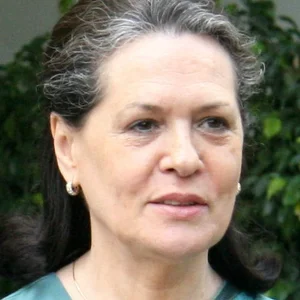

Born Edvige Antonia Albina Màino in 1946 in Italy, Sonia Gandhi married Rajiv Gandhi in 1968 and became an Indian citizen. Following her husband's assassination in 1991, she took over the leadership of the Indian National Congress in 1998 and led the UPA coalition to victory in 2004, declining the position of Prime Minister.
Sonia Gandhi(1946 — ?)
Sonia Gandhi
Italie, Inde
8 min read
Frequently asked questions
Key Facts
- 1946: born in Lusiana, Veneto (Italy)
- 1968: married Rajiv Gandhi, son of Indira Gandhi
- 1991: Rajiv Gandhi assassinated during the election campaign — Sonia temporarily withdrew from public life
- 1998: became president of the Indian National Congress (INC) and revitalized the party
- 2004: the UPA coalition won the general elections; she declined to become Prime Minister, leaving the post to Manmohan Singh
Works & Achievements
A collection of tributes compiled and prefaced by Sonia Gandhi in honor of her assassinated husband. The first public text in which she expressed her political and personal vision, before her involvement in the Congress Party.
Sonia Gandhi reunited and revitalized a party in disarray when she took over the Congress leadership. Under her guidance, the party regained national cohesion and led two terms in government (2004–2014).
Sonia Gandhi forged a coalition of regional and secular parties that unexpectedly defeated Vajpayee's BJP. This victory, built on a social platform known as 'Shining India for All,' is widely regarded as her greatest political achievement.
A landmark program championed by the National Advisory Council chaired by Sonia Gandhi, guaranteeing 100 days of paid work per year to poor rural families. Considered one of the most significant anti-poverty policies in Indian history.
A transparency law actively supported by Sonia Gandhi, allowing Indian citizens to access government documents. Regarded as a major step forward for democratic accountability and the fight against corruption.
Though not written by her, this authorized biography traces her remarkable journey and helped shape her international image as a political figure of extraordinary destiny.
Anecdotes
In 1968, Sonia Màino met Rajiv Gandhi in Cambridge while she was studying English. Their wedding in New Delhi drew her into one of the world's most powerful political dynasties, the Nehru-Gandhi family — whose main language, Hindi, she did not initially speak.
Following the assassination of her husband Rajiv Gandhi on May 21, 1991, by a suicide bomber from the Tamil Tigers, Sonia Gandhi withdrew completely from public life for several years. She long resisted calls from the Congress Party to return, choosing instead to raise her two children, Rahul and Priyanka, on her own.
In 2004, after leading the UPA coalition to a surprise victory over Vajpayee's BJP, Sonia Gandhi made the dramatic decision to decline the post of Prime Minister. She cited an 'inner voice' to explain her choice — a move that outmaneuvered her opponents, who had tried to use her foreign origins against her.
Hindu nationalist opponents attacked her Italian origins, calling her 'the foreigner.' Yet she had obtained Indian citizenship as early as 1983 and spoke fluent Hindi. This debate over national identity left a lasting mark on Indian politics throughout the 1990s and 2000s.
In 1999, during an assassination attempt, a man armed with a knife managed to reach her during a campaign rally in Rajasthan. She continued her speech after the incident, an act that cemented her image of courage and resilience among her supporters.
Primary Sources
I have heard the voice of my conscience. I must follow what it tells me. The post of Prime Minister is not my goal. My priority is the welfare of the country and the UPA.
Rajiv loved ordinary people. He believed that technology could serve the poorest. He taught me that serving India is not a sacrifice — it is a privilege.
I am joining this organization not for power, but because Congress needs to be united. The values of Jawaharlal Nehru and Indira Gandhi must guide our actions.
This program is the right of the poorest rural citizens to decent work. The State has an obligation to guarantee this right. This is the meaning of the democracy Nehru bequeathed to us.
Key Places
Sonia Gandhi's official residence in New Delhi, which became the nerve center of the Indian National Congress party during her years as its president. It was here that she announced her decision to forgo the position of Prime Minister in 2004.
Sonia Gandhi's birthplace (born Edvige Antonia Albina Màino), located in northern Italy. Her humble origins in this rural region stand in sharp contrast to the dynastic grandeur she would later become part of.
Sonia Gandhi's parliamentary constituency, which she won multiple times with overwhelming majorities. This rural stronghold in Uttar Pradesh symbolizes her deep roots in grassroots India and the enduring loyalty of the people to the Gandhi-Nehru family.
The site of her legislative work as a member of the Lok Sabha and chairperson of the National Advisory Council. It was in Parliament that she championed the major social welfare programs of the UPA era.
The site of Rajiv Gandhi's assassination on May 21, 1991, an event that transformed Sonia Gandhi's life and shaped the trajectory of an entire generation of Indian politics. A memorial at the site honors the memory of the former Prime Minister.
Typical Objects

After the assassination of Rajiv Gandhi, Sonia Gandhi adopted white — the color of mourning in India — as the near-exclusive color of her public wardrobe. This understated clothing choice reinforced her image as a widow devoted to her husband's memory.

Portraits of the dynasty's founder — Rajiv Gandhi's grandfather — are a constant fixture in Congress Party political spaces. For Sonia Gandhi, they represent dynastic legitimacy and the secular ideological legacy she has made it her mission to preserve.

As a candidate in the Amethi constituency (Uttar Pradesh) and later Rae Bareli, Sonia Gandhi built her political mastery by crisscrossing rural electoral terrain, armed with these documents and reports from her local party workers.

A distinctive mark of married women in Hindu tradition, Sonia Gandhi began wearing a bindi on her forehead from the time of her marriage, signaling her cultural integration into India. This detail is frequently cited by her supporters to counter accusations that she is a 'foreigner'.

During electoral campaigns — most notably the crucial 2004 campaign — Sonia Gandhi was known for her marathon rounds of local meetings across rural states, coordinating coalition alliances with a packed schedule and rigorous organization.
School Curriculum
Vocabulary & Tags
Key Vocabulary
Tags
Daily Life
Morning
Sonia Gandhi begins her days very early, often with prayer and meditation — a practice she adopted after immersing herself in Indian culture. She reviews the newspapers — The Hindu, Times of India — and receives a briefing from her political advisors before 8 a.m. Mornings at 10 Janpath are marked by a steady stream of Congress party officials arriving from across the country.
Afternoon
Afternoons are devoted to coordination meetings with leaders of UPA coalition states, parliamentary consultations, and audiences with local delegations. During election campaigns, she moves by helicopter from one rural constituency to the next across Uttar Pradesh, shaking thousands of hands.
Evening
Evenings often involve working dinners with political allies or foreign ambassadors. Sonia Gandhi places great importance on the cohesion of the UPA coalition, nurturing informal contacts at every opportunity. She also sets aside time for her children Rahul and Priyanka, instilling in them a sense of public service.
Food
Her daily meals blend the Italian traditions of her childhood with the vegetarian Indian cuisine she has made her own. She is fond of dal (lentils), basmati rice, vegetables sautéed with mild spices, and masala tea. At official receptions, she carefully observes Indian dietary customs.
Clothing
Since her marriage to Rajiv Gandhi, Sonia Gandhi wears almost exclusively saris — immaculate white cotton for official occasions as a sign of mourning and simplicity. She chooses more colorful saris for regional festivals and cultural celebrations, honoring the local dress codes of each state she visits.
Housing
She lives at 10 Janpath, a large government residence in New Delhi that came with her standing as a member of the Nehru-Gandhi family. The home serves as both a private residence and a genuine political headquarters, with a constant flow of staff, accredited journalists, and regional delegations.
Historical Timeline
Period Vocabulary
Visual Style
Un style visuel sobre et majestueux, dominé par les blancs immaculés du sari de deuil, les tons chauds de l'Inde institutionnelle et l'iconographie officielle de la démocratie parlementaire indienne.
Sound Ambience
Une ambiance mêlant la ferveur des rassemblements politiques ruraux indiens, le bruissement des couloirs du pouvoir à New Delhi et la solennité des lieux de mémoire liés à la famille Nehru-Gandhi.
Liens externes & ressources
Références
Œuvres
Rajiv, A Remembrance (ouvrage commémoratif)
1992
Présidence du Parti du Congrès (INC)
1998—2017, puis 2019—
Coalition UPA (United Progressive Alliance) — victoire électorale
2004
National Rural Employment Guarantee Act (NREGA/MGNREGA)
2005
Right to Information Act (RTI)
2005
Sonia: A Biography — autobiographie indirecte (Erik Sean Solheim)
2004