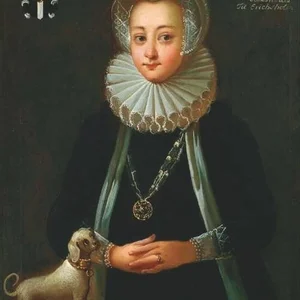

A Danish astronomer and horticulturist of the 16th century, she actively collaborated with her brother Tycho Brahe in his astronomical observations. A passionate self-taught scholar, she also mastered chemistry, medicine, and genealogy.
Sophie Brahé
Sophie Brahe
7 min read
Frequently asked questions
Key Facts
- Born in 1556 in Knudstrup, Denmark
- Collaborated with her brother Tycho Brahe in his astronomical observations from the 1580s onward
- Took part in the observation of the lunar eclipse of December 9, 1573, alongside Tycho
- Studied chemistry, horticulture, medicine, and genealogy entirely on her own, without any formal institutional training
- Died in 1643 in Elsinore, after a life devoted to science and learning
Works & Achievements
Direct participation in the astronomical measurements carried out with Tycho Brahe. This collaborative work stands as one of the earliest documented contributions by a woman to modern observational astronomy.
Sophie regularly assisted her brother in recording planetary and stellar positions. This data formed the foundation upon which Kepler would later formulate his laws of planetary motion.
Sophie created one of the most remarkable gardens in Scandinavia, combining ornamental horticulture with medicinal botany. This living laboratory bears witness to her expertise in plant chemistry and medicine.
A monumental genealogical compilation of the Danish nobility covering sixty distinguished families across several thousand pages. This scholarly work, grounded in archival research, remains a valuable historical source.
Anecdotes
At just 17 years old, Sophie Brahe joins her brother Tycho in observing a lunar eclipse on 8 December 1573. Standing in the Danish cold, she handles the instruments and records measurements with a precision that impresses her older brother. This early collaboration seals their scientific working relationship.
Entirely self-taught, Sophie independently learns Latin, astronomy, chemistry, and medicine — disciplines then reserved for men and universities. Never permitted to enrol in any educational institution, her knowledge nonetheless rivals that of the professional scholars of her time.
Sophie creates at Eriksholm one of the most remarkable gardens in Scandinavia, where she cultivates medicinal plants and conducts experiments in plant chemistry. This garden is at once a living laboratory and a work of art, celebrated throughout the Danish nobility.
After Tycho's death in 1601, Sophie devotes several decades to compiling a monumental genealogical work tracing the history of sixty Danish noble families. This scholarly undertaking, completed around 1626, runs to thousands of manuscript pages and remains a valuable source for historians.
The correspondence between Sophie and her brother Tycho reveals a relationship of equals — rare for the era. Tycho consults her on scientific questions and publicly acknowledges her contribution to his work, which is exceptional for a woman in the sixteenth century.
Primary Sources
Tycho refers on several occasions to his sister Sophie as a collaborator in his observations, notably during the lunar eclipse of December 1573, highlighting her mastery of astronomical instruments.
Description of the instruments used at Uraniborg, some of which were operated by Sophie during nocturnal observations she conducted alongside her brother.
A vast manuscript compilation of Danish noble genealogies, written by Sophie Brahe over several decades, covering more than sixty illustrious families of the kingdom.
In these letters, Sophie discusses astronomical questions, medicine, and chemistry with her brother, bearing witness to a remarkable intellectual equality between the two scholars.
Key Places
The Brahe family castle where Sophie was born and grew up. It was here that she developed her passion for science, entirely outside any formal institutional education.
Europe's first great astronomical observatory, built by Tycho Brahe. Sophie stayed there regularly to assist her brother in his precise nocturnal observations.
An underground observatory built next to Uraniborg to shield its instruments from the wind. Sophie took part there in measuring stellar positions with a precision unmatched before the telescope.
The estate where Sophie established a renowned botanical garden and chemical laboratory. She spent much of her adult life there, continuing her scientific research.
Capital of the Danish kingdom and centre of intellectual and noble life. Sophie moved in learned circles there and maintained correspondence with the leading European scholars of her day.
Typical Objects

An astronomical instrument fixed to a wall, used to measure the altitude of celestial bodies with great precision. Sophie uses it during nighttime observations at Uraniborg alongside Tycho.

A portable instrument for determining the position of stars and local time. Sophie is skilled with this tool for her astronomical calculations and planning observations.

A distillation apparatus used in alchemy and chemistry. Sophie uses it in her laboratory at Eriksholm to extract plant essences for medicinal purposes.

A thick collection of parchments covered in family trees and coats of arms. Sophie dedicates decades to compiling the history of the great Danish noble families within its pages.

A sphere representing the starry sky with engraved constellations. An indispensable tool for planning observations and locating celestial bodies in the Danish night sky.

A collection of dried and catalogued plants, reflecting Sophie's passion for botany. She cultivates and studies these plants in her celebrated garden at Eriksholm.
School Curriculum
Vocabulary & Tags
Key Vocabulary
Tags
Daily Life
Morning
Sophie rises early, often after a night of observation. She devotes the morning to transcribing and checking her astronomical notes, copying data onto quality sheets of paper. In winter, she works beside a fireplace in the castle library, surrounded by celestial globes and Latin treatises.
Afternoon
In the afternoon, Sophie goes down to her garden or laboratory to prepare herbal remedies or conduct distillation experiments. She sometimes receives learned visitors, dictates letters to scientific correspondents, or advances her genealogical research in the family archives.
Evening
As night falls, when the weather permits, Sophie makes her way to the observatory to measure the positions of planets and stars with the large instruments. She carefully records the angles, checks Tycho's calculations, and can spend hours in the Nordic cold, eyes raised to the sky.
Food
The Danish nobility of the 16th century ate rye bread, salted and smoked fish (herring, cod), roasted meats (pork, game), and light ales. Garden vegetables — cabbage, turnip, carrot — rounded out the meals, along with medicinal herbs that Sophie grew herself.
Clothing
Sophie wears long dresses in wool or dark velvet, fastened at the collar with a white starched ruff in the Danish Lutheran fashion. She sometimes puts on a linen apron for her laboratory work. In the observatory, she wraps herself in fur-lined cloaks to withstand the Nordic cold.
Housing
Sophie lives in solid ashlar castles typical of Danish Renaissance architecture: large vaulted halls, monumental fireplaces, and diamond-paned leaded windows. At Uraniborg, her brother's observatory is a true scholarly residence, complete with a library, alchemical laboratory, and symmetrical gardens.
Historical Timeline
Period Vocabulary
Visual Style
Style Renaissance nordique flamand avec clair-obscur à la bougie, dorures de laiton astronomique et parchemins sur fond d'observatoire de pierre danois sous un ciel d'encre.
Sound Ambience
Sons d'une nuit d'observation astronomique au XVIe siècle : vent marin sur une île danoise, instruments de mesure en bois et laiton, plume sur parchemin et distillation en laboratoire.
Liens externes & ressources
Références
Œuvres
Observations de l'éclipse de lune du 8 décembre 1573
1573
Collaboration aux observations systématiques d'Uraniborg
1576-1597
Jardin botanique et laboratoire d'Eriksholm
après 1590
Slægtsbog (Livre des lignages)
vers 1626