
Sosigenes of Alexandria was a Greek astronomer and mathematician of the 1st century BC. He advised Julius Caesar on the reform of the Roman calendar, which led to the Julian calendar in 46 BC. His work introduced the 365-day year with a leap day every four years.
Sosigenes
Sosigenes
6 min read
Frequently asked questions
Key Facts
- Greek astronomer active in Alexandria in the 1st century BC
- Advised Julius Caesar on the reform of the Roman calendar
- Devised the Julian calendar, which came into effect in 46 BC
- Set the year at 365 days with an intercalary day every four years
- Is said to have written several treatises on celestial phenomena mentioned by Pliny the Elder
Works & Achievements
Designed at Caesar's request, a solar calendar of 365 days that founded our way of counting time for more than sixteen centuries.
A system of one day added every four years to make up for the quarter-day of the solar year, the ancestor of February 29th.
An estimate of the length of the solar year, remarkably close to the true figure, the mathematical basis of the entire reform.
According to Pliny, writings in which Sosigenes revised his own calculations, proof of a scientific approach grounded in self-criticism.
Works of astronomy and meteorology now lost, known only through the references in the “Natural History.”
Anecdotes
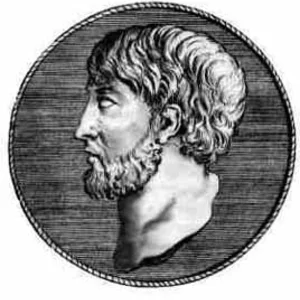
Sosigenes is known almost entirely from a single source: Pliny the Elder, who cites him three times in his *Natural History*. We do not know his dates of birth and death, nor even his face: he is a famous scholar of whom Antiquity preserved almost nothing but his work.
When Julius Caesar decided to reform the calendar in 46 BC, the Roman year was in such disorder that the seasons no longer fell in the right months. To make up for the accumulated lag, Caesar and Sosigenes had to add nearly 90 extra days to that single year: 46 BC lasted 445 days and was nicknamed “the year of confusion.”
Sosigenes's brilliant idea was to abandon the lunar calendar and follow the Sun alone, fixing the year at 365 days and a quarter. To handle that quarter of a day, he proposed adding one day every four years: this is the ancestor of our February 29th, the leap day.
Pliny reports that Sosigenes himself acknowledged that his calculations were not perfect and later published corrections. He was right to be cautious: his year was 11 minutes too long, a tiny error which, accumulated over centuries, forced Pope Gregory XIII to reform the calendar in 1582.
Sosigenes probably came from Alexandria in Egypt, then the greatest centre of learning in the world, with its famous Library. The Egyptians had long been using a solar year of 365 days: Sosigenes drew on this Eastern knowledge to reform the calendar of Rome.
Primary Sources
There were three principal schools: that of the Chaldeans, that of the Egyptians, and that of the Greeks. To these a fourth was added among us, in the time of the dictator Caesar, who brought the years, which had fallen out of step, back into agreement with the observation of the Sun, under the direction of the learned Sosigenes.
Sosigenes himself, though more accurate than the others, nevertheless went on later to correct his own calculation through three successive treatises, the error persisting all the same.
Caesar submitted the problem to the best philosophers and mathematicians, and, drawing on the methods already tried and tested, devised his own corrected way of setting the calendar right.
Key Places
Great learned city of Egypt, presumed homeland of Sosigenes and a hub of Greek astronomy thanks to its Museum and Library.
Research institution where Egyptian, Babylonian, and Greek astronomical knowledge was preserved — the very learning that inspired the calendar reform.
Capital of the Republic where Caesar, with the help of Sosigenes, put the Julian calendar into effect in 46–45 BC.
The political and religious heart of Rome, where Caesar, as high priest, proclaimed the calendar reform governing civic life.
Typical Objects

An instrument made of rings representing the celestial circles, used by Greek astronomers to model the motion of the Sun and the stars. It helped them understand the solar year.

A simple rod planted vertically whose shadow, cast on the ground, makes it possible to measure the height of the Sun. It was used to determine the solstices and the length of the year.

A water clock that measures time through the steady flow of a liquid. It was indispensable to astronomers for timing their nighttime observations.

Papyrus scrolls covered with columns of figures giving the calculated positions of the Sun and the Moon. They were the foundation of every calendar calculation.

A counting board fitted with tokens or grooves, used to carry out complex additions and multiplications. It was the everyday tool of the Hellenistic mathematician.

The official Roman calendar engraved on stone or bronze, marking the auspicious and inauspicious days. The Julian reform upended its organization.
School Curriculum
Vocabulary & Tags
Key Vocabulary
Tags
Daily Life
Morning
In the morning, an Alexandrian scholar like Sosigenes would go to the Museum, a state-funded place of study, to consult scrolls and astronomical tables. He exchanged ideas with other mathematicians and checked the previous night's observations.
Afternoon
The afternoon was spent calculating on the abacus, drawing geometric figures, and measuring the shadow of the gnomon to track the Sun's course. When he advised Caesar in Rome, he discussed the details of the reform with the pontiffs.
Evening
As night fell, the astronomer observed the sky, locating the position of the stars and noting the time on the water clock. These patient vigils fed his calculations on the exact length of the year.
Food
The Hellenistic diet was based on bread, olive oil, wine diluted with water, dried legumes, fish, and figs. Meat remained rare and tied to feast days.
Clothing
A Greek scholar wore the tunic (chiton) and, over it, a draped cloak (himation), often of wool or linen. The plainness of his attire signaled the seriousness of the philosopher.
Housing
He probably lived in an urban house with an inner courtyard, typical of Greek cities, close to the learned institutions. The furniture was simple: a bed, stools, chests, and oil lamps.
Historical Timeline
Period Vocabulary
Liens externes & ressources
Références
Œuvres
Réforme du calendrier romain (calendrier julien)
46-45 av. J.-C.
Introduction du jour bissextile
45 av. J.-C.
Calcul de l'année tropique à 365 jours ¼
vers 46 av. J.-C.
Trois traités de correction astronomique
après 45 av. J.-C.
Traités cités par Pline l'Ancien
Ier siècle av. J.-C.