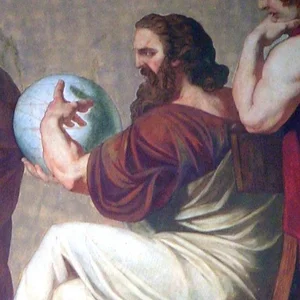

Greek pre-Socratic philosopher (c. 500–428 BC), born in Ionia. He introduced the concept of Nous (Cosmic Mind) as the organizing principle of the universe and was the first to offer a rational explanation for solar eclipses. A close friend of Pericles, he lived in Athens before being banished on charges of impiety.
Anaxagoras of Clazomenae(499 av. J.-C. — 427 av. J.-C.)
Anaxagoras of Clazomenae
8 min read
Frequently asked questions
Famous Quotes
« All things were together, infinite in number and infinite in smallness.»
« Nous is infinite, self-ruled, and mixed with nothing.»
« The appearances of things that are not seen are a vision of the unseen.»
Key Facts
- c. 500 BC: born in Clazomenae in Ionia (present-day Turkey)
- c. 461–430 BC: settled in Athens, close friend and advisor to Pericles
- c. 434 BC: charged with impiety for claiming that the Sun is a fiery rock
- He proposed that matter is infinitely divisible and that everything contains a portion of everything else
- 427 BC: died in Lampsacus, where he had taken refuge after his exile from Athens
Works & Achievements
The only known work of Anaxagoras, surviving only in fragments quoted by later authors. In it, he develops his theory of the infinite composition of matter and the role of Nous as the organizing principle.
A revolutionary philosophical concept holding that a pure and infinite Intelligence set in motion the primordial vortex from which the cosmos was born. This idea profoundly influenced Plato and Aristotle, both of whom engaged with it at length.
The doctrine that all matter is composed of infinitely small particles containing every quality within them, called 'seeds'. Everything contains a portion of everything else; only the predominance of one quality determines its apparent nature.
The first scientific explanation of solar and lunar eclipses through the interposition of celestial bodies. This discovery, made without any appeal to the gods, stands as a landmark in the history of science.
Anaxagoras argued that the Sun was a mass of incandescent molten rock and the Moon an opaque body of earth reflecting sunlight. These hypotheses, heretical to his contemporaries, foreshadow the discoveries of modern astronomy.
Anecdotes
Anaxagoras was the first philosopher to settle in Athens, transforming the city into the intellectual capital of the Greek world. He lived there for about thirty years, gathering around him a community of thinkers whose influence on Western philosophy would prove lasting.
Charged with impiety for claiming that the sun was not a god but a burning rock, roughly the size of the Peloponnese, Anaxagoras was tried and convicted. His friend Pericles, then at the height of his power, managed to save his life but could not prevent his exile. This affair reveals the limits of free thought, even in Athenian democracy.
According to the tradition recorded by Diogenes Laërtius, when Anaxagoras was asked why it was better to be born than not to be born, he replied: 'To contemplate the heavens and the order of the entire universe.' This answer perfectly captures the ideal of the contemplative philosopher who devotes his life to understanding the cosmos.
Anaxagoras explained solar eclipses by the interposition of the Moon between the Earth and the Sun, and lunar eclipses by the shadow cast by the Earth. This purely mechanical explanation, with no appeal to the gods, was revolutionary for his contemporaries, who were accustomed to seeing such phenomena as divine signs.
At the end of his life, having withdrawn to Lampsacus after his exile from Athens, the townspeople asked what favor he wished for. Anaxagoras requested that children be given a holiday every year in the month of his death — which was granted. This anecdote, reported by Plutarch, shows the high regard in which he was held by his contemporaries.
Primary Sources
All things were together, infinite in number and in smallness. For the small too was infinite. And since all things were together, nothing was distinguishable on account of smallness. For air and aether dominated everything.
Mind is infinite and self-ruled, and is mixed with nothing, but is alone itself by itself. For if it were not by itself, but were mixed with anything else, it would partake of all things.
Anaxagoras of Clazomenae, whom the Athenians called 'the Mind,' was the teacher of Pericles. Through him, Pericles acquired not only an elevation of thought and a nobility of expression, but also that serenity of spirit which never deserted him.
I once heard someone reading from a book by Anaxagoras, in which it was claimed that Mind is the organizer and cause of all things. I was delighted by this explanation, and it seemed right to me that Mind should be the cause of all things.
Anaxagoras of Clazomenae, son of Hegesibulus, held that the sun was a fiery mass, larger than the Peloponnese. He was the first to write on the composition of the heavenly bodies. He lived in Athens as a friend of Pericles.
Key Places
Greek city in Asia Minor where Anaxagoras was born, at the mouth of the Gulf of Smyrna. This Ionian cultural center was renowned for its naturalist philosophical tradition, inherited from Thales and Anaximenes.
The city where Anaxagoras lived for about thirty years, founding a school and influencing Pericles, Euripides, and the young Socrates. It was here that he was put on trial for impiety, marking a turning point in the history of freedom of thought.
Greek city on the European shore of the Dardanelles where Anaxagoras went into exile after his trial. He founded a school there that flourished long after his death, and the townspeople honored him with lasting funeral rites.
The religious and political heart of Athens, symbol of Pericles' power. Anaxagoras moved in Pericles' inner circle as the statesman oversaw the construction of the Parthenon, embodying the connection between philosophy, art, and power.
Typical Objects

The writing medium Anaxagoras used to compose his treatise On Nature. According to Plato, this book sold for one drachma in the Athenian agora, suggesting a remarkable level of circulation for the time.

An astronomical instrument consisting of a vertical rod that casts a shadow. Anaxagoras used it to observe the sun's path and measure angles of incidence, supporting his theories about eclipses.

A cosmological model representing the vault of the sky and its celestial bodies. Anaxagoras conceived the cosmos as a rotating sphere, set in motion originally by the Nous, whose swirling movement had separated the elements.

Anaxagoras claimed that the Sun was a blazing mass of molten rock. This claim led to his trial, but his theory was paradoxically confirmed by the fall of a meteorite at Aegospotami around 467 BCE — a fall he may have predicted.

A Greek vessel used at the symposium, the philosophical drinking gathering among intellectuals. It was at such gatherings that Anaxagoras debated with Pericles, Sophocles, and other members of the Athenian intellectual elite.

An outer garment worn by Greek philosophers, draped around the body. The philosopher's plain dress contrasted sharply with the opulence of Athenian aristocrats, reflecting Anaxagoras's detachment from material possessions.
School Curriculum
Vocabulary & Tags
Key Vocabulary
Daily Life
Morning
Anaxagoras rose at dawn, the ideal time for observing the sky. He noted the positions of the stars and recorded his observations on wax tablets or papyrus scrolls. His reputation quickly drew visitors to his Athenian home from early morning.
Afternoon
Afternoons were devoted to teaching under the porticos of the agora or at the home of Pericles, whose regular guest he was. There he debated with Sophists, poets such as Euripides, and trained disciples in his method of rational observation of nature.
Evening
In the evenings, Anaxagoras sometimes attended the symposia of the Athenian elite, where philosophy, politics, and poetry mingled over wine. Yet he was also known for his austerity: he often preferred to remain alone, contemplating the night sky and meditating on the Nous.
Food
Like most Greeks, Anaxagoras lived frugally — barley bread, olives, cheese, vegetables, and dried fish made up the bulk of his diet. Wine diluted with water was the drink of the philosophical symposium. Philosophers of his era valued dietary restraint as a discipline of the mind.
Clothing
Anaxagoras wore the chiton, a draped white linen tunic fastened with fibulae, covered by a woolen himation for outings. Philosophers and ordinary citizens looked much alike in dress, differing mainly in the quality of the fabric. His plain appearance was in keeping with his detachment from material possessions.
Housing
In Athens, Anaxagoras most likely lived in a modest house built around a central courtyard (oikos), with rooms arranged around a peristyle. His quarters also served as a workspace, furnished with tablets, scrolls, and instruments for observation. After his exile, he lived in Lampsacus in a residence provided by the city's grateful citizens.
Historical Timeline
Period Vocabulary
Visual Style
Esthétique classique grecque du Ve siècle av. J.-C. : marbres blancs, ciel égéen profond, céramique à figures rouges, lumière méditerranéenne vive sur les portiques des stoas.
Sound Ambience
Ambiance sonore d'Athènes au Ve siècle av. J.-C. : agitation de l'agora, débats philosophiques sous les portiques, chantier du Parthénon en arrière-plan.
Liens externes & ressources
Références
Œuvres
Peri Physeos (Sur la nature)
v. 450 av. J.-C.
Théorie du Noûs (Intelligence cosmique)
v. 450 av. J.-C.
Théorie de l'homéomérie (semences infinies)
v. 450 av. J.-C.
Explication rationnelle des éclipses
v. 467-450 av. J.-C.
Théorie de la nature du Soleil et de la Lune
v. 450 av. J.-C.
See also
Related Characters
Alexander II of Macedon
Anaximander
609 av. J.-C. — 545 av. J.-C.
Eratosthenes
275 av. J.-C. — 193 av. J.-C.
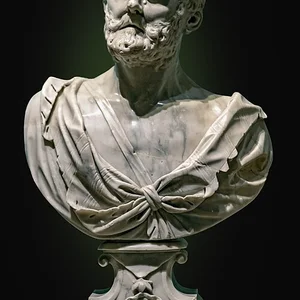
Heraclitus
534 av. J.-C. — 470 av. J.-C.
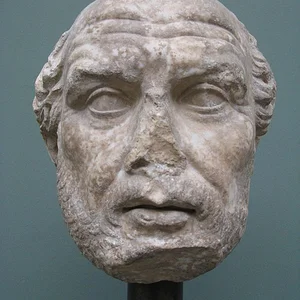
Phidias
499 av. J.-C. — 429 av. J.-C.
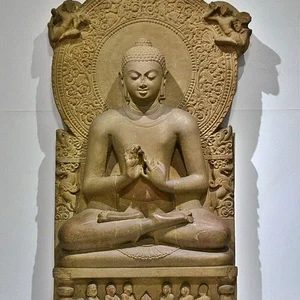
Siddhartha Gautama
500 av. J.-C. — 500 av. J.-C.