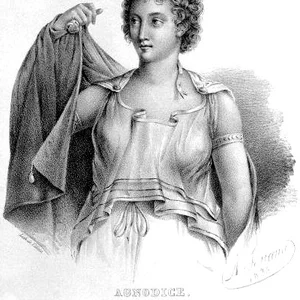

Agnodice is a legendary figure from ancient Greece, presented as the first female physician and gynecologist in Athens in the 4th century BCE. According to the account of the Latin author Hyginus, she disguised herself as a man in order to study medicine under Herophilus in Alexandria, and then to practice in Athens.
Agnodice(400 av. J.-C. — 360 av. J.-C.)
Agnodice
6 min read
Frequently asked questions
Key Facts
- 4th century BCE: Agnodice is said to have lived and practiced medicine in Athens
- She allegedly disguised herself as a man to study medicine under Herophilus in Alexandria
- In Athens, the law forbade women and slaves from practicing medicine
- Accused of being a man seducing his patients, she reportedly revealed her true sex before the Areopagus
- According to legend, her trial led Athens to allow free women to practice medicine
Works & Achievements
According to tradition, Agnodice was the first woman to officially practice gynecology and obstetrics in Athens, symbolically opening medical practice to free women.
Agnodice is said to have trained under Herophilus of Alexandria, a pioneer of anatomy — which would make her one of the first women to receive a scientific medical education in antiquity.
The trial of Agnodice, as recounted by Hyginus, is said to have led to a change in Athenian law allowing free women to practice medicine — a landmark legal reform.
Anecdotes
To study medicine in Alexandria, Agnodice cut her hair and dressed in men's clothing, enrolling under a false identity with the physician Herophilus. In Athens, laws forbidding women from practicing medicine forced her to maintain this disguise in order to treat her female patients.
Her Athenian colleagues, jealous of her growing success among women, accused her before the Areopagus of abusing her patients. To defend herself, Agnodice revealed her true identity as a woman — only to immediately face a new charge: practicing medicine illegally as a female.
At her trial, the noble women of Athens appeared en masse before the Areopagus to defend Agnodice, declaring that they considered her their physician, not a criminal. Their collective pressure compelled the judges to amend the law and allow free women to practice medicine.
The story of Agnodice, transmitted by the Latin author Hyginus in his Fabulae (2nd century AD), is today regarded by historians as an etiological legend — a tale invented to explain an existing situation — rather than a verified historical fact. Her story nonetheless illustrates the very real obstacles women faced in accessing medical knowledge in the ancient world.
Primary Sources
Hagnodice virgo cum parturientes videret morbo affligi neque posse curari propter verecundiam, tonsisque crinibus habituque mutato medicinae operam dedit apud Herophilum.
Soranus discusses the earliest practices of gynecology and obstetrics in Greece, providing the medical context in which the figure of Agnodice is situated.
Herophilus of Alexandria is presented as one of the founders of scientific anatomy, having performed human dissections — the supposed teacher of Agnodice according to tradition.
Key Places
The political and judicial heart of the city-state, the Areopagus was the court where Agnodice was tried for the illegal practice of medicine, according to the account by Hyginus.
Founded by Alexander the Great, Alexandria became the world center of medical knowledge. It is here that Agnodice is said to have studied under Herophilus, one of the first anatomists of the ancient world.
The birthplace of Hippocrates and the cradle of rational Greek medicine, whose treatises formed the foundation of the medical education that Agnodice pursued.
A major intellectual hub of Athens in the 4th century BCE, where philosophers and scholars gathered — the cultural backdrop against which Agnodice's pursuit of knowledge took shape.
Typical Objects

A bronze or wooden box containing scalpels, probes, and forceps, essential for a traveling Greek physician. According to legend, Agnodice concealed this case beneath her male clothing to move freely through Athens.

The short tunic worn by Greek men, which Agnodice is said to have adopted in order to go unnoticed during her studies and medical consultations.

The writing medium on which Hippocratic treatises and clinical observations were copied and passed down. Agnodice is said to have studied these texts under Herophilus in Alexandria.

Plants such as hellebore, carefully dosed hemlock, and mugwort, used in gynecology and obstetrics in ancient Greek medicine to treat women in labor.

A terracotta lamp fueled by olive oil, the only available light source for nighttime consultations and deliveries, which often took place after dark.

An abdominal bandage used by Greek midwives and physicians to support women in labor. This type of object is directly linked to the gynecological specialty attributed to Agnodice.
School Curriculum
Vocabulary & Tags
Key Vocabulary
Tags
Daily Life
Morning
Agnodice rises before dawn, dons male clothing to move freely through the streets of Athens. She prepares her instruments and medicinal herbs, then responds to calls from families seeking her care for their sick or laboring wives.
Afternoon
She consults her patients in the private space of the gyneceum — the women's quarters of Greek homes — the only place where she can discreetly reveal her female identity to establish the trust necessary for gynecological care.
Evening
Back in her home, Agnodice studies medical papyrus scrolls brought from Alexandria by the light of an oil lamp, recording her clinical observations and preparing the following day's remedies.
Food
Her diet follows the classic Greek pattern: barley or wheat bread, olives, boiled vegetables, sheep's cheese, figs, and dried grapes. Meat, being costly, appears only at religious festivals; wine, diluted with water, accompanies the evening meal.
Clothing
In public, Agnodice wears a short male chiton and a plain cloak (himation) to avoid drawing attention. At her patients' homes, she changes back into women's garments — a long draped chiton — which allows her to reveal herself as both woman and physician.
Housing
She likely lives in a modest two-story urban dwelling (oikos): a ground floor opening onto an inner courtyard, with an upper floor reserved for rest. The space is spare, furnished with low beds, wooden chests, and a central hearth. Her medical scrolls and instruments occupy a prized place.
Historical Timeline
Period Vocabulary
Visual Style
Esthétique inspirée de la céramique à figures rouges, tons ocres et bleu égéen, lumière méditerranéenne douce sur les colonnades de marbre blanc.
Sound Ambience
L'atmosphère sonore d'Athènes au IVe siècle av. J.-C. : le brouhaha de l'agora, les pierres du port, et le silence feutré des maisons où une femme médecin s'active discrètement à la lueur d'une lampe à huile.
Liens externes & ressources
Références
Œuvres
Exercice de la médecine féminine à Athènes
Vers 400-360 av. J.-C.
Études auprès d'Hérophile à Alexandrie
Fin IVe siècle av. J.-C.
Procès devant l'Aréopage
Vers 360 av. J.-C.