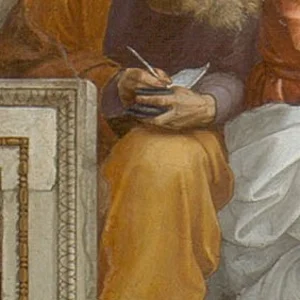

Pre-Socratic Greek philosopher born around 609 BCE in Miletus, a disciple of Thales. He proposed the apeiron (the boundless, indeterminate infinite) as the originating principle of all things, and created one of the earliest known maps of the world.
Anaximander(609 av. J.-C. — 545 av. J.-C.)
Anaximander
Milet
9 min read
Frequently asked questions
Key Facts
- Born around 609 BCE in Miletus, in Ionia (present-day Turkey)
- A disciple of Thales, he led the Milesian school after him
- Introduced the concept of the apeiron (the boundless) as the originating principle of the world
- Created one of the earliest known maps of the Earth, around 560 BCE
- Died around 545 BCE; only a single fragment of his work has survived
Works & Achievements
The first philosophical treatise written in Greek prose, this work set out the theory of the apeiron, a cosmology, and an account of the origin of living beings. Only a single direct fragment survives, transmitted by Simplicius, but its influence on Aristotle and later authors was considerable.
The first reasoned geographical map of the known world, depicting the Earth as a flat disk surrounded by Ocean, with Greece at its center. This foundational achievement in geography was later revised and expanded by Hecataeus of Miletus a generation later.
Anaximander is credited with introducing the use of the gnomon to Greece for determining solstices and equinoxes, and with establishing a spherical representation of the sky showing the relative distances of celestial bodies. This work represents one of the earliest attempts at mathematical astronomy in Greece.
Anaximander conceived of the stars as wheels of fire wrapped in mist, of which we see only the openings — thereby explaining eclipses and phases. This geometric model of the cosmos, free from divine intervention, marks a decisive break with mythological cosmology.
Anecdotes
Anaximander is said to have been the first person to draw a map of the known world, depicting the Earth as a flat cylinder surrounded by water. This map, now lost, showed the lands known to the Greeks — Europe, Asia, and Libya — arranged around the Mediterranean Sea. Later Greek geographers, such as Hecataeus of Miletus, drew directly on his work.
Unlike his teacher Thales, who believed that everything came from water, Anaximander proposed a bold idea: the original principle of all things was the apeiron, an infinite, indeterminate, and eternal substance. This abstract concept, which corresponds to no concrete element, is considered one of the earliest attempts to explain the world without resorting to myth.
Anaximander put forward the hypothesis that the first living creatures had been born in water, and that humans had evolved from fish-like aquatic beings. This remarkable insight, formulated 2,500 years before Darwin, makes Anaximander one of the forerunners of evolutionary thought.
According to Cicero, Anaximander reportedly predicted an earthquake at Sparta, advising the inhabitants to spend the night outside their homes. The tremor did indeed occur, and the Spartans came to regard him as a true man of science. It was most likely the result of careful observation of natural warning signs rather than any form of prophecy.
Anaximander was one of the first thinkers to propose that the Earth floated freely in space, unsupported, held in equilibrium by its central position in the universe. This revolutionary idea broke with the view of an Earth resting on water or held up by columns, and paved the way for a cosmology grounded in geometric and rational principles.
Primary Sources
"He says that the principle and element of existing things is the apeiron... from which the generation of existing things comes to be, and into which their destruction returns according to necessity; for they pay penalty and retribution to each other for their injustice according to the assessment of time."
"Some make the infinite (apeiron) this principle... Anaximander of Miletus, disciple and successor of Thales, says that the principle is the infinite, and was the first to use this term 'principle'."
"Anaximander says that the Earth is suspended freely and is held up by nothing; it stays in place because of its equal distance from everything."
"Anaximander holds that the first animals formed in moisture, enclosed in thorny bark; as they aged, they moved onto drier land and, their bark having split open, they survived for a short time in a different form."
Key Places
Anaximander's hometown, Miletus was in the 6th century BC one of the most prosperous Greek cities in Ionia, a major commercial and intellectual hub. It was here that the Milesian School was born — the cradle of Greek philosophy and science.
According to Cicero, Anaximander traveled there and reportedly predicted an earthquake, earning him a great reputation as a learned man. This journey reflects the intellectual exchanges between Greek city-states in the 6th century BC.
According to Aelian, Anaximander led an expedition of Milesian colonists to found or consolidate this settlement on the northern Black Sea coast, showing that the philosopher was also a man of civic action.
A neighboring Ionian city to Miletus, Ephesus was a major religious and intellectual center where the ideas of the Milesian School circulated widely. Heraclitus of Ephesus, a thinker closely linked to Anaximander's tradition, developed his philosophy there shortly afterward.
Capital of Croesus's Lydian kingdom, Sardis lay two days' march from Miletus and was the political heart of the western world in Anaximander's time. Milesian scholars were welcomed there, and cultural exchanges were intense.
Typical Objects

Anaximander is credited by Herodotus and Diogenes Laërtius with having introduced the gnomon to Greece. He used it to measure solstices and equinoxes and to trace meridians, turning this simple instrument into a tool for cosmological understanding.

A common writing and drawing surface in Archaic Greece, the wax-coated tablet allowed notes and sketches to be inscribed and erased. Anaximander is said to have used one to draft early versions of his world map before engraving it onto bronze or clay.

Anaximander's cosmographic map was probably engraved on a flat surface of bronze or fired clay. It was a rare and precious object, a symbol of rational inquiry that sought to represent the entire inhabited world.

His treatise On Nature (Peri Physeos), the first philosophical work written in Greek prose, was recorded on papyrus scrolls. The fragility of this medium explains why the work did not survive directly, reaching us only through quotations by later authors.

A timekeeping instrument used in Ionian city-states, the clepsydra allowed scholars to measure durations and observe astronomical phenomena with precision — directly relevant to Anaximander's work on cosmic cycles.

The outer garment of the educated Greek citizen, the large draped woolen cloak was the hallmark of the traveling philosopher and scholar. As a respected public figure and thinker in Miletus, Anaximander would certainly have worn one of fine quality.
School Curriculum
Vocabulary & Tags
Key Vocabulary
Daily Life
Morning
Anaximander rose at dawn to observe the position of the sun using his gnomon planted in the courtyard of his home. He recorded the cast shadows on a wax tablet to calculate the solstices and verify his astronomical measurements. His mornings thus began with a rigorous practice of sky observation, long before heading to the agora.
Afternoon
In the afternoon, he frequented the agora of Miletus — the heart of the city's intellectual and commercial life — where he debated with his disciples and fellow thinkers. He also worked on writing his treatise, dictating or inscribing his ideas on papyrus within an informal school that brought together young people eager to learn. Visitors from other Ionian cities would sometimes come to consult his map of the world, which was displayed in a public place.
Evening
In the evening, gathered with family and disciples around a simple meal, Anaximander continued his philosophical discussions on the nature of the apeiron and the order of the cosmos. He observed the night sky and reflected on the arrangement of stars and planets, seeking rational explanations for celestial phenomena. The evening would often end in solitary meditation on the great question of the origin of all things.
Food
Like most wealthy citizens of Miletus, Anaximander subsisted mainly on barley or wheat bread, olive oil, olives, goat's cheese, and dried legumes. Fresh or dried fish, abundant in this Ionian seaport, rounded out his everyday diet, accompanied by wine diluted with water according to Greek custom. On festival days or at philosophical symposia, mutton or goat meat would be served.
Clothing
Anaximander wore the chiton, a long tunic of linen or light wool, characteristic of the inhabitants of Ionia, who were renowned for their refined taste. Over it, the himation — a large rectangular woolen cloak — was draped skillfully over the shoulder, a mark of dignity and social standing befitting a respected philosopher. Leather sandals with straps and a well-kept beard completed the appearance of a cultivated man from the upper circles of Milesian society.
Housing
Anaximander most likely lived in a peristyle house of stone and mud brick, typical of the bourgeois homes of Miletus, organized around an open inner courtyard. This courtyard, equipped with a well and facing south, also served as an improvised observatory for his gnomon measurements. His library — a few precious papyrus scrolls — and his bronze measuring instruments were kept in a room set aside for intellectual work.
Historical Timeline
Period Vocabulary
Visual Style
Ionie archaïque baignée de lumière méditerranéenne : colonnes de calcaire, mer Égée turquoise, tablettes de bronze gravées et philosophe drapé d'ivoire étudiant un gnomon sous un ciel lumineux.
Sound Ambience
Les sons du port animé de Milet au VIe siècle av. J.-C. : vagues, commerce maritime, agora bourdonnante et atelier du philosophe avec clepsydre et stylet sur tablette de cire.
Liens externes & ressources
Références
Œuvres
Sur la nature (Peri Physeos)
~575-560 av. J.-C.
Carte du monde (Périodos gês)
~570 av. J.-C.
Introduction du gnomon et observations astronomiques
~560-550 av. J.-C.
Théorie cosmologique des sphères célestes
~570-545 av. J.-C.
See also
Related Characters
Alexander II of Macedon
Anaxagoras of Clazomenae
499 av. J.-C. — 427 av. J.-C.
Eratosthenes
275 av. J.-C. — 193 av. J.-C.
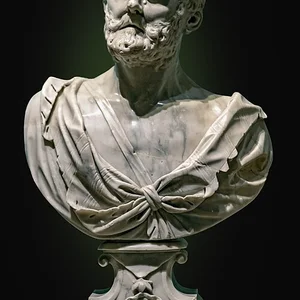
Heraclitus
534 av. J.-C. — 470 av. J.-C.
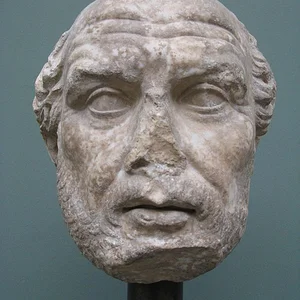
Phidias
499 av. J.-C. — 429 av. J.-C.
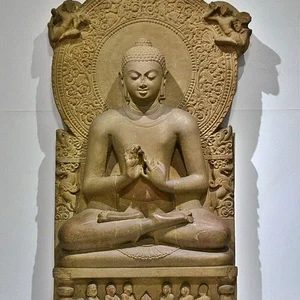
Siddhartha Gautama
500 av. J.-C. — 500 av. J.-C.