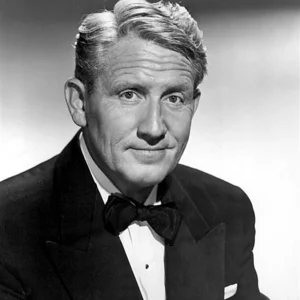

Spencer Tracy (1900-1967) was one of the most respected actors of Hollywood's golden age. Known for his natural, understated acting, he was the first performer to win two consecutive Academy Awards for Best Actor and formed a famous duo, both on screen and in real life, with Katharine Hepburn.
Spencer Tracy(1900 — 1967)
Spencer Tracy
États-Unis
6 min read
Frequently asked questions
Key Facts
- Born on April 5, 1900, in Milwaukee (Wisconsin), he began his career on the Broadway stage in the 1920s before moving into film in 1930.
- First actor to win two consecutive Academy Awards for Best Actor: for “Captains Courageous” (1937) and “Boys Town” (1938).
- From 1942 onward, he formed a lasting artistic and romantic partnership with Katharine Hepburn, making nine films together.
- Worked under contract with MGM, the most prestigious of Hollywood's major studios, for more than twenty years.
- Ended his career with “Guess Who's Coming to Dinner” (1967), a film about interracial marriage, and died on June 10, 1967, shortly after filming wrapped.
Works & Achievements
Tracy's first Oscar-winning role, as a Portuguese fisherman who reforms a spoiled boy. A classic of family adventure.
Tracy plays Father Flanagan, founder of a home for boys. The role earns him a second Oscar in a row.
Tracy takes on the dual role of the scientist and his evil alter ego, an adaptation of Stevenson's famous novel.
His first film with Katharine Hepburn, launching their legendary on-screen pairing and their off-screen romance.
A comedy in which Tracy plays a father overwhelmed by his daughter's wedding, one of his great popular hits.
A thriller in which a one-armed man confronts the racism of a small town; one of his most tightly wound roles.
Tracy plays a lawyer defending the teaching of evolution, inspired by a real 1925 trial.
His final film, about an interracial marriage. Tracy died two weeks after shooting wrapped.
Anecdotes
In 1938 and 1939, Spencer Tracy became the first actor in history to win two Best Actor Oscars in two consecutive years, for “Captains Courageous” and then “Boys Town.” At the second ceremony, the statuette was even mistakenly engraved with the name “Dick Tracy,” the comic strip hero!
Spencer Tracy and Katharine Hepburn made nine films together between 1942 and 1967, forming one of Hollywood's most famous couples. Both on screen and off, their bond was real, but it long remained discreet because Tracy, a Catholic, never divorced his wife.
Tracy hated long rehearsals and learned his lines very quickly. His acting advice became famous: “Know your lines and don't bump into the furniture.” This restraint actually concealed relentless work to give the impression that nothing was being acted at all.
His very last film, “Guess Who's Coming to Dinner” (1967), tackled the marriage between a young white woman and a black man, a burning issue in the United States at the time. Very ill, Tracy died just two weeks after filming wrapped, without having seen the finished film.
Tracy had first considered becoming a priest, then a doctor, before discovering theater at university. A student at the American Academy of Dramatic Arts in New York, he made his Broadway debut before Hollywood spotted him at the dawn of talking pictures.
Primary Sources
“The secret is to learn your lines and not bump into the furniture.”
“If what Joey and John feel is half of what we felt, then that's everything.”
She described Tracy as an actor of absolute truth, able to express everything while appearing to do nothing.
Key Places
Industrial city in the northern United States where Spencer Tracy was born in 1900 into a Catholic family of Irish descent.
Prestigious drama school where Tracy trained as an actor in the early 1920s before his Broadway debut.
New York's theater district where Tracy honed his craft on stage before being spotted by Hollywood.
Capital of American cinema where Tracy made most of his films, notably for MGM, the flagship studio of the golden age.
Residential city near Hollywood where Spencer Tracy died in June 1967, shortly after finishing his final film shoot.
Typical Objects

Award from the Academy of Motion Picture Arts and Sciences; Tracy was the first to win two of them in consecutive years. His was once engraved by mistake in the name of “Dick Tracy.”

Heavy camera mounted on a dolly, used on the sets of the major studios to film actors in carefully composed shots. It symbolizes the industrialization of Golden Age cinema.

The film's text, which Tracy learned very quickly and preferred to perform without rehearsing too much. Its pages carried his notes for a natural, understated delivery.

A classic outfit — dark suit, shirt, and tie — that Tracy often wore on screen in his roles as men of integrity. It matches the masculine dress style of the first half of the 20th century.

Microphone suspended above the actors, indispensable since the arrival of talking pictures at the end of the 1920s. It forced actors to master their diction, something Tracy excelled at making sound natural.

A large illustrated placard announcing the films, where Tracy's name appeared at the top of the bill. It was the studios' main advertising tool for drawing in audiences.
School Curriculum
Vocabulary & Tags
Key Vocabulary
Tags
Daily Life
Morning
During filming, Tracy got up early and arrived at the studio at dawn for makeup and wardrobe. He liked to know his lines by heart before reaching the set, which spared him long rehearsals.
Afternoon
Afternoons were spent under the lights of the MGM soundstages, shooting take after take. Tracy hated reshooting scenes and often gave his best on the very first one, surprising his co-stars with how natural he was.
Evening
In the evening, he returned to a quiet home, avoiding Hollywood's flashy social scene. He enjoyed peaceful evenings, sometimes in the company of Katharine Hepburn, far from the spotlights and the photographers.
Food
Tracy led a sober life in his final years to protect his fragile health. In his younger days he had known excess and problems with alcohol, which he eventually mastered through discipline.
Clothing
On screen as in life, Tracy readily wore the classic dark suit, white shirt and tie, the image of the respectable American man of his time. His sturdy frame and weathered face embodied characters of authority and integrity.
Housing
He lived in the Los Angeles area, close to the studios, and spent his final years in a discreet residence in Beverly Hills. Far from the glamour of some stars, he favored privacy and tranquility.
Historical Timeline
Period Vocabulary
Liens externes & ressources
Références
Œuvres
Capitaines courageux (Captains Courageous)
1937
Des hommes sont nés (Boys Town)
1938
Docteur Jekyll et Mister Hyde
1941
Le Père de la mariée (Father of the Bride)
1950
Un homme est passé (Bad Day at Black Rock)
1955
Procès de singe (Inherit the Wind)
1960