 flip
flipChakkarai Pongal (Sweet Rice with Jaggery for Pongal Festival)
Chakkarai Pongal (Sweet Rice with Jaggery for Pongal Festival)
Why this dish? Pongal, the Tamil harvest festival, marks Ramanujan's year. The new rice is boiled in milk until it overflows, with cries of 'Pongalo Pongal!' This sweet rice, first offered to the gods then shared, belongs to the devout universe where the mathematician saw the hand of the goddess Namagiri.
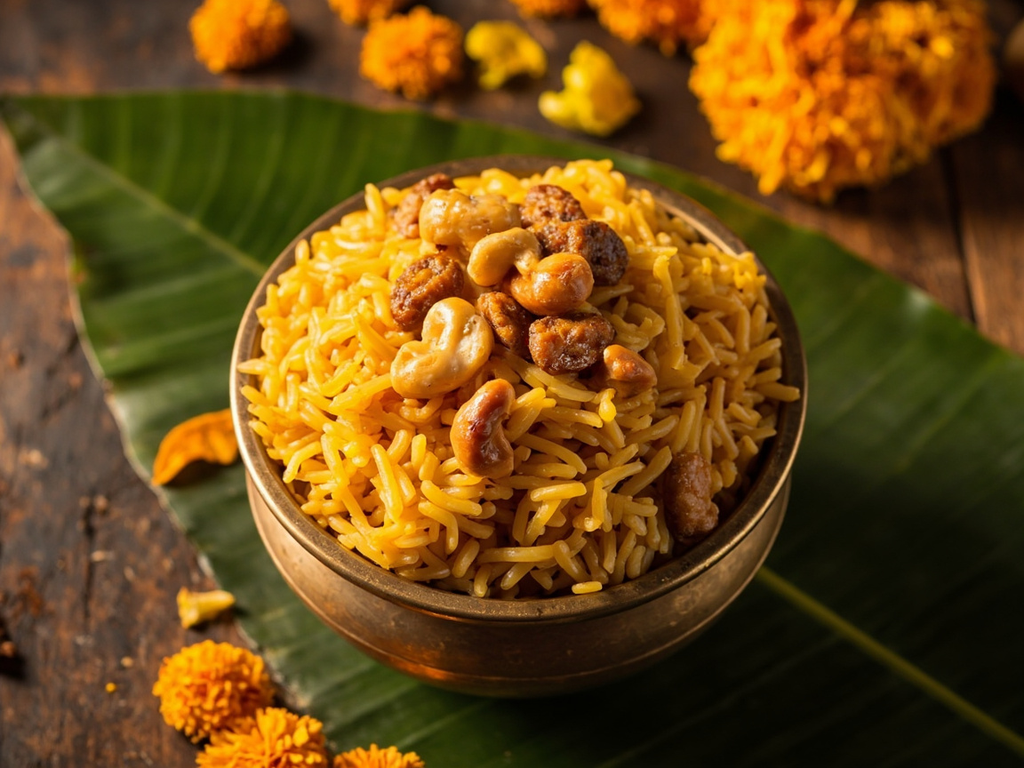
A creamy rice cooked with moong lentils, sweetened with jaggery (unrefined brown cane sugar), perfumed with cardamom, enriched with ghee, cashews, and golden raisins.
In January, when the sun turns north, my whole house smelled of ghee and jaggery. We let the milk rise and overflow from the new pot — overflow of happiness, they said, sign of a full year. I stirred this sweet rice that stuck to the spoon, fragrant with cardamom, and before tasting it, we placed it before the goddess. A true equation and this offered rice seemed to me of the same nature: two gifts received, not invented. Eat it warm, with your fingertips, and you will understand my childhood joy.
- •New harvest rice — one measure (base)
- •Moong lentils (pasi paruppu) — a quarter measure (creaminess)
- •Jaggery (vellam) — generously (sweetness, color)
- •Clarified butter (ghee) — abundant (richness, fragrance)
- •Cardamom, cashews, raisins — a handful (flavor, garnish)
Chakkarai Pongal (Sweet Rice with Jaggery for Pongal Festival)
A creamy rice cooked with moong lentils, sweetened with jaggery (unrefined brown cane sugar), perfumed with cardamom, enriched with ghee, cashews, and golden raisins.
Why this dish? Pongal, the Tamil harvest festival, marks Ramanujan's year. The new rice is boiled in milk until it overflows, with cries of 'Pongalo Pongal!' This sweet rice, first offered to the gods then shared, belongs to the devout universe where the mathematician saw the hand of the goddess Namagiri.
In January, when the sun turns north, my whole house smelled of ghee and jaggery. We let the milk rise and overflow from the new pot — overflow of happiness, they said, sign of a full year. I stirred this sweet rice that stuck to the spoon, fragrant with cardamom, and before tasting it, we placed it before the goddess. A true equation and this offered rice seemed to me of the same nature: two gifts received, not invented. Eat it warm, with your fingertips, and you will understand my childhood joy.
Ingredients (period version)
- New harvest rice — one measure (base)
- Moong lentils (pasi paruppu) — a quarter measure (creaminess)
- Jaggery (vellam) — generously (sweetness, color)
- Clarified butter (ghee) — abundant (richness, fragrance)
- Cardamom, cashews, raisins — a handful (flavor, garnish)
Ingredients
- Short-grain rice — 150 g (base)
- Skinned moong lentils — 50 g (creaminess)
- Grated jaggery — 200 g (sweetener)
- Ghee — 4 tbsp (richness)
- Milk — 250 ml (creamy cooking)
- Ground cardamom — 1/2 tsp (flavor)
- Cashews and raisins — 2 tbsp (garnish)
Method
- Dry-roast the moong lentils for one minute, rinse, then cook with the rice in water and milk until very tender porridge.
- Melt the jaggery in a little water, strain impurities, then stir this syrup into the rice.
- Cook stirring until thickened, add ghee little by little and cardamom.
- Fry cashews and raisins in a little ghee until golden, pour over the top.
- Serve warm, ideally on a banana leaf.
How it was made : Pongal was cooked outdoors, in a new clay pot over a wood fire, and the overflowing of the sweet milk was the sacred moment of the festival. Jaggery, not white sugar, gave the amber color and molasses taste.
The contemporary twist : A pinch of fleur de sel on top to awaken the jaggery, like salted caramel — a modern nod to Tamil sweetness.
Sources : S. Meenakshi Ammal, Samaithu Paar (Cook and See), 1951
Srinivasa Ramanujan · Charactorium