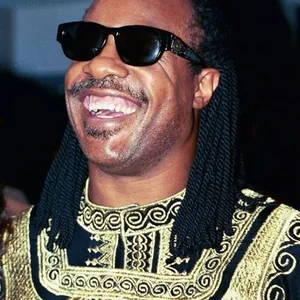

Stevie Wonder is an American singer-songwriter and multi-instrumentalist, a major figure of soul music and Motown. Blind since birth, he became one of the most influential and award-winning artists in twentieth-century popular music.
Stevie Wonder(1950 — ?)
Stevie Wonder
États-Unis, Ghana
5 min read
Frequently asked questions
Key Facts
- Born on May 13, 1950, in Saginaw, Michigan, blind from birth.
- Signed with Motown at age 11 and had his first hit with “Fingertips” (1963).
- Released the landmark album “Songs in the Key of Life” (1976).
- Composed “Happy Birthday” (1980), a song campaigning to make Martin Luther King Day a national holiday.
- Winner of 25 Grammy Awards, one of the most decorated artists in history.
Works & Achievements
Live recording that propelled the thirteen-year-old artist to the top of the American charts.
Album marking his creative turning point, featuring the hits “Superstition” and “You Are the Sunshine of My Life.”
Socially engaged album, honored with several Grammy Awards, blending funk, soul and synthesizers.
Double album regarded as his masterpiece, a vast musical fresco on love, society and spirituality.
Upbeat tribute to Duke Ellington and the jazz greats, now a classic.
Worldwide-famous ballad, awarded the Oscar for Best Original Song.
Anthem-like song from the campaign to establish Martin Luther King Day.
Anecdotes
Born prematurely, Stevie Wonder lost his sight shortly after his birth in Detroit due to retinopathy caused by excess oxygen in the incubator. Far from holding him back, this blindness sharpened his ear: as a child, he was already playing piano, harmonica, and drums in his Detroit parish.
Discovered at eleven, he signed with Motown under the name “Little Stevie Wonder.” At thirteen, his live recording “Fingertips (Part 2)” became the number-one selling record in the United States, making him one of the youngest artists ever to reach that peak.
Upon coming of age in 1971, Stevie Wonder renegotiated his contract to gain total artistic control. This freedom launched his most creative period, during which he explored synthesizers and produced albums that became classics.
In 1973, a serious car accident left him in a coma for several days. When he woke, it is said that a close friend hummed one of his songs near his ear to bring him back to consciousness; he returned to performing a few months later.
Stevie Wonder campaigned for Martin Luther King's birthday to become a national holiday. His song “Happy Birthday” (1980) accompanied this campaign, which succeeded in 1983 when President Reagan signed the law establishing Martin Luther King Day.
Primary Sources
“I have never considered being blind a handicap. It's just a part of who I am.”
“We must honor a man who gave his life so that others could live free and in dignity.”
The artist's dedication thanking God and inviting the listener to celebrate love and unity through music.
Key Places
Industrial city in Michigan where Stevie Wonder was born in 1950. His family later moved to Detroit.
Birthplace of Motown and the city where the artist grew up. It is there that he was discovered and signed his first contract.
House-studio where Motown recorded its hits. Stevie Wonder shaped his first successes there as a teenager.
Federal capital where his campaigns to have Martin Luther King Day recognized as a national holiday came to fruition.
City where Stevie Wonder later based his activities and where he received many honors from the music industry.
Typical Objects

Pocket wind instrument that Stevie Wonder turned into his sonic signature, capable of expressive glissandos. He played it from childhood and during his greatest solos.

Electromechanical keyboard with a punchy sound, popularized by the funky riff of “Superstition.” It helped define the sound of 1970s soul.

Analog synthesizers that Stevie Wonder explored in the early 1970s to create brand-new sonic textures. They turned his music into an experimental laboratory.

Accessory that became emblematic of his stage appearance, worn because of his blindness. They are part of his instantly recognizable public image.

Keyboard with a warm, mellow tone, omnipresent in his soul ballads. It accompanies his rich and refined harmonies.

Format on which his concept albums were released, in a double-LP edition for Songs in the Key of Life. The gatefold sleeve included lyrics and acknowledgments.
School Curriculum
Vocabulary & Tags
Key Vocabulary
Tags
Daily Life
Morning
In the studio, Stevie Wonder is known for his offbeat schedule: he often records at night and sleeps in the morning. His days start late, built around listening sessions and instrument setups.
Afternoon
Afternoons are spent rehearsing and composing, where he layers several instruments himself. His musical memory allows him to retain melodies and arrangements without any written score.
Evening
His evenings are paced by concerts or the long recording sessions that stretch late into the night. On stage, the artist improvises and engages in dialogue with his audience.
Food
Like many touring stars, he adapts to meals taken on the road and in the studio. Drawn to humanitarian causes, he has supported efforts to fight hunger around the world.
Clothing
On stage, Stevie Wonder sports colorful outfits, tunics inspired by African patterns, and his inseparable dark glasses. His braids and jewelry add to his flamboyant image.
Housing
After his childhood in Detroit, his career has led him to live mainly in the United States, particularly in California. His life is largely organized around recording studios.