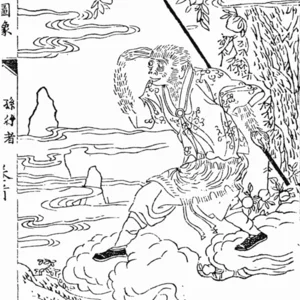

Sun Wukong, the Monkey King, is the main character of the classic Chinese novel Journey to the West (16th century). This mythological hero, gifted with superhuman powers and great wisdom, accompanies the monk Xuanzang on his spiritual journey to India to retrieve the Buddhist scriptures.
Frequently asked questions
Key Facts
- Main character of the novel Journey to the West (Xiyouji), written by Wu Cheng'en in the 16th century
- Born from a cosmic stone, he gains immortality and extraordinary magical powers after his Taoist apprenticeship
- Accompanies the monk Xuanzang and two other disciples on a 14-year initiation journey to India
- Overcomes 81 trials and spiritual obstacles before attaining Buddhist enlightenment
- Recognized as the archetypal rebellious and cunning hero in Asian literary tradition
Works & Achievements
A classic Chinese novel in which Sun Wukong is the main protagonist. This landmark work of Chinese literature tells the story of the Monkey King's journey alongside the monk Xuanzang to India to retrieve Buddhist scriptures.
Refusing to accept his limited authority, Sun Wukong rebels against the cosmic order and terrorizes the celestial kingdoms. This epic battle showcases his superhuman power and marks a turning point in the character's story.
Sun Wukong acquires the ability to transform into 72 different forms. This magical power is one of his most important weapons and symbolizes his adaptability and wisdom.
Sun Wukong obtains a magical weapon capable of changing its weight and size. This staff becomes his iconic instrument of combat throughout his journey.
The monk Xuanzang places a magical headband on Sun Wukong's head to keep him in check. This artifact symbolizes the Monkey King's spiritual education and his path toward enlightenment.
At the end of the journey, Sun Wukong achieves spiritual enlightenment and becomes a Buddha. This final transformation represents his evolution from a rebellious and chaotic being into one of wisdom and serenity.
Anecdotes
Sun Wukong is born from a cosmic stone on the Mountain of Flowers and Fruit, according to the novel "Journey to the West." This extraordinary origin makes him immortal and capable of transforming into various creatures — talents that will prove indispensable during the journey to India.
The Monkey King acquires his superhuman powers from the master Patriarch Subodhi, who teaches him celestial martial arts and Taoist magic. Among his 72 transformations, he can turn into birds, fish, or even entire buildings, a feat that has captivated readers since the 16th century.
Sun Wukong embodies rebellion against authority: he proclaims himself the "Great Sage Equal to Heaven" and defies the Jade Emperor before being defeated and imprisoned beneath a mountain. This revolt symbolizes the quest for freedom and remains at the heart of his character throughout the novel.
During his journey with the monk Xuanzang, Sun Wukong wears a magic headband that causes him excruciating pain whenever he disobeys. This device represents the learning of discipline and wisdom, gradually transforming the rebellious monkey into a true Buddhist disciple.
Journey to the West, in which Sun Wukong is the main hero, is one of the Four Great Classic Novels of Chinese literature. Written in the 16th century during the Ming Dynasty by Wu Cheng'en, this novel has influenced Asian literature, art, and popular culture for more than five centuries.
Primary Sources
The Monkey King Sun Wukong was born from a cosmic stone. Having mastered the magical arts, he became king of the monkeys and vowed to seek immortality. Captured by the Buddha, he was imprisoned beneath a mountain for five hundred years until his encounter with the monk Xuanzang.
This story recounts the pilgrimage of the monk Xuanzang to the West to obtain the sacred scriptures, accompanied by three remarkable disciples, among whom Sun Wukong stands as the most celebrated companion for his extraordinary powers and bravery.
Sun Wukong, also known as the Great Sage Equal to Heaven, possesses the power of cloud-riding, shape-shifting, and penetrating sight. He represents unruly nature brought under the discipline of spiritual practice.
Key Places
The mythological birthplace of Sun Wukong in the novel 'Journey to the West'. It is on this mountain that the Monkey King is born from a cosmic stone, marking the beginning of his extraordinary existence.
The place where Sun Wukong receives his education and early teachings. It is in this Buddhist monastery that the Patriarch monk teaches him the martial and spiritual techniques that will become the source of his power.
Sun Wukong is imprisoned beneath a mountain here for 500 years following his rebellion against Heaven. This place symbolizes cosmic punishment and marks a decisive turning point in the character's story.
The site of the first meeting between Sun Wukong, freed from his imprisonment, and the monk Xuanzang. This is the starting point of the famous journey to the West to retrieve the Buddhist scriptures.
The spiritual pilgrimage route that Sun Wukong travels alongside Xuanzang. This journey, fraught with trials and mythological creatures, forms the central narrative thread of the novel 'Journey to the West'.
The final destination of Sun Wukong and Xuanzang's journey. Having overcome 81 ordeals, Sun Wukong attains enlightenment and achieves sainthood alongside his master.
Typical Objects

Sun Wukong's legendary weapon, capable of changing size and weight at his will. This golden iron staff, weighing 13,500 pounds, is the Monkey King's iconic object and a symbol of his superhuman power.

A magical diadem placed on Sun Wukong's head to keep him under control. When the monk Xuanzang recites a mantra, the headband tightens and causes unbearable pain, serving as a constant reminder of the need for obedience.

Sun Wukong's extraordinary means of transport, allowing him to travel swiftly across the heavens. This cloud symbolizes his ability to move between the celestial and earthly realms.

An ornate garment worn by Sun Wukong, reflecting his status as a celestial creature and warrior. This richly decorated robe is typical of the imagery found in medieval Chinese mythology.

The sacred Buddhist texts that Sun Wukong helps carry all the way to India. These scriptures represent the spiritual purpose of the journey and embody the quest for wisdom and enlightenment.

An instrument used for ritual and spiritual calls throughout the journey to the West. The conch shell is an important symbol in Buddhism, representing the transmission of the dharma.

Magical objects used to seal powers or protect against demons. These talismans embody the fusion of Taoist and Buddhist magic that is characteristic of medieval Chinese literature.
School Curriculum
Vocabulary & Tags
Key Vocabulary
Daily Life
Morning
Sun Wukong wakes with the first rays of sunlight, often meditating on a sacred mountain. He practices martial exercises and kung fu techniques, strengthening his superhuman powers and his connection to both celestial and earthly forces.
Afternoon
The afternoon is devoted to accompanying the monk Xuanzang along the Silk Road, protecting the caravan from demons and spiritual obstacles. Sun Wukong alternates between moments of warrior vigilance and meditation to maintain his balance between wild nature and Buddhist discipline.
Evening
In the evening, Sun Wukong shares camp with his companions, listening to the monk's teachings or recounting his own adventures. He meditates under the stars, seeking spiritual progress and atonement for his past rebellions against the celestial order.
Food
Sun Wukong feeds primarily on wild fruits, roots, and mountain vegetation, in keeping with his nature as a creature of the wild. During his travels with the monk, he respects Buddhist principles by avoiding meat, sharing in the simple meals of the monastic caravan.
Clothing
Sun Wukong wears golden armor and a headband bestowed upon him by the heavens, symbols of his status as a celestial hero. He is draped in a flowing cape and wears cloud-treading boots, reflecting his hybrid nature as both divine creature and martial warrior.
Housing
Sun Wukong has no fixed home, though he originally dwells on the Mountain of Flowers and Fruit. During his journey to the West, he lives nomadically, sleeping under trees or in monastic caves, embodying the Buddhist ideal of detachment from material possessions.
Historical Timeline
Period Vocabulary
Visual Style
Un style visuel inspiré des peintures chinoises classiques et des gravures sur bois de la dynastie Ming, combinant techniques d'encre traditionnelle avec une esthétique mythologique épique. L'atmosphère mêle spiritualité bouddhiste et dynamisme martial, avec des effets de brume mystique et une palette de couleurs dorées et écarlates.
Sound Ambience
Une ambiance sonore épique fusionnant instruments traditionnels chinois (erhu, flûte de bambou, gongs) avec des éléments mystiques et surnaturels, évoquant le voyage spirituel du Roi Singe à travers des montagnes brumeuses vers l'illumination bouddhiste.
Liens externes & ressources
Références
Œuvres
Le Voyage vers l'Ouest (西遊記)
XVIe siècle (dynastie Ming)
La Rébellion contre le Ciel (大闹天宫)
Récit du Voyage vers l'Ouest
La Maîtrise des soixante-douze transformations
Récit du Voyage vers l'Ouest
Le Bâton du Roi Singe (金箍棒)
Récit du Voyage vers l'Ouest
Le Diadème d'Or (紧箍咒)
Récit du Voyage vers l'Ouest
L'Illumination Bouddhiste et la Canonisation
Récit du Voyage vers l'Ouest