
Suzanne Valadon was a French painter and engraver, a former model for the great artists of Montmartre who became a leading self-taught artist. She was one of the first women admitted to the Société Nationale des Beaux-Arts and the mother of the painter Maurice Utrillo.
Suzanne Valadon(1865 — 1938)
Suzanne Valadon
France
6 min read
Frequently asked questions
Key Facts
- Born in 1865 in Bessines-sur-Gartempe, died in 1938 in Paris
- Model for Puvis de Chavannes, Renoir and Toulouse-Lautrec in the 1880s
- Encouraged by Edgar Degas, who bought her drawings and introduced her to engraving around 1893
- First woman painter admitted to the Société Nationale des Beaux-Arts in 1894
- Mother of the painter Maurice Utrillo, born in 1883
Works & Achievements
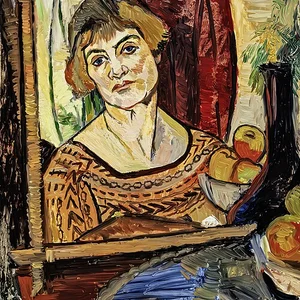
One of her earliest self-portraits, revealing from a very young age an unflinching gaze upon herself.
A large composition of nudes outdoors that asserts her ambition as a painter in the face of academic tradition.
A triptych of three male nudes, a rare audacity for a woman painter of the period.
Portrait of a reclining modern woman, in trousers and with a cigarette, which became an icon of women's painting; held at the Centre Pompidou.
A group portrait showcasing her mastery of painting from life and of bold, vivid colours.
A female nude outlined with a vigorous black line, characteristic of her style free of idealization.
An intimate portrait that reveals her tenderness for scenes of everyday life and motherhood.
Anecdotes
Born Marie-Clémentine Valadon, the daughter of a laundress, she was in turn an apprentice, a shop assistant and a circus acrobat in her youth. A fall from the trapeze, around the age of fifteen, put an end to that career and pushed her toward the studios of Montmartre, where she became a model to earn her living.
A sought-after model, she posed for Pierre Puvis de Chavannes, Auguste Renoir and Henri de Toulouse-Lautrec. It was the latter who, amused by her nerve and her temperament, is said to have nicknamed her “Suzanne,” in reference to the biblical episode of Susanna and the Elders, because she was surrounded by older painters.
While she posed, Suzanne secretly watched the masters' gestures and drew on the sly. When she showed her drawings to Edgar Degas, he was struck by their strength and warmly encouraged her, buying her works and teaching her engraving: “You are one of us,” he is said to have told her.
A very young mother to Maurice Utrillo, born in 1883 when she was only eighteen, she taught him to paint herself in an attempt to steer him away from alcoholism. Her son became a famous painter of Montmartre, making the Valadon-Utrillos one of the best-known families of artists in Paris.
Bold for her time, she was one of the first women painters to openly depict male nudes. Her powerful bodies, outlined with a black contour and free of idealization, shocked viewers with their frankness and asserted a woman artist's gaze that was rare in the art of her day.
Primary Sources
“You are one of us.” Degas, discovering Valadon's drawings, recognizes in her a true artist and encourages her to persevere.
Degas calls her “the terrible Maria” and buys several of her drawings, praising the vigor of her line.
Suzanne Valadon is among the first women admitted to exhibit within the Société, starting in 1894.
“I painted people in order to know them.” She lays claim to a direct art, observed from real life and without indulgence.
Key Places
Birthplace of Suzanne Valadon, which she left as a child to move to Paris with her mother, a laundress.
Bohemian district of painters and cabarets where she grew up, posed as a model, and then became a painter.
Studio she shared with Utrillo and Utter; the building today houses the Museum of Montmartre.
Estate acquired in the 1920s where the Valadon-Utrillo-Utter family painted landscapes and still lifes.
Gallery that hosted a major retrospective in 1932 that cemented her reputation.
Burial place of Suzanne Valadon, where she was laid to rest after her funeral in 1938.
Typical Objects

A pointed metal tool given to her and taught by Degas, with which Valadon incised copper plates to make her engravings of nudes and intimate scenes.

A painter's palette loaded with bright colors and deep blacks, the instrument of her move from drawing to oil painting.

A notebook in which, during her modeling sessions, she secretly drew the artists and models, sharpening a nervous, confident line.

An apparatus from her teenage years as an acrobat; a fall from it ended her dreams of the circus and steered her toward painters' studios.

Sticks of charcoal and white chalk with which she heightened her drawings, outlining the figures with a characteristic black line.

A wooden easel set up in her studio on the rue Cortot in Montmartre, where she painted portraits, nudes, and bouquets.
School Curriculum
Vocabulary & Tags
Key Vocabulary
Daily Life
Morning
In the early morning, in her studio on rue Cortot bathed in northern light, Suzanne prepared her colors and arranged a model. She first drew with a firm line before tackling the canvas, demanding of herself as much as of those who posed for her.
Afternoon
Her afternoons were spent painting nudes, portraits of those close to her, or bouquets of flowers. She also watched over her son Maurice, whom she introduced to painting to steer him away from alcohol, all while managing an often turbulent household of artists.
Evening
In the evening, Montmartre came alive with cabarets and cafés where painters, models, and poets crossed paths. Suzanne sometimes met up there with Utrillo and Utter, but above all she remained a tireless worker, more attached to her studio than to the festivities.
Food
Coming from modest means, she had known the simple food of a working-class neighborhood: bread, soups, cold cuts, and wine from the corner wine merchant. With success, her table became more generous, but she kept the tastes of a Montmartre street kid.
Clothing
A free-spirited woman, she dressed without regard for convention, gladly trading bourgeois attire for practical, paint-stained studio clothes. She was said to love wearing flashy jewelry and even, so the story goes, a bunch of carrots tied to her belt to provoke.
Housing
She lived for a long time in the lodgings and studios of Montmartre, in particular the studio on rue Cortot, surrounded by canvases, easels, and creative disorder. Success also allowed her to stay at the Château de Saint-Bernard, on the banks of the Saône.
Historical Timeline
Period Vocabulary
Liens externes & ressources
Références
Œuvres
Autoportrait
1883
La Joie de vivre
1911
Le Lancement du filet
1914
Portrait de la famille Bachellerie
1926
Nu à la draperie rayée
1922
Marie-Coca et sa fille Gilberte
1913