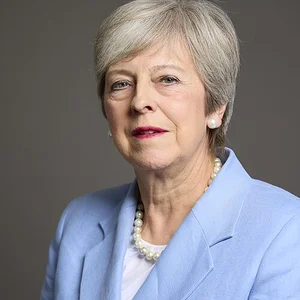

Theresa May (born 1956) is a British politician and member of the Conservative Party. She served as Prime Minister of the United Kingdom from 2016 to 2019, succeeding David Cameron following the Brexit referendum.
Theresa May(1956 — ?)
Theresa May
Royaume-Uni
7 min read
Frequently asked questions
Famous Quotes
« Brexit means Brexit.»
« No deal is better than a bad deal.»
Key Facts
- Born on 1 October 1956 in Eastbourne, England
- Elected MP for Maidenhead in 1997, a seat she held for over 25 years
- Home Secretary from 2010 to 2016, one of the longest tenures in that role
- Became Prime Minister in July 2016 following David Cameron's resignation after the Brexit referendum
- Resigned in July 2019 after her EU withdrawal agreement was repeatedly defeated in Parliament
Works & Achievements
Theresa May officially initiated the procedure for the United Kingdom's withdrawal from the European Union, launching an unprecedented diplomatic process in European history.
After eighteen months of intense negotiations, May concluded a 585-page agreement with Brussels setting out the terms of Brexit, which was rejected three times by the British Parliament.
As Home Secretary (2010–2016), May undertook a major reform of the police forces, reducing staffing levels while keeping crime rates low.
Theresa May steered this landmark legislation through Parliament — a first in Europe — criminalising all forms of human trafficking and modern slavery in the United Kingdom.
In this speech, May set out her vision of a post-Brexit United Kingdom open to the world and committed to international trade, laying the foundations for British diplomacy after leaving the EU.
Anecdotes
Theresa May is known for her passion for shoes, which she collects carefully. She notably wore leopard-print kitten heels at a Conservative Party conference in 2002, earning her the ironic nickname 'the woman in leopard shoes' in the British press.
During the European Union summit in March 2019, Theresa May performed an awkward dance on stage — dubbed the 'Maybot dance' by the media — in front of cameras from around the world at a conference in Cape Town. The footage went viral on social media and became a symbol of her time in office.
Theresa May was the second woman to become British Prime Minister after Margaret Thatcher, though she followed little of Thatcher's governing style. She cited Thatcher as a role model in her inaugural speech outside 10 Downing Street in July 2016.
On 29 March 2019, the date originally set for Brexit, the British Parliament rejected the withdrawal agreement negotiated by Theresa May for the third time. She wept publicly when announcing her resignation on 24 May 2019 — a rare sight for a leader renowned for her composure.
Theresa May is the daughter of an Anglican vicar and grew up in an Oxford vicarage. Her Christian faith has always shaped her positions, particularly on social justice and inequality — themes she addressed from her very first speech outside 10 Downing Street.
Primary Sources
I am about to become Prime Minister of a great country — a great government that will not only deliver the Brexit that people voted for, but will also build on it. Because Brexit must mean Brexit.
I have done everything I can to convince MPs to back that deal. Sadly I have not been able to do so... It is and will always remain a matter of deep regret to me.
We are seeking the best possible deal for Britain... But no deal is better than a bad deal.
Her Majesty's Government hereby notifies the European Union of the United Kingdom's intention to withdraw from the European Union and from the European Atomic Energy Community.
Key Places
The official residence and office of the British Prime Minister, where Theresa May lived and governed from July 2016 to July 2019.
May served as MP for Maidenhead from 1997, and later defended her Brexit deals at the dispatch box before a hostile Parliament.
Theresa May's constituency since 1997, a town in west London's commuter belt where she still lives today.
The venue for crucial negotiations between Theresa May and European leaders over the terms of Brexit, and the stage for many a hard-fought diplomatic stand-off.
The town where Theresa May grew up as the daughter of the Reverend Hubert Brasier. This Anglican upbringing instilled in her a strong sense of public service and moral integrity.
Typical Objects

Theresa May is famous for her flamboyant shoes, which stood in sharp contrast to her otherwise austere image. These iconic heels became a symbol of her quietly confident personal style.

The dispatch box is the wooden podium used in the House of Commons during Prime Minister's Questions. May stood at it hundreds of times to face the opposition during her years in power.

Thousands of pages of legal and diplomatic documents made up Theresa May's daily reality during her three years in office, symbolising the grinding complexity of negotiations with Brussels.

The famous black door of the British Prime Minister's official residence, in front of which May delivered her most memorable speeches — including those marking her arrival and her resignation.

Article 50 of the Treaty on the Functioning of the EU was the central legal instrument of May's tenure, setting out the conditions and timeline for Britain's withdrawal.

Theresa May regularly wore understated, classic jewellery — including pearl bracelets — in keeping with her image as a serious politician rooted in the traditions of British conservatism.
School Curriculum
Vocabulary & Tags
Key Vocabulary
Tags
Daily Life
Morning
Theresa May rises early and begins her day by reading press reviews and confidential briefing notes prepared by her cabinet. She often has a modest breakfast before chairing cabinet meetings or Prime Minister's Questions preparation sessions.
Afternoon
Her afternoons are shaped by diplomatic audiences, Brexit crisis meetings with ministers and advisers, or sessions in the House of Commons. She regularly took part in PMQs (Prime Minister's Questions) on Wednesdays, facing Jeremy Corbyn across the dispatch box.
Evening
Evenings at Downing Street were often extended by working dinners with ambassadors, heads of state, or government members. May and her husband Philip, a former investment banker, maintained a quiet and stable home life, well away from the social scene.
Food
Theresa May follows a simple, balanced diet in keeping with her middle-class English background. She appreciates traditional British cooking and is known to favour local cuisine; her husband Philip has a reputation as the household cook.
Clothing
Theresa May is recognised for her tailored suits in bold or understated colours, accessorised with statement shoes — her trademark. She favours British designers such as Amanda Wakeley and regularly wears understated but carefully chosen jewellery.
Housing
During her tenure, May lived at 10 Downing Street, the austere yet history-laden official residence at the heart of Westminster. Her primary home remains in Maidenhead, Berkshire — a comfortable suburban house she has shared with her husband Philip May for decades.
Historical Timeline
Period Vocabulary
Visual Style
Un style visuel sobre et institutionnel, ancré dans les décors néoclassiques de Westminster, avec des teintes froides de bleu marine et de gris, animées par des détails personnels comme les chaussures à motifs de May.
Sound Ambience
L'environnement sonore de Theresa May mêle le tumulte des joutes parlementaires à Westminster, le calme feutré des couloirs de Downing Street et l'atmosphère tendue des négociations européennes à Bruxelles.
Liens externes & ressources
Références
Œuvres
Activation de l'article 50 du Traité sur l'UE
29 mars 2017
Accord de retrait UE-Royaume-Uni
Novembre 2018
Réforme de la police britannique (Modern Crime Prevention Strategy)
2016
Modern Slavery Act (loi sur l'esclavage moderne)
2015
Discours 'Global Britain' (doctrine de politique étrangère)
Janvier 2017