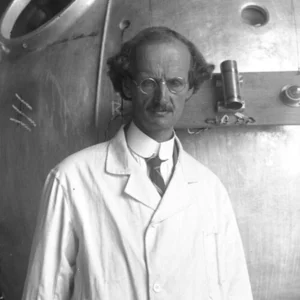

British computer scientist born in 1955, Tim Berners-Lee is the inventor of the World Wide Web (1989–1991). He designed the HTTP and HTML protocols that revolutionized global communication.
Tim Berners-Lee(1955 — ?)
Tim Berners-Lee
Royaume-Uni
8 min read
Frequently asked questions
Famous Quotes
« The Web is more a social creation than a technical one.»
« The original idea of the web was that it should be a collaborative space where you can communicate through sharing information.»
Key Facts
- 1955: born in London
- 1989: proposes the World Wide Web project at CERN
- 1991: the first website goes online
- 1994: founds the W3C (World Wide Web Consortium) to standardize the web
- 2004: knighted by Queen Elizabeth II for his contributions to computing
Works & Achievements
The founding document submitted to CERN in which Berners-Lee first sketched the architecture of a global hypertext system. His supervisor described it as 'vague but exciting.'
The first software allowing users to browse and create web pages, developed on a NeXT computer at CERN. It could both read and edit hypertext pages — a revolutionary capability.
A computer program enabling a machine to respond to requests from other computers via the HTTP protocol; it is the original software that made the Web operational.
The first public web page in history, explaining how the World Wide Web worked. It remains accessible at its original address, preserved and restored by CERN.
An international organization responsible for defining Web standards (HTML, CSS…) to ensure interoperability and keep it open; the W3C remains the primary Web standards body to this day.
An autobiographical book in which Berners-Lee recounts the invention of the Web and sets out his vision of a network that is open, universal, and never subject to commercial or political control.
A nonprofit organization founded to advocate for an open Web accessible to everyone, particularly in countries where connectivity remains insufficient.
Anecdotes
In March 1989, Tim Berners-Lee submitted to his supervisors at CERN a document titled 'Information Management: A Proposal'. His manager, Mike Sendall, scrawled in the margin the note 'Vague but exciting' before returning it — those words would remain famous as the first official verdict on the invention of the World Wide Web.
Unlike many inventors, Berners-Lee chose never to patent the World Wide Web. By making his HTTP and HTML protocols royalty-free, he allowed anyone to create websites without paying a licence fee: it is this decision that explains why the Internet grew so quickly and so universally.
The very first web server in history was a black NeXT cube sitting on Berners-Lee's desk at CERN. He had stuck a red label on it reading 'This machine is a server — DO NOT POWER IT DOWN!' to prevent technicians from accidentally switching it off and taking the world's very first website offline.
Both of Tim Berners-Lee's parents were mathematicians who had worked together on the Manchester Mark 1, one of the world's very first commercial computers. Raised on conversations about computing machines from an early age, he quickly developed a passion for the idea of connecting computers on a large scale.
While a student at Oxford, Berners-Lee and a friend were caught using a university computer without permission. As punishment, the authorities banned him from the institution's machines — a memorable twist of fate for the man who would go on to invent the global computer network.
Primary Sources
We should work toward a universal linked information system, in which generality and portability are more important than fancy graphics techniques, and in which new information may be linked to old information. Existing links should not break when new things are added.
HyperText is a way to link and access information of various kinds as a web of nodes in which the user can browse at will. Potentially, HyperText provides a single user-interface to many large classes of stored information such as reports, notes, data-bases, computer documentation and on-line systems help.
The WorldWideWeb (W3) is a wide-area hypermedia information retrieval initiative aiming to give universal access to a large universe of documents.
I had to create the system in a way that would allow it to be used without the permission of anyone. That was a crucial design decision. The freedom to connect is fundamental.
Key Places
Tim Berners-Lee was born on 8 June 1955 in London. Both of his parents worked in the emerging field of computing, directly shaping his scientific vocation.
Berners-Lee studied physics at Oxford from 1973 to 1976. It was there that he built his first computer from salvaged components and developed his passion for computing.
It was at this major particle physics laboratory that Berners-Lee invented the World Wide Web between 1989 and 1991, in response to researchers' need to share data easily.
Berners-Lee co-founded the W3C at the Massachusetts Institute of Technology in 1994 and led its computer science and artificial intelligence group for several years.
He conducted significant research there on the Semantic Web, an extension of the Web aimed at making data interpretable by machines as well as by humans.
Typical Objects

It was on this sleek black computer, designed by Steve Jobs, that Berners-Lee developed the first web server and the first web browser in 1990. It is now preserved at CERN and regarded as one of the most important machines in the history of computing.

Network cables were the arteries of CERN's computing infrastructure in the 1980s–90s; it was his desire to better connect researchers scattered across multiple buildings that gave Berners-Lee the idea for a global information-sharing system.

Berners-Lee typed the HTML code and HTTP specifications by hand on his keyboard, laying the foundations of a language that would allow billions of people to publish and read information.

In the 1980s–90s, the modem made it possible to connect a computer to the telephone network; it was through this device that the first internet users accessed web pages, at speeds very slow compared to today.

Research documents at CERN circulated as printed reports; it was precisely to manage this information more effectively without relying on paper that Berners-Lee envisioned a digital hypertext system.

Like many engineers of his era, Berners-Lee wrote down his ideas by hand before coding them; it was in notebooks like these that the first architectures of the Web took shape, before being formalized and submitted to his superiors.
School Curriculum
Vocabulary & Tags
Key Vocabulary
Tags
Daily Life
Morning
In the years 1989–1991, Berners-Lee arrived early at CERN, in the buildings of the European Organization for Nuclear Research on the Franco-Swiss border. He began his day by reviewing his specifications and programming on his NeXT computer, surrounded by engineers and physicists from around the world.
Afternoon
Afternoons were often devoted to meetings with colleagues to test the first versions of the Web, debug code, and refine the HTTP and HTML protocols. He also replied to emails from curious researchers who were discovering his system and wanted to try it out.
Evening
In the evening, he would return home to the Geneva area or continue coding. Passionate and a perfectionist, he constantly thought about possible improvements to the Web — in particular, how to make it more open and more universal, independent of any centralized control.
Food
Like most of his fellow engineers in a large international laboratory, Berners-Lee often had lunch in the CERN cafeteria, a meeting place for researchers of all nationalities. His diet was that of a British person living in Switzerland, with no notable documented particularities.
Clothing
In the late 1980s, computer engineers like Berners-Lee typically wore casual clothes: a shirt, jeans, or trousers. CERN's research environment imposed no formal dress code, unlike the traditional companies of the era.
Housing
Berners-Lee lived with his family in the outskirts of Geneva, like many researchers based at CERN. The salary of a senior engineer at this laboratory allowed for a comfortable life in a region renowned for its high standard of living.
Historical Timeline
Period Vocabulary
Liens externes & ressources
Références
Œuvres
Information Management: A Proposal
Mars 1989
WorldWideWeb — premier navigateur et éditeur web
1990
Premier site web — info.cern.ch
6 août 1991
Weaving the Web
1999
World Wide Web Foundation
2009