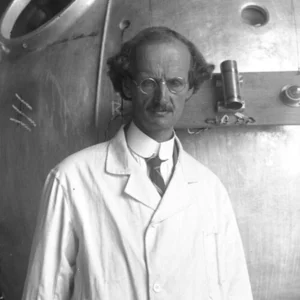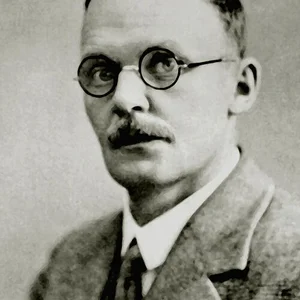

German physicist (1882–1945), Hans Geiger is famous for inventing the Geiger counter, an instrument for detecting ionizing radiation. He worked with Ernest Rutherford and contributed to the alpha particle scattering experiment that revealed the structure of the atomic nucleus.
Hans Geiger(1882 — 1945)
Hans Geiger
Troisième Reich, république de Weimar, Empire allemand
8 min read
Frequently asked questions
Key Facts
- 1882: Born in Neustadt an der Weinstraße, Germany
- 1908: Invention of the first particle counter with Ernest Rutherford
- 1909: Participation in the Geiger-Marsden experiment on alpha particle scattering, leading to the Rutherford model
- 1928: Major improvement of the Geiger counter with Walther Müller (Geiger-Müller counter)
- 1945: Death in Potsdam, leaving behind a measuring instrument still in use today
Works & Achievements
Geiger designs in Manchester the first device capable of detecting and individually counting alpha particles emitted by radioactive substances. This invention revolutionizes experimental nuclear physics by enabling precise quantitative measurements where only rough estimates had previously been possible.
By bombarding a gold foil with alpha particles, Geiger and Marsden observe that some particles bounce straight back — a completely unexpected result. This experimental work would directly lead Rutherford to propose the nuclear model of the atom in 1911, one of the foundational discoveries of modern physics.
Together with John Nuttall, Geiger establishes an empirical relationship between the energy of emitted alpha particles and the half-life of the emitting nucleus. The first quantitative law of nuclear physics, it would later be explained by the quantum mechanical tunnelling effect.
Publication of a rigorous method for counting alpha particles emitted by radium with unprecedented precision, contributing to the determination of Avogadro's constant. This work established Geiger as one of the finest experimentalists of his generation.
In collaboration with his student Walther Müller, Geiger refines his original counter to make it capable of detecting all forms of ionizing radiation (alpha, beta, gamma) with greater sensitivity and reliability. This standardized instrument was mass-produced and has been used worldwide to this day.
Anecdotes
In 1909, Hans Geiger and his student Ernest Marsden bombarded a thin gold foil with alpha particles, under Rutherford's direction. To their great surprise, some particles bounced back almost in the opposite direction. Rutherford would later say it was “like firing 15-inch shells at tissue paper and having them come back and hit you.” This astonishing experiment revealed the existence of the atomic nucleus.
Geiger is the inventor of the first device capable of detecting and counting radioactive particles one by one. In 1908, he developed a cylindrical tube containing a gas and a central wire: when an ionizing particle passes through the tube, it triggers an electrical discharge that produces an audible “click.” This revolutionary instrument now bears his name throughout the world.
During the First World War, Geiger interrupted his research to serve as an artillery officer in the German army. After the conflict, he resumed his work but confided to those close to him that the war years had left a deep mark on him. His military experience nonetheless gave him an added precision and rigor in his experimental work.
In 1928, Geiger collaborated with his student Walther Müller to significantly improve the original counter. The new Geiger-Müller counter was far more sensitive, less expensive, and easier to manufacture. This improved version became the world's standard instrument for radiation detection, still used today in hospitals, nuclear power plants, and laboratories.
Toward the end of his life, Geiger suffered from serious health problems linked to decades of exposure to ionizing radiation without adequate protection, as the dangers of radioactivity were poorly understood at the time. He also took part in the German nuclear program during the Second World War, without conclusive results. He died in Potsdam on September 24, 1945, just a few months after the end of the conflict in Europe.
Primary Sources
It is seen from the above results that the number of α-particles reflected at large angles is considerably larger than would be expected on the ordinary theory of scattering. The reflection is not due to a single deflection but to a series of small deflections.
On this view, the α-particle must have passed very near the centre of the atom, and must have been deflected through a very large angle by the intense electric field of the central charge. This is in good accord with the results of Geiger and Marsden.
Es wird über ein Zählrohr berichtet, das auch bei schwächsten Aktivitäten noch Einzelstöße zu zählen gestattet und das sich durch einfache Herstellungsweise und große Empfindlichkeit auszeichnet.
The number of α-particles emitted per second from one gram of radium has been found to be 3.4 × 10^10, a value which is in good accord with independent determinations based on other methods.
Key Places
Birthplace of Hans Geiger, born on September 30, 1882, in this city in the Rhenish Palatinate. It was in this region that he grew up before leaving to study physics at Erlangen, Munich, and Tübingen.
The site of his most decisive work (1906–1912) alongside Ernest Rutherford. It was in these laboratories that the gold foil experiment was carried out and the first particle counter was developed.
Germany's national metrology institute, where Geiger directed the radioactivity laboratory from 1912 to 1925. There he developed standardized methods for measuring ionizing radiation that gained international recognition.
Geiger held the chair of physics here from 1925 to 1929. It was during this period, in collaboration with his student Walther Müller, that he perfected the Geiger-Müller counter, which became the world standard.
Geiger taught here from 1936 until the end of his career. Weakened by the effects of radiation and the hardships of the war, he concluded his academic work at this institution.
The city where Hans Geiger died on September 24, 1945. His health, severely deteriorated by decades of unprotected exposure to ionizing radiation, did not allow him to survive long after the end of the war.
Liens externes & ressources
Références
Œuvres
Premier compteur de particules alpha (compteur Geiger)
1908
Expérience de diffusion Geiger-Marsden (expérience de la feuille d'or)
1909
Loi de Geiger-Nuttall
1911
Méthode de comptage des particules alpha (Geiger & Rutherford)
1912
Compteur Geiger-Müller amélioré
1928