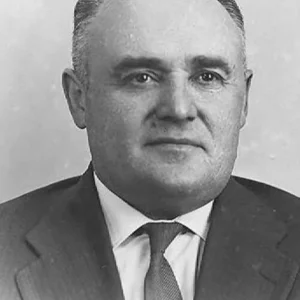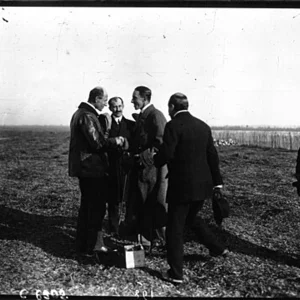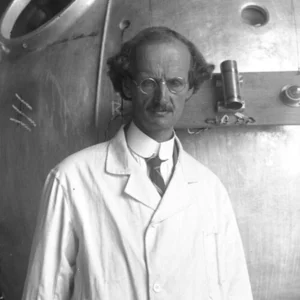

Swiss physicist (1884–1962), he was the first person to reach the stratosphere by balloon (1931), then designed the bathyscaphe to explore the ocean depths. A pioneer of extreme exploration, he pushed the boundaries of scientific knowledge in both vertical directions.
Auguste Piccard(1884 — 1962)
Auguste Piccard
Suisse
8 min read
Frequently asked questions
Key Facts
- 1931: first balloon flight into the stratosphere, reaching an altitude of 15,781 m
- 1932: new balloon altitude record at 16,940 m
- 1948: development of the bathyscaphe FNRS-2 for deep-sea exploration
- 1953: descent to a depth of 3,150 m aboard the bathyscaphe Trieste
- His son Jacques Piccard would reach the Mariana Trench in 1960 aboard the Trieste
Works & Achievements
Piccard's first major achievement: a hermetically sealed spherical gondola allowing humans to survive in the stratosphere. This invention paved the way for very high-altitude flight and inspired the pressurized cabins of future commercial aircraft.
Flying with Max Cosyns, Piccard set a new world record of 16,940 metres, confirming the scientific validity of his cosmic-ray measuring instruments and cementing his international reputation.
The world's first autonomous bathyscaphe, whose revolutionary design Piccard conceived: a gasoline float paired with a steel sphere capable of withstanding extreme pressures. It opened humanity's eyes to the possibility of exploring the deep ocean without a tether.
A second bathyscaphe built by Piccard together with his son Jacques, more advanced than the FNRS-2. Sold to the United States Navy, the Trieste made history in 1960 when Jacques Piccard and Don Walsh dived to the deepest point in the world's oceans.
Popular-science books in which Piccard recounts his adventures and explains the physical principles behind his inventions. Translated into several languages, they inspired a generation of young scientists and explorers.
Anecdotes
On May 27, 1931, Auguste Piccard and his co-pilot Paul Kipfer lifted off from Augsburg aboard a stratospheric balloon. They reached an altitude of 15,781 meters, becoming the first humans to enter the stratosphere. But the descent turned into a nightmare: a leak in the gondola and a faulty valve prevented them from descending before nightfall, and they landed on an Austrian glacier exhausted but alive.
To protect his passengers from the extreme cold and near-zero pressure of the stratosphere, Piccard invented a spherical pressurized aluminum cabin — a radical innovation for the time. He then applied this same pressure-sealing principle in reverse to the bathyscaphe, proving that a single stroke of genius can conquer both extremes of our planet.
Hergé drew direct inspiration from Auguste Piccard to create Professor Calculus in the Adventures of Tintin. The tall frame, absent-minded manner, round glasses, and passion for daring inventions: readers of the time immediately recognized the Swiss scientist in this character who became an icon of the comics world.
Auguste had a twin brother, Jean Félix Piccard, also a scientist and aeronaut, who conducted his own stratospheric flights in the United States during the 1930s. Scientific adventure ran in the family: Auguste's son, Jacques Piccard, dived in 1960 aboard the bathyscaphe Trieste to a depth of 10,916 meters in the Mariana Trench, the deepest point in the oceans.
To fund his bathyscaphe, Piccard turned to the Belgian National Fund for Scientific Research (FNRS). The vessel, named FNRS-2, was tested unmanned in 1948 off the coast of Dakar. Piccard had devised a revolutionary principle: a float filled with gasoline (less dense than water) and an ultra-resistant steel sphere for the crew, allowing the craft to dive without cables or winches.
Primary Sources
At 15,000 metres altitude, the sky was a deep blue, almost violet. We could see the curvature of the Earth. The silence was absolute, broken only by the faint creak of the sphere under pressure.
The spherical aluminium gondola, 2.10 metres in diameter, maintained sufficient internal pressure throughout the ascent. The outside temperature reached −50 °C at the maximum recorded altitude.
The same physical principle that allows a balloon to rise through the air allows a bathyscaphe to descend into the sea: one need only control the density of the float relative to the surrounding medium. Nature is consistent.
The vessel reached a depth of 1,380 metres during the 1948 trials, unmanned. The forged steel observation sphere, 90 mm thick, showed no deformation.
Key Places
Birthplace of Auguste and his twin brother Jean Félix Piccard, where both grew up in a stimulating intellectual environment in the late 19th century.
Institution where Piccard taught physics from 1922 and developed his research on cosmic rays, benefiting from support from the Belgian FNRS for his expeditions.
Departure point of the historic flight of May 27, 1931, during which Piccard and Kipfer became the first to reach the stratosphere and set a world altitude record.
Maritime area where the FNRS-2 bathyscaphe was tested unmanned in November 1948, validating for the first time the principle of a free-diving submersible at great depth.
City where Auguste Piccard spent his final years and passed away on March 24, 1962, having lived to see his son Jacques complete the ultimate dive into the Mariana Trench.
City that lent its name to the famous bathyscaphe built by Piccard, where the craft was assembled and tested before being sold to the U.S. Navy, which used it for the record-breaking dive of 1960.
Typical Objects

A sphere 2.10 meters in diameter invented by Piccard for his stratospheric flights, maintaining breathable pressure and temperature at deadly altitudes. This innovation was the cornerstone of his aerial expeditions.

A silk envelope of several thousand cubic meters inflated with hydrogen, capable of carrying the gondola to the edge of the atmosphere. Piccard personally oversaw its design and the choice of materials.

A free-diving submersible with no cable, invented by Piccard, consisting of a gasoline-filled float and a steel sphere for the crew. It made it possible to explore the deep ocean without any depth limit imposed by a winch cable.

An instrument that measures altitude through atmospheric pressure, essential during balloon ascents. Piccard used precision models to record his altitude achievements.

An instrument measuring water pressure during bathyscaphe dives. At 10,000 meters below the surface, pressure reaches 1,000 times that at sea level, and the manometer allowed real-time monitoring of the sphere's integrity.

A technical garment worn during the early ascents to protect against extreme cold, before the sealed gondola made it unnecessary. It foreshadowed the spacesuits later worn by astronauts.

An instrument carried aboard the balloons to measure the intensity of cosmic rays at altitude — the primary scientific objective of Piccard's stratospheric flights.
School Curriculum
Vocabulary & Tags
Key Vocabulary
Daily Life
Morning
Piccard began his days early in his office or workshop, poring over data collected during his flights or dives. A demanding professor, he devoted part of his mornings to preparing his physics lectures at the Université libre de Bruxelles, blending theory with hands-on experiments to captivate his students.
Afternoon
Afternoons were dedicated to engineering work: overseeing the construction of balloons or the metal components of the bathyscaphe in specialist workshops, and meeting with engineers and FNRS funders. He drafted the blueprints for his inventions himself, combining physical calculations with mechanical constraints and the precision of a watchmaker.
Evening
In the evenings, Piccard read international scientific journals and kept up an extensive correspondence with fellow researchers across Europe and America. A lover of classical music, he would sometimes unwind at the piano, and family dinners with his wife Marianne and their children were an unmissable part of his day.
Food
Like many educated Swiss and Belgian professionals of his era, Piccard ate simply and sensibly: bread, Swiss cheeses, cold cuts, seasonal vegetables, and during expeditions, compact, high-energy rations carefully calculated to sustain him for several hours inside the gondola.
Clothing
In his daily academic life, Piccard wore the dark three-piece suit typical of European university professors from the 1920s through the 1950s, usually finished with a tie and pocket square. During his flights, he layered up in warm woolen clothing and a waterproof suit — before the sealed gondola made specialized gear unnecessary.
Housing
Piccard lived in comfortable apartments suited to the academic middle class, first in Zurich and later in Brussels, lined with shelves heavy with scientific volumes and terrestrial globes. His desk was always crowded with calculation notebooks, measuring instruments, and the working blueprints of his next invention.
Historical Timeline
Period Vocabulary
Liens externes & ressources
Références
Œuvres
Ballon stratosphérique FNRS-1 et gondole pressurisée
1930–1931
Second vol stratosphérique depuis Dübendorf
1932
Bathyscaphe FNRS-2
1946–1948
Bathyscaphe Trieste
1953
Au-dessus des nuages / Entre ciel et mer (mémoires)
1933–1954