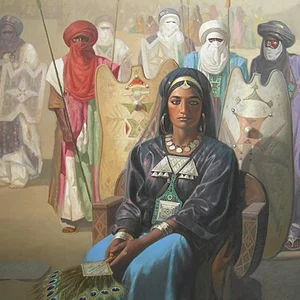

Legendary queen of the Tuareg people, Tin Hinan is considered by oral tradition to be the matriarchal ancestor of the Hoggar (Ahaggar) nobles. A founding figure said to have come from the Tafilalt region, according to stories passed down through generations, she is believed to have lived around the 4th–5th century CE.
Tin Hinan(350 — ?)
Tin Hinan
7 min read
Frequently asked questions
Key Facts
- Tin Hinan is known solely through Tuareg oral tradition — no contemporary written sources directly confirm her existence
- A monumental tomb discovered at Abalessa (Hoggar, Algeria) in 1925 is attributed to her by tradition; excavations revealed a woman's burial site dated to around the 4th century CE
- Her name is said to mean 'she of the tents' or 'woman of the encampments' in Tamasheq, the Tuareg language
- She is regarded as the matrilineal ancestor of the Kel Rela, a noble clan of the Hoggar Tuareg
- According to legend, she migrated from the Tafilalt region (present-day Morocco) to the Hoggar, accompanied by her servant Takamat, who became the ancestor of the vassal tribes
Works & Achievements
Oral tradition credits Tin Hinan with establishing the matrilineal social structure of the Tuareg of the Hoggar, in which nobility and clan membership are passed down through women. This organization still partially persists today.
A funerary monument of complex architecture — featuring a central chamber and several annexes — this mausoleum is the only direct archaeological evidence associated with Tin Hinan. Its elaborateness points to significant social organization and resources.
A collection of stories, songs, and poems passed down orally by griots and noble Tuareg women, recounting Tin Hinan's journey, her deeds, and her wisdom. This body of work forms the founding identity and collective memory of the Hoggar Tuareg.
Oral traditions associate Tin Hinan with control over trade routes linking the Maghreb to sub-Saharan Africa via the Hoggar. The presence of Roman objects in her tomb confirms her integration into long-distance exchange networks.
Anecdotes
In 1925, a Franco-American expedition discovered a monumental tomb at Abalessa, in the Hoggar mountains, containing the skeleton of a tall woman adorned with gold and silver jewelry. Carbon-14 analysis dated the burial to the 4th century. The local Tuareg had no doubt: this was the tomb of Tin Hinan, their venerated ancestor.
According to oral tradition, Tin Hinan left the Tafilalet region (in present-day Morocco) accompanied by a single servant named Takamat. The journey across the Sahara was grueling, and it was thanks to an anthill full of grain that the two women survived famine. This founding story teaches that survival sometimes comes from the most humble of sources.
The name 'Tin Hinan' means 'She of the Tents' or 'She Who Travels with Her Tent' in Tamasheq, underscoring her role as a nomadic leader who gathered peoples around her. The name is still carried with pride in Tuareg culture today as a symbol of founding motherhood.
Tuareg society is matrilineal: nobility and clan identity are passed down through women. Tin Hinan is considered the origin of this distinctive social organization, which gives her exceptional standing among Africa's legendary ancestors — a rare example of a woman as the founder of a civilization.
Primary Sources
Tin Hinan came from the North, from the land of Tafilalet, with her servant Takamat. She crossed the desert and settled in the Hoggar. From this woman descend the Kel Rela, the nobles of the Hoggar.
The skeleton discovered belongs to a tall woman, surrounded by gold and silver bracelets, Roman beads, and a coin of Constantine I. The main burial chamber is surrounded by several annexe rooms containing offerings.
Tuareg griot women celebrate Tin Hinan in their compositions on the imzad, a ritual single-stringed fiddle, as the mother of mothers, she whose blood flows through all the noble encampments of the Hoggar.
The tradition of the Kel Ahaggar is unanimous: Tin Hinan is their common ancestor. Her tomb at Abalessa is a place of veneration. Noble women claim direct descent from her lineage.
Key Places
Site of Tin Hinan's monumental tomb, discovered in 1925. This dry-stone mausoleum, called 'Tin Hinan' by the local Tuareg, is listed as Algerian national heritage and remains a living place of memory.
The legendary region of origin of Tin Hinan according to oral accounts. She is said to have left this oasis in southern Morocco to cross the Sahara and establish her reign in the Hoggar.
The present-day capital of the Tuareg Hoggar region, direct heir to the territory over which Tin Hinan is said to have held authority. The Kel Ahaggar keep the memory of their ancestor alive here.
A vast volcanic massif in the central Sahara, the natural backdrop of Tin Hinan's reign. Its gorges and plateaus (tassili) sheltered the encampments of the Tuareg nobility she is credited with founding.
Typical Objects

Found on the arms of the skeleton at Abalessa, these solid bracelets are a sign of noble rank. Among the Tuareg, silver jewelry is worn by free women and passed down from mother to daughter as a mark of clan identity.

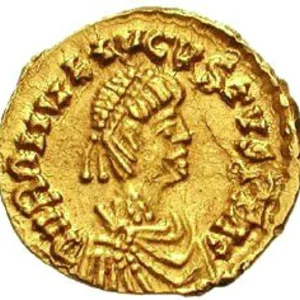
A 4th-century Roman coin discovered in the tomb attests to exchanges between the Hoggar and the Mediterranean world. It shows that Tin Hinan lived within an active trans-Saharan trade network linking Rome to sub-Saharan Africa.

An exclusively female instrument in Tuareg culture, the imzad is played during ceremonies to invoke ancestors and honor warriors. It is closely linked to the memory of Tin Hinan, whose griots perpetuate her legacy through their chants.

The Tuareg tent belongs to the woman and symbolizes her authority over the household. Tin Hinan, whose name means 'She of the Tents,' embodies precisely this central feminine power in nomadic social organization.

Found in the tomb at Abalessa, these colored beads came from Mediterranean workshops. They illustrate Tin Hinan's position as a great merchant or leader of a strategic caravan route.

The deep indigo veil, dyed with a plant from West Africa, is a defining marker of Tuareg identity. For nobles, it signals rank and spiritual protection. Tin Hinan, founder of the Hoggar nobility, is associated with this distinctive form of dress.
School Curriculum
Vocabulary & Tags
Key Vocabulary
Tags
Daily Life
Morning
Tin Hinan rises before dawn to check on the herds and organize the camp. She consults the elders and family heads about upcoming movements, planning routes according to available pastures and water sources. Her authority over the group's practical decisions is felt from the earliest hours.
Afternoon
She receives visitors, settles disputes between families, and negotiates with passing caravans crossing the Hoggar. Managing trade exchanges — salt, gold, enslaved people, Mediterranean goods — is a central prerogative of her rank as chief.
Evening
At sunset, the community gathers around the fire. Women play the imzad, and poets recite genealogies and the deeds of ancestors. Tin Hinan presides over these evening gatherings, which strengthen the group's collective identity and preserve its living memory.
Food
The diet centers on camel and goat milk, dried cheese, dates, and grilled meat at celebrations. Grains such as millet and barley are obtained through trade with settled populations. Tea had not yet reached West Africa during this period.
Clothing
Tin Hinan wears garments of supple leather and indigo-dyed linen, characteristic of Tuareg noble rank. She is adorned with heavy silver bracelets on her wrists and ankles, bead necklaces, and gold pendants. The veil was not yet widespread among women at this time.
Housing
The tent made of cowhide or camel wool (ehen) is the nomadic dwelling. It belongs to the woman and symbolizes her domestic authority. As clan chief, Tin Hinan's tent is larger than most, decorated with embroidered rugs and cushions, and also serves as a reception space.
Historical Timeline
Period Vocabulary
Visual Style
Esthétique désertique monumentale : femme noble touarègue drapée d'indigo et parée d'argent, paysage volcanique ocre du Hoggar, motifs géométriques berbères, lumière dorée de fin d'Antiquité.
Sound Ambience
Un paysage sonore désertique et nomade : vent du Sahara sur les rocailles du Hoggar, mélopée de l'imzad féminin, feux de camp et caravanes de chameaux sous un ciel étoilé.
Liens externes & ressources
Références
Œuvres
Fondation de la royauté matrilinéaire des Kel Ahaggar
IVe-Ve siècle
Tombeau d'Abalessa
IVe-Ve siècle
Cycle épique oral des Imenan
Tradition vivante depuis le IVe-Ve siècle
Établissement d'une route caravanière transsaharienne
IVe-Ve siècle