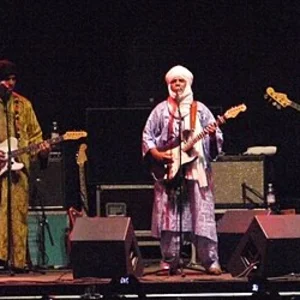

Tinariwen is a Tuareg music group formed in 1979 in the refugee camps of the Sahara. Pioneers of the “desert blues,” they blend electric guitars with Tuareg tradition, and won a Grammy Award in 2012.
Tinariwen
Tinariwen
5 min read
Frequently asked questions
Key Facts
- Group founded in 1979 by Ibrahim Ag Alhabib in the Tuareg camps of southern Algeria and Libya
- Album “The Radio Tisdas Sessions” (2001), their first international recognition
- Breakthrough at the Festival au Désert in Essakane (Mali) in the early 2000s
- Grammy Award for Best World Music Album in 2012 for “Tassili”
- Pioneers of “assouf,” or desert blues, a fusion of the electric guitar and Tuareg songs
Works & Achievements
First official album, recorded in a radio station in Kidal, which brought the band to attention beyond the Sahara.
The album that introduced Tinariwen to Europe and launched their international career.
Critically acclaimed album, accompanied by world tours.
Album recorded in Mali, faithful to the band's roots.
Acoustic album recorded deep in the desert, awarded the Grammy Award for Best World Music Album.
Album recorded between Morocco and the American deserts, shaped by the exile caused by the Malian conflict.
Album recorded at a camp in Mauritania, true to the band's nomadic spirit.
Anecdotes
The band's name comes from the Tamasheq word *ténéré*, which refers to the vast expanses of desert. *Tinariwen* roughly means “the deserts” in the plural, a way of evoking the wandering and exile of the Tuareg people.
Several founding members learned guitar and wrote their first songs while they were fighters or refugees in the military camps of Libya and Algeria in the 1980s. Their audio cassettes circulated hand to hand across the Sahara, without any record label.
In 2012, Tinariwen won the Grammy Award for Best World Music Album for *Tassili*. It was a rare international recognition for a band singing in Tamasheq, the language of the Tuareg.
Because of the insecurity in northern Mali, the band recorded some albums abroad, notably in the American desert of California for the album *Elwan*, thereby recreating a landscape close to their native Sahara.
Tinariwen's style, nicknamed “desert blues,” has influenced many Western musicians, and the band has collaborated with artists such as Carlos Santana and members of famous rock bands.
Primary Sources
Album recorded partly outdoors in the Tassili n'Ajjer desert, awarded the Grammy Award for Best World Music Album.
Best World Music Album: Tassili — Tinariwen.
A collection of songs evoking exile, the desert and the Tuareg cause, popularized on the international stage.
Key Places
Birthplace of some of the band's members and the heart of Mali's Tuareg country. A region marked by rebellions and exile.
A city in the Algerian Sahara where many exiled Tuaregs settled and where the band took shape.
A historic Sahel city near which the Festival au Désert was held, bringing the band to the world's attention.
A desert plateau famous for its rock paintings, which gave its name to the band's Grammy-winning album.
The country where several of the band's founders lived in exile and learned music in the 1980s.