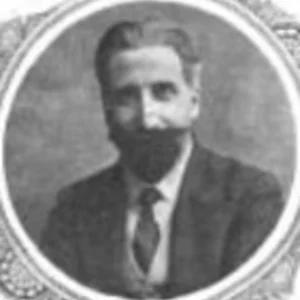

Alberto Gentili (1873–1954) was an Italian composer and musicologist. He is best known for rediscovering and cataloguing a vast collection of Vivaldi manuscript scores, playing a key role in the revival of the Baroque composer's work.
Alberto Gentili(1873 — 1954)
Alberto Gentili
Italie, royaume d'Italie
7 min read
Frequently asked questions
Key Facts
- Born in 1873 in Turin, died in 1954
- Professor at the Turin Conservatory for several decades
- Discovered in 1926–1927 a vast collection of 300 handwritten Vivaldi concertos in the possession of the Durazzo heirs
- This Vivaldi collection was acquired by the National Library of Turin thanks to his efforts
- His work contributed to the worldwide revival of Vivaldi's music in the 20th century
Works & Achievements
A scholarly inventory of the approximately 450 works by Vivaldi held at the Biblioteca Nazionale Universitaria di Torino. This catalogue is the foundation of all subsequent Vivaldi research and made possible the major critical editions of the twentieth century.
A work of cultural diplomacy carried out by Gentili to persuade the Foà and Giordano families to entrust their precious manuscripts to an Italian public institution rather than selling them abroad, thereby saving an irreplaceable musical heritage.
Courses in music history taught at an Italian conservatory at a time when the discipline had not yet been institutionalized in Italy, helping to train a first generation of specialized Italian scholars.
Academic articles and studies on the Vivaldi manuscripts that laid the groundwork for the major Ricordi critical editions of the second half of the twentieth century and for the international Vivaldi revival.
Anecdotes
In the early 1920s, Alberto Gentili learned of a substantial collection of unpublished musical manuscripts held by noble Genoese families. Upon examining them, he realized they comprised hundreds of works by Vivaldi that had been virtually forgotten since the 18th century. This discovery would revolutionize the understanding of Baroque music.
Gentili tirelessly negotiated to ensure these precious manuscripts remained in Italy rather than being sold abroad. Thanks to his efforts, Roberto Foà donated a first collection to the National University Library of Turin in 1927, in memory of his son Mauro. Three years later, Renzo Giordano gave a second collection, forming an exceptional set of some 450 works by Vivaldi.
For years, Gentili worked methodically to catalogue these hundreds of manuscript scores, deciphering handwriting sometimes darkened by time and piecing together fragmentary works. This painstaking labour, carried out in the halls of the Turin library, laid the foundations for all Vivaldian musicology of the 20th century.
Gentili was one of the first to teach music history in a systematic way at an Italian conservatory, helping to establish musicology as an academic discipline in Italy. His students enjoyed direct access to the original manuscripts he had assembled — a remarkably innovative teaching approach for the time.
When composer Alfredo Casella organized the *Settimana Vivaldiana* in Siena in 1939 — the first festival devoted entirely to Vivaldi — the scores used came largely from the collections that Gentili had helped to preserve and catalogue. Without his archival work, this landmark event would never have been possible.
Primary Sources
Official document by which Roberto Foà transferred his collection of musical manuscripts to the Turin library in memory of his son Mauro Foà, following negotiations conducted by Alberto Gentili.
Second donation deed completing the Foà collection, bringing the number of Vivaldi works held in Turin to approximately 450, thanks to negotiations led by Gentili.
Systematic inventory compiled by Gentili of the Vivaldian manuscripts deposited at the Biblioteca Nazionale Universitaria di Torino, covering concertos, operas, and sacred works, classified by instrumental ensemble and key.
Letters exchanged between the musicologist and the library's administration documenting the negotiations for the acquisition of the collections, the conditions of preservation, and the cataloguing programme.
Key Places
Repository of the Foà and Giordano collections of Vivaldian manuscripts, this is the library where Gentili spent years cataloguing the rediscovered works. It still houses this exceptional collection today.
The institution where Gentili taught music history, helping to train a generation of Italian musicologists and to establish the discipline within higher music education.
The city where, in the early 1920s, Gentili discovered Vivaldian manuscripts held by local noble families. This find in Genoa's palaces triggered one of the most significant rescues of musical heritage in the twentieth century.
The centre of Gentili's professional life throughout his career. It was in this Piedmontese city that he lived, taught, and conducted his musicological research, making Turin a major hub of Italian musicology.
The Tuscan city where the Settimana Vivaldiana was organised in 1939 — the first major festival dedicated to Vivaldi — whose programme drew on the manuscripts that Gentili had helped to preserve and catalogue.