
The only surviving child of Rembrandt van Rijn, Titus was a painter and art dealer in 17th-century Amsterdam. He worked in his father's studio and strove to support the family after their financial ruin. He died at just 27, shortly after his marriage.
Titus van Rijn(1641 — 1668)
Titus van Rijn
Provinces-Unies
8 min read
Frequently asked questions
Key Facts
- 1641: born in Amsterdam, son of Rembrandt van Rijn and Saskia van Uylenburgh
- 1656: Rembrandt's bankruptcy — Titus officially inherited the family's assets to shield them from seizure
- c. 1663: entered into partnership with Rembrandt as an art dealer to secure him a steady income
- 1668: married Magdalena van Loo in Amsterdam
- 1668: died in Amsterdam at the age of 27, before the birth of his daughter Titia
Works & Achievements
A canvas long attributed to Rembrandt, today considered by some scholars to be a work by Titus himself. It bears witness to the son's assimilation of his father's style in the handling of light and the melancholic gaze.
Titus's principal achievement as an adult was the founding and management of this commercial company with Hendrickje Stoffels, allowing Rembrandt to continue painting despite his bankruptcy. This ingenious legal arrangement saved his father's artistic career.
A painting in which the direct influence of Rembrandt is clearly visible, with expressive treatment of the face and pronounced chiaroscuro contrasts. This work illustrates the technical level Titus had reached before his premature death.
Titus played an active role in the production of his father's studio: preparing canvases, making pedagogical copies, and retouching works. Although few pieces are attributed to him with certainty, this apprenticeship forms the heart of his artistic training.
Anecdotes
After Rembrandt's spectacular bankruptcy in 1656, Titus, then a teenager, found himself in a paradoxical situation: to protect his father from creditors, he and Hendrickje Stoffels set up an art dealing business in 1660. Rembrandt officially worked for them as a simple employee, which allowed him to escape his debts while continuing to paint.
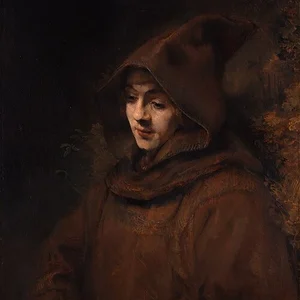
Titus appears in many of his father's paintings, depicted at various ages with unmistakable tenderness. Rembrandt painted him reading, as Saint Francis, as a monk, or simply as a melancholy young man — these portraits stand as a rare testament to a great master's paternal love for his only son.
Titus inherited from his mother Saskia a share of the estate that Rembrandt had no legal right to touch. For years, the father was legally required to account to his own son for the management of this inheritance — an awkward legal situation that vividly illustrates the family's financial troubles.
Titus married Magdalena van Loo in February 1668, a cousin of his late mother. The marriage seemed to open a new chapter for the 26-year-old. But just a few months later, in September 1668, he died suddenly — most likely from the plague — leaving his young wife pregnant. His daughter Titia was born after his death and never knew her father.
Primary Sources
The inventory drawn up in 1656 during the *cessio bonorum* proceedings lists the belongings, paintings, and household objects of Rembrandt's home, noting Titus's position as heir to his mother Saskia and creditor of his own father.
A notarial document establishing the art-dealing partnership between Hendrickje Stoffels and Titus van Rijn, with Rembrandt employed by them for his paintings and engravings, thereby shielding him from his creditors.
Entry recorded in Amsterdam in February 1668, registering the union of Titus van Rijn, painter and art dealer, with Magdalena van Loo, in the presence of family witnesses.
Titus dictated his will shortly before his death, bequeathing his estate to his wife Magdalena van Loo and their unborn child, reflecting his awareness that the end was near.
Key Places
A grand bourgeois townhouse acquired by Rembrandt in 1639, where Titus was born and spent his entire childhood. Rembrandt amassed an enormous collection of art and curiosities there before being forced to sell it during his bankruptcy in 1658; it is now the Rembrandthuis Museum.
A street in the working-class Jordaan neighbourhood where Rembrandt, Titus, and Hendrickje moved after losing their house in 1658. It was in this modest lodging that Titus ran the art-dealing partnership and lived until his death.
Amsterdam's great Reformed church, where Titus van Rijn married Magdalena van Loo in February 1668. His father Rembrandt was buried there in 1669, although the exact grave remains unknown to this day.
The economic capital of the Dutch Republic and the world centre of the art trade in the 17th century, Amsterdam was the only home Titus ever knew. He was born there, learned painting there, practised as an art dealer there, and died there at the age of 27, at the height of the Dutch Golden Age.
Typical Objects

A daily tool of Rembrandt's workshop, the wooden palette held pigments mixed with linseed oil. Animal-hair brushes allowed for both precise touches and the broad flat strokes characteristic of Dutch Baroque painting.

Seventeenth-century Dutch painters used linen canvases stretched over wooden frames and coated with a ground layer of chalk and oil. In Rembrandt's workshop, preparing supports was a task in which Titus took part from a very young age.

A commercial ledger in which the dealer recorded purchases, sales, and transactions of artworks. Titus and Hendrickje kept such a register for their trading company, logging the paintings and prints by Rembrandt sold to collectors.

The medium for acid-based printmaking, the polished copper plate was coated with a varnish into which the engraver drew his design before immersing it in acid. Rembrandt's etchings, printed in multiple impressions, formed a source of income that Titus sold commercially.

Rembrandt's workshop held a collection of exotic garments, helmets, and cloaks used as props for models. Titus himself was often painted wearing these Oriental or historical costumes for his father's biblical and allegorical compositions.

Artificial lighting played a crucial role in the painter's workshop: candles and oil lamps made it possible to work in the evening and to create the chiaroscuro effects that Rembrandt mastered with such genius. For Titus, who grew up in this environment, light was both a tool and a subject of study.
School Curriculum
Vocabulary & Tags
Key Vocabulary
Daily Life
Morning
Titus began his day early in the family workshop, helping prepare canvases, grind pigments, and arrange his father's tools. From adolescence, he regularly posed as a model for Rembrandt's biblical and historical compositions, standing still for long hours in the slanting light of the studio.
Afternoon
Afternoons were devoted to amateur painting and, from his twenties onward, to the art trade. Titus received collector clients at the Rozengracht lodging, negotiated the sale of his father's paintings and prints, and kept the accounts of the small family business in order to prevent creditor seizures.
Evening
Evenings were spent with the family in the modest Rozengracht apartment. In his youth, Titus studied the old masters through the prints and drawings in his father's collection. Later, after Hendrickje's death and the ongoing hardships, evenings were no doubt darker, shadowed by worry over his aging father's health.
Food
Like Amsterdam's craftsmen and tradespeople of modest means, Titus ate mainly rye bread, Gouda cheese, salt herring, and root vegetables. Seventeenth-century Dutch cuisine was simple but sustaining, washed down with light beer or genever for adults.
Clothing
Titus wore woollen cloth or linen, plain and practical for workshop life. The portraits his father painted of him show him sometimes in dark working clothes, sometimes dressed in elaborate costumes when serving as a model. For his marriage in 1668, he most likely wore his finest bourgeois attire — black cloth in keeping with the Reformed fashion of the Dutch middle classes.
Housing
After the sale of the large house on Jodenbreestraat in 1658, the family moved into a modest rented apartment on Rozengracht, in the working-class Jordaan neighborhood. It was a typical Amsterdam dwelling: narrow, deep, with tall windows facing the canal to let in the light so essential for painting.
Historical Timeline
Period Vocabulary
Liens externes & ressources
Références
Œuvres
Portrait d'un jeune homme (attribué à Titus van Rijn)
vers 1660
Société de négoce Stoffels & van Rijn
1660–1668
Travaux d'atelier et apprentissage auprès de Rembrandt
années 1650–1668