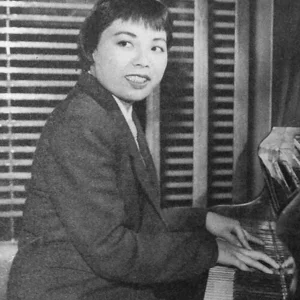

Toshiko Akiyoshi is a Japanese American jazz pianist, composer, and bandleader born in 1929. The first Japanese student at the Berklee College of Music, she has led a celebrated big band since 1973, blending American jazz with elements of traditional Japanese music.
Toshiko Akiyoshi(1929 — ?)
Toshiko Akiyoshi
États-Unis
6 min read
Frequently asked questions
Key Facts
- Born on December 12, 1929, in Liaoyang, in Manchuria, then under Japanese occupation
- Discovered by Oscar Peterson, she recorded her first album in 1953
- In 1956, she became one of the first Japanese students at the Berklee College of Music in Boston
- Founded the Toshiko Akiyoshi–Lew Tabackin Big Band in 1973, praised for its integration of Japanese motifs into jazz
- Named an NEA Jazz Master in 2007, America's highest jazz honor, and nominated several times for the Grammy Awards
Works & Achievements
First album, recorded in Tokyo thanks to Norman Granz, which revealed her talent as a bebop pianist.
The creation in Los Angeles of the orchestra that would earn her worldwide fame as a composer and bandleader.
A groundbreaking album in which she blends the jazz big band with traditional Japanese instruments and singing.
A masterwork whose title evokes the long road traveled from Japan; praised by critics.
A suite inspired by old Japan, illustrating her desire to tell stories through music.
An album containing the suite “Minamata,” which evokes the tragedy of mercury poisoning in Japan; nominated for a Grammy.
Anecdotes
In 1953, the great Canadian pianist Oscar Peterson, passing through Tokyo on tour, happened to hear the young Toshiko playing in a club. Amazed, he convinced producer Norman Granz to record her right away. This first record launched her career and opened the doors to the United States.
In 1956, Toshiko received a scholarship to the Berklee College of Music in Boston and became the first Japanese student at this famous jazz school. Leaving postwar Japan alone for America was a bold adventure for a young woman of the time.
In 1974, she composed “Kogun” (“the one-man army”), inspired by the Japanese soldier Hiroo Onoda, who had just emerged from the Philippine jungle after continuing to fight for nearly thirty years, unaware that the war was over. To evoke Japan, she had her American big band play traditional tsuzumi drums and chants from Noh theater.
Toshiko Akiyoshi was one of the first to blend classical Japanese instruments with a large jazz orchestra, creating a unique sound that told the story of both America and her native country.
Over the course of her career, she was nominated fourteen times for the Grammy Awards. She was also the first woman to be voted best arranger and best composer in the polls of the prestigious jazz magazine DownBeat.
Primary Sources
“Jazz is my native language”: the film's title borrows the phrase Akiyoshi uses to describe her intimate bond with this music, which she regards as her most natural means of expression.
In her memoirs, Akiyoshi recounts her childhood in Manchuria, her family's repatriation to Japan in 1946, and her discovery of jazz, which became the center of her entire life.
Akiyoshi explains that in “Kogun” she sought to bring the American jazz big band into dialogue with the sounds of the tsuzumi drum and nō singing in order to express a deeply Japanese emotion.
Key Places
City in Japanese-occupied Manchuria where Toshiko Akiyoshi was born in 1929 into a Japanese family.
City where her family settled after the 1946 repatriation; it was there that she began playing jazz piano.
Capital where she performed in clubs during the 1950s and where Oscar Peterson discovered her.
Jazz school she entered in 1956 as its first Japanese student.
City where she founded her big band with Lew Tabackin in 1973.
Jazz capital where she settled in 1982 and reformed her orchestra, performing in clubs such as the Village Vanguard.
Typical Objects

Toshiko Akiyoshi's central instrument, used both for her virtuoso solos and for composing her big band arrangements.
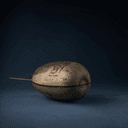
A small Japanese hand drum from nō theater that she introduced into her jazz orchestra, notably in “Kogun”.

On these sheets, she wrote out by hand the part for each musician in the big band, the heart of her work as an arranger.

The medium for her major albums such as “Kogun” and “Long Yellow Road”, which spread her music around the world.

From the piano, she led her big band, coordinating the brass, reed, and rhythm sections.

A traditional Japanese garment she sometimes wore in concert to assert her dual cultural heritage.
School Curriculum
Vocabulary & Tags
Key Vocabulary
Tags
Daily Life
Morning
Early in the morning, in the quiet, Toshiko Akiyoshi sits at the piano to compose and write out her arrangements by hand, note by note, for each instrument in the orchestra. The morning is devoted to this solitary, painstaking work of musical writing.
Afternoon
In the afternoon, she leads rehearsals of her big band, balancing the brass, reed, and rhythm sections. She runs through the difficult passages again and again until she achieves the exact sound she imagines.
Evening
In the evening, she performs in concert, at renowned clubs such as the Village Vanguard in New York or on major stages. A musician's evenings often stretch late into the night.
Food
Her life as a touring musician takes her back and forth between Japan and America, with meals that are often irregular between shows. She keeps her taste for Japanese cuisine while adapting to American life.
Clothing
On stage, she favors elegant, polished outfits. To highlight her dual heritage, she sometimes wears a traditional Japanese kimono for important concerts.
Housing
She lives in apartments in major American cities, in Los Angeles and then New York, generally close to the clubs and venues where her orchestra rehearses and plays.