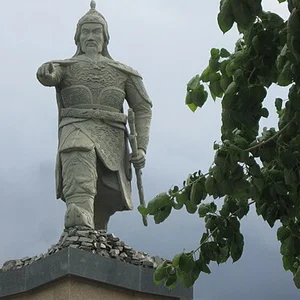

Vietnamese prince and great general of the Trần dynasty (c. 1228–1300), he commanded the armies of Đại Việt during the three Mongol-Yuan invasions (1258, 1285, 1288) and repelled each one, most notably through the decisive victory on the Bạch Đằng River.
Trần Hưng Đạo(1228 — 1300)
Trần Hưng Đạo
Đại Việt
9 min read
Frequently asked questions
Famous Quotes
« Phải khoan thư sức dân để làm kế sâu rễ bền gốc. [The burden of the people must be lightened — this is the lasting foundation of the nation.] (advice to Trần Anh Tông before his death, 1300) [1]»
« Năm nay đánh giặc nhàn. [This year, fighting the enemy will be easy.] (reply to King Trần Nhân Tông before the third Yuan invasion, 1287–1288) [1]»
Key Facts
- Born c. 1228 in Tức Mặc (Ninh Bình province); son of Prince An Sinh Vương Trần Liễu, nephew of King Trần Thái Tông [1]
- 1257: appointed general tasked with defending the northern frontier ahead of the first Mongol invasion (December 1257–January 1258) [1]
- 1283: promoted to Quốc công tiết chế (supreme commander) to coordinate resistance against the second Yuan invasion; victories at Hàm Tử, Chương Dương, and Vạn Kiếp (1285) [1]
- 1288: third Yuan invasion repelled; the Mongol-Yuan fleet was destroyed on the Bạch Đằng River using submerged stakes, drawing on the tactic pioneered by Ngô Quyền [1]
- Died 5 October 1300 at Vạn Kiếp; deified by the people under the name Đức Thánh Trần; author of the Hịch tướng sĩ (proclamation to the officers) and the Binh thư yếu lược (military treatise) [1]
Works & Achievements
A stirring patriotic appeal addressed to his officers before the second Yuan invasion, urging them to sacrifice themselves for their homeland. Considered a masterpiece of classical Vietnamese prose in chữ Hán, it is still studied in schools today.
A treatise on military strategy and tactics laying the foundations of the art of war in medieval Vietnam, shaped by the experience of three wars against the Mongol-Yuan forces.
A military strategy treatise passed down to his disciples at Vạn Kiếp; together with the *Binh thư yếu lược*, it forms one of the cornerstones of Trần dynasty military thought.
His greatest historical achievement: repelling three invasions by the most powerful army of his era, preserving the independence of Đại Việt and making him one of the most revered figures of national resistance in Vietnamese history.
Anecdotes
In 1237, the all-powerful regent Trần Thủ Độ forced Trần Quốc Tuấn's father, Prince Trần Liễu, to surrender his own wife — three months pregnant — to King Trần Thái Tông, who had no heir. Humiliated, Trần Liễu raised troops in rebellion, but was crushed and forced to submit. This family injustice would weigh on Trần Quốc Tuấn for the rest of his life.
Smitten with his cousin Princess Thiên Thành, whom the king had promised to another, the young Trần Quốc Tuấn slipped into her chambers under cover of night. His adoptive mother, Princess Thụy Bà, immediately alerted the palace to protect him. King Trần Thái Tông, faced with a fait accompli, consented to the marriage and compensated the other suitor with 2,000 rice fields.
On his deathbed in 1251
his father Trần Liễu seized his hand and whispered:
If you do not reclaim the throne for your father, I will not be able to rest in peace beneath the earth." Trần Quốc Tuấn etched those words into his memory, but chose to serve the crown with loyalty rather than seek revenge — a decision that, according to the chronicles, would one day save the country's independence.
Before the third Mongol-Yuan invasion in 1288
King Trần Nhân Tông was anxious about the outcome of the conflict. Trần Hưng Đạo reassured him with calm confidence:
This year, fighting the enemy will be an easy matter." He kept his promise by applying the tactics of Ngô Quyền: iron-tipped wooden stakes driven into the Bạch Đằng River tore apart the Yuan fleet as the tide went out.
Before his death in October 1300
Trần Hưng Đạo left King Trần Anh Tông this counsel on governance:
You must husband the strength of the people so that the roots run deep and the trunk stands firm." This phrase, preserved in the Vietnamese chronicles, sums up his philosophy: the power of a state rests on the well-being of its people, not on military force alone.
Primary Sources
Tháng 9 - 1257, vua Trần Thái Tông xuống chiếu, lệnh cho tả hữu tướng quân đem quân thủy bộ ra ngăn giữ biên giới phía Bắc theo sự tiết chế của Quốc Tuấn. (In September 1257, the king issued a decree ordering his generals to guard the northern border under the command of Quốc Tuấn.)
A patriotic appeal written by Trần Hưng Đạo before the second Yuan invasion (1285), urging his officers to defend Đại Việt with courage and resist the enemy's promises of reward. It is considered a masterpiece of classical Vietnamese prose.
A treatise on military strategy and tactics written by Trần Hưng Đạo, cited in the annals as one of his foundational intellectual contributions to the Vietnamese art of war.
The Chinese annals of the Yuan dynasty record the three military expeditions against Đại Việt and their failures, confirming through enemy sources themselves the scale of the Mongol defeats.
A military strategy treatise attributed to Trần Hưng Đạo and passed down to his disciples at Vạn Kiếp; cited in the annals as one of the foundations of the military school of the Trần dynasty.
Key Places
Birthplace of Trần Quốc Tuấn, located in the Thiên Trường region — the cradle of the Trần dynasty — in northern present-day Vietnam (Nam Định province).
The thái ấp (lordly estate) of Trần Hưng Đạo, where he resided between military campaigns, recruited his lieutenants (Phạm Ngũ Lão, Yết Kiêu…), wrote his treatises, and died in 1300. A temple dedicated to him still stands there.
A coastal river in northeastern Vietnam where the decisive battle of 1288 took place: Trần Hưng Đạo destroyed the Yuan fleet there using the stratagem of submerged stakes, forcing the Mongol-Yuan forces to withdraw for good.
Capital of Đại Việt, evacuated and then recaptured during each of the three Mongol-Yuan invasions. Trần Hưng Đạo coordinated military operations there with the Trần court and received his official appointments.
Typical Objects

Emblematic weapon of the medieval Vietnamese general and prince, carried both in battle and at military ceremonies. It symbolizes the authority of command and the legitimacy to lead the armies of Đại Việt.

Writing medium used to compose the Hịch tướng sĩ and military treatises. In 13th-century Vietnam, official and strategic texts were written in chữ Hán (classical Chinese characters).

Hundreds of sharpened, iron-tipped stakes driven into the bed of the Bạch Đằng River before the 1288 battle, designed to impale Yuan warships as the tide receded. This stratagem, inherited from Ngô Quyền, was the key to the decisive victory recorded in the chronicles.

Armor made of metal plates or lacquered leather worn by Trần dynasty generals in battle. It protected the body while signaling the rank and role of the commander on the battlefield.

Large banner bearing the insignia of the prince-general, raised to direct troop movements on the battlefield and mark the position of the command post. Essential for coordinating tens of thousands of men.

Percussion instrument of wood and stretched hide used to relay orders in battle — advance, retreat, change of formation. Indispensable in river battles such as Bạch Đằng, where vocal communication was impossible over long distances.
School Curriculum
Vocabulary & Tags
Key Vocabulary
Daily Life
Morning
At his estate in Vạn Kiếp, Trần Hưng Đạo began his day by inspecting military training. He had turned his *thái ấp* into a recruitment and training center where he welcomed talented men such as Phạm Ngũ Lão, Yết Kiêu, Dã Tượng, and Đỗ Hành, sought out from across the country.
Afternoon
Afternoons were devoted to strategy and the drafting of his military treatises. The annals record that he regularly toured different regions to inspect local military schools (*giảng võ đường*) and assess the troops' readiness for resistance.
Evening
The details of his evenings are not documented in available sources. His written output (*Hịch tướng sĩ*, *Binh thư yếu lược*, *Vạn Kiếp tông bí truyền thư*) nonetheless bears witness to an intense intellectual life and deep study of the art of war.
Food
Trần Hưng Đạo's day-to-day diet is not detailed in available primary sources. The Trần aristocracy of the 13th century subsisted mainly on rice, Red River fish, vegetables, and broths — a typical diet of medieval northern Vietnam.
Clothing
As a prince (*vương*) and supreme commander, he wore lacquered armor and a helmet in battle, and embroidered silk robes in the colors of the Trần dynasty for court ceremonies. The details of his everyday attire at Vạn Kiếp are not documented in available sources.
Housing
He resided at his *thái ấp* (lordly estate) of Vạn Kiếp, a vast property comprising residences, military schools, and farmland. The annals (*Đại Việt sử ký toàn thư*) record that he returned there regularly between stays at the capital, in keeping with the custom of Trần princes.
Historical Timeline
Period Vocabulary
Liens externes & ressources
Références
Œuvres
Hịch tướng sĩ (Proclamation aux généraux et soldats)
vers 1284-1285
Binh thư yếu lược (Précis d'art militaire)
fin XIIIe siècle
Vạn Kiếp tông bí truyền thư (Livre secret de l'école de Vạn Kiếp)
fin XIIIe siècle
Commandement des trois guerres contre les Yuan (1258, 1285, 1288)
1258-1288