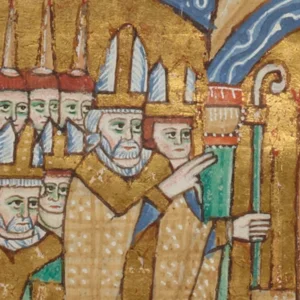

Pope from 1088 to 1099, Urban II was the instigator of the First Crusade, proclaimed at the Council of Clermont in 1095. A Cluniac monk of French origin, he strengthened papal authority and continued the Gregorian Reform of the Church.
Urban II(1035 — 1099)
Urban II
8 min read
Frequently asked questions
Key Facts
- Born around 1042 in Châtillon-sur-Marne, he was the first French pope to come from the Cluniac order
- Elected pope in 1088, he succeeded Gregory VII and continued the reform of the Church against simony and nicolaitism
- In November 1095, at the Council of Clermont, he called on the Christians of the West to liberate Jerusalem — the founding act of the First Crusade
- The crowd responded to his speech with the cry 'God wills it!', which became the rallying cry of the Crusaders
- He died on 29 July 1099, fifteen days after the capture of Jerusalem, without having learned the news; he was beatified in 1881
Works & Achievements
A landmark speech that mobilized tens of thousands of warriors and pilgrims toward Jerusalem. It was the most resounding political and religious act of Urban II's pontificate, and the founding moment of the Crusade movement.
A set of disciplinary reforms aimed at eradicating simony and nicolaitism within the clergy. This council laid the groundwork for Urban II's reforming agenda, following in the footsteps of Gregory VII.
An assembly at which Urban II received Byzantine delegates and established the theological conditions for military aid to the Christian East. This council directly paved the way for the call at Clermont.
A corpus of several hundred official letters shaping papal policy: clerical reform, organization of the Crusade, and relations with European rulers. An essential source for understanding the governance of the Church at the end of the 11th century.
Urban II strengthened the role of cardinals as advisors and papal legates, helping to centralize the governance of the Church around Rome. This institutional reform had lasting effects on the papal monarchy.
Anecdotes
At the Council of Clermont in November 1095, Urban II delivered such a fiery speech calling for the liberation of Jerusalem that the crowd spontaneously interrupted him, crying out 'Deus lo volt!' ('God wills it!'). This cry instantly became the rallying call of all the Crusaders, repeated on every battlefield all the way to Jerusalem.
Urban II died on July 29, 1099 — just fourteen days after the Crusaders captured Jerusalem on July 15, 1099. He never learned that his call had succeeded: the messengers carrying the news had not yet reached Rome when he drew his last breath.
Born Odo of Châtillon, from a noble family in Champagne, he entered the monastery of Cluny and became one of the close collaborators of Abbot Hugh of Cluny. This Cluniac formation deeply shaped his papacy: he made the moral and disciplinary reform of the Church the great cause of his reign.
For much of his papacy, Urban II was driven out of Rome by the antipope Clement III, backed by Emperor Henry IV. He was forced to wander from one Italian city to another, governing the Church from exile — which earned him the reputation of a tireless, combative pope who never resigned himself to yielding to imperial power.
Urban II was the first pope to travel through France in person to preach the Crusade. This journey of 1095–1096, which took him from Clermont to the Pyrenees, was an unprecedented pastoral and political tour during which he consecrated churches, convened synods, and rallied feudal lords for the expedition to the Holy Land.
Primary Sources
The pope said: 'Let those who have hitherto been robbers now become soldiers of Christ. Let those who once fought against their brothers and kinsmen now rightfully fight against the barbarians. Let those who have been mercenaries for small wages now obtain an eternal reward.'
Urban II declared: 'Let the Holy Land, which the Lord our God made illustrious by His birth, adorned by His life, consecrated by His Passion, redeemed by His death, and glorified by His burial, be purified. Set out on the road to the Holy Sepulchre, wrest that land from the wicked races, and make it your own.'
Urban II writes: 'We urge and entreat — not we ourselves, but the Lord — that the poor of Christ make haste to the Holy Places and liberate Jerusalem from the tyranny of the Saracen peoples.'
Canon I: 'Whoever sets out for Jerusalem out of devotion alone, and not to gain honor or wealth, but for the liberation of the Church of God, let that journey be counted as full penance for him.'
The author reports that Urban II, in convening the Council of Clermont, had already received ambassadors from the Byzantine emperor Alexios I Komnenos, who was appealing to him for armed assistance against the Seljuk Turks threatening Constantinople.
Key Places
It was here, in November 1095, that Urban II delivered his famous speech at the council calling for the First Crusade. The cathedral square was the stage for one of the most influential addresses in medieval history.
A major center of monastic reform in Burgundy, where Urban II entered as a monk and was shaped by the reformist spirituality of the community. He became prior there before being summoned to Rome by Gregory VII.
The official residence of the popes in the Middle Ages and the seat of Church governance. Urban II resided there once he was finally able to reclaim Rome, in his struggle against the imperial antipope.
A village in Champagne where Odo of Châtillon, the future Urban II, was born around 1042. A statue of the pope still overlooks the Marne valley there, a lasting reminder of the Champenois origins of the man who launched the Crusades.
The spiritual and military objective of the crusade launched by Urban II. The city was captured in 1099, just days before his death, fulfilling the vow he had made at Clermont.
Typical Objects

A triple-crowned headdress symbolizing the pope's spiritual, temporal, and ecclesiastical authority. Urban II wore it during major ceremonies such as the Council of Clermont.

An official document sealed with a lead seal (bulla) through which the pope proclaimed laws, crusades, and reforms. Urban II issued hundreds of them, including those summoning the crusaders.

A large cross carried at the head of papal processions and crusading armies. It symbolized the sacred mission of the crusade preached by Urban II.

The black woolen robe of the Order of Cluny, worn by Urban II before his election as pope. It was a reminder of his monastic origins and his commitment to strict reforming principles.

The distinctive emblem adopted by the crusaders on the recommendation of Urban II himself at the Council of Clermont. A symbol of Christ's sacrifice, it marked each crusader's solemn vow.

The papal ring depicting Saint Peter fishing, used to seal confidential documents. It symbolized the apostolic succession claimed by Urban II as the foundation of his reform program.
School Curriculum
Vocabulary & Tags
Key Vocabulary
Tags
Daily Life
Morning
Urban II rose before dawn to chant Matins and Lauds with his chaplains, in keeping with the Benedictine rule he had learned at Cluny. He would then celebrate a pontifical Mass, often in the presence of the curial household, before turning to the letters received from legates and bishops across Europe.
Afternoon
His afternoons were devoted to audiences and councils: receiving ambassadors, deliberating with cardinals on Church affairs, and drafting or dictating papal bulls and apostolic letters. During councils, he presided over sessions of theological and disciplinary debate.
Evening
After None and Vespers, Urban II shared a frugal meal at the common table with his closest collaborators, then withdrew for lectio divina or the study of patristic texts. Compline closed his day in the silence of the palatine chapel.
Food
True to his monastic origins, Urban II strictly observed the fasting and abstinence days prescribed by the Church — roughly half the year. His regular diet consisted of legumes, dark bread, fish, vegetables, and seasonal fruits, with wine diluted with water at communal meals.
Clothing
As pope, Urban II wore the white pontifical alb, the blood-red cope for ceremonies, and the mitre on major liturgical occasions. While travelling, he added a plainer travelling cope; in private, he sometimes kept to the black habit of the Cluniac monks.
Housing
In Rome, Urban II resided at the Lateran Palace, the traditional seat of the papacy. Driven out by the imperial antipope, he spent long months in episcopal palaces in southern Italy and Campania. During his great tour of France (1095–1096), he lodged in abbeys and episcopal residences along his route.
Historical Timeline
Period Vocabulary
Visual Style
Style art roman tardif aux enluminures dorées, entre solennité pontificale et élan mystique des croisades, dominé par l'or, le cramoisi et le bleu lapis-lazuli.
Sound Ambience
Ambiance sonore mêlant le recueillement liturgique des monastères clunisiens et la ferveur collective du concile de Clermont, entre chant grégorien et clameurs de foule.