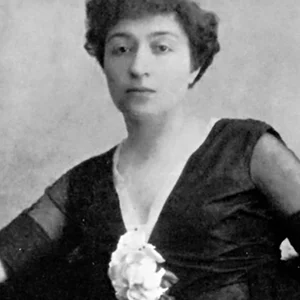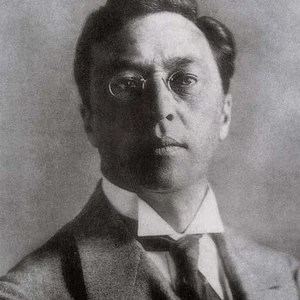

Russian-born painter who was naturalized German and then French (1866–1944), Kandinsky is one of the pioneers of abstract art. He theorized the connection between color, form, and emotion, laying the groundwork for a radically new aesthetic.
Vassily Kandinsky(1866 — 1944)
Vassily Kandinsky
France, Allemagne, république socialiste fédérative soviétique de Russie, Union soviétique, Empire russe
8 min read
Frequently asked questions
Famous Quotes
« Color is a power which directly influences the soul.»
« Concerning the Spiritual in Art.»
Key Facts
- 1866: born in Moscow
- 1910: painted one of the first abstract works in the history of art
- 1911: co-founded the Der Blaue Reiter (The Blue Rider) group in Munich
- 1922–1933: taught at the Bauhaus in Weimar and then Dessau
- 1944: died in Neuilly-sur-Seine
Works & Achievements
A foundational theoretical treatise in which Kandinsky sets out the relationship between color, form, and inner emotion. This text stands as the manifesto of abstract art and remains an essential reference for understanding the avant-garde movements of the 20th century.
A monumental canvas (200 × 300 cm) considered the masterpiece of Kandinsky's pre-Bauhaus period. An explosion of colors and swirling forms, it is the result of dozens of preparatory studies and embodies the fullness of lyrical abstraction.
Painted after a concert of atonal music by Arnold Schoenberg, this canvas translates into color — dominated by a blazing yellow — the emotion felt while listening. It perfectly illustrates Kandinsky's synesthesia and his search for equivalences between sounds and images.
An iconic work of his Bauhaus period, built from geometric shapes — circles, lines, triangles — skillfully arranged. It reflects Kandinsky's shift toward a more rigorous and analytical abstraction.
A large composition featuring the three primary colors so central to Kandinsky's vision, along with their symbolic meanings: aggressive yellow, balanced red, and deep, spiritual blue. It synthesizes his theory of color as developed during his Bauhaus years.
Kandinsky's second major theoretical treatise, drawn from his teaching at the Bauhaus. In it, he analyzes the plastic and expressive properties of fundamental graphic elements, laying the foundations for an abstract visual grammar.
A composition centered on circles of varying sizes and colors, representing for Kandinsky the most perfect and most spiritual of all forms. This work illustrates his passion for geometric precision combined with vibrant chromatic richness.
Anecdotes
Kandinsky suffered from synesthesia: he perceived colors as sounds and sounds as colors. At the age of 30, attending a performance of Wagner's *Lohengrin* in Moscow, he saw a parade of intense colors and vibrant forms in his mind. This experience founded his conviction that painting and music shared the same universal language of emotions.
In 1896, Kandinsky visited an Impressionist exhibition in Moscow where one of Monet's paintings of a haystack was on display. He was deeply moved: he only recognized the subject by reading the label, so vividly did the painting seem to glow with its own inner light. That moment sparked his artistic calling — he was 30 years old and had a promising career as a lawyer.
One evening in 1908, Kandinsky returned to his Munich studio at nightfall and spotted a canvas resting on the floor, radiating an extraordinary beauty of colors and forms. He stepped closer and realized it was one of his own works, seen upside down. This revelation convinced him that figurative representation was unnecessary: color and form alone were enough to move the viewer.
In 1933, the Nazis shut down the Bauhaus, the art and design school where Kandinsky had been teaching since 1922. His works were branded “degenerate art” (*Entartete Kunst*) and displayed in a 1937 Nazi exhibition designed to ridicule them. Kandinsky had already fled to France and obtained French citizenship in 1939, ending his life in Neuilly-sur-Seine.
Kandinsky was also an accomplished cellist and pianist. He considered music the purest of the arts because it imitated nothing in the visible world and acted directly on the soul. It was in seeking to give painting that same power of abstraction that he developed his series of Impressions, Improvisations, and Compositions — terms borrowed directly from the vocabulary of music.
Primary Sources
Color is a means of exerting direct influence upon the soul. Color is the keyboard, the eyes are the hammers, and the soul is the piano with many strings.
I now knew for certain that the object was harmful to my paintings. A terrifying abyss opened before me, accompanied by all manner of dizzying questions of infinite responsibility.
The point is the most concise form. In its highest meaning, it is a unity that contains within itself the tension of a condensed force.
In your works, you have achieved what I have longed for so deeply in music: an autonomous life independent of all connection with nature.
We draw a temporal boundary and show through our examples how inner aspiration expresses itself in the most varied forms.
Key Places
Kandinsky's birthplace, where he grew up in a cultivated environment and to which he returned during the First World War. His memories of the golden domes and Russian folk festivals always nourished his sense of colour.
Kandinsky lived here from 1896 to 1914 and laid the foundations of abstract art. It was here that he founded the **Der Blaue Reiter** group in 1911 and published his treatise *Concerning the Spiritual in Art*.
A small Alpine village where Kandinsky stayed frequently with Gabriele Münter from 1908 onwards. Its luminous landscapes and Bavarian decorative traditions accelerated his liberation from figurative representation.
Kandinsky taught here from 1922 to 1933, leading the preliminary course on colour and the mural painting workshop. This legendary school brought together the finest artists and architects of the era, and gave rise to his treatise *Point and Line to Plane*.
Kandinsky's final place of exile and creation from 1933 onwards. He obtained French citizenship here in 1939 and died on **13 December 1944**, continuing to paint organic, colourful compositions until the very end.