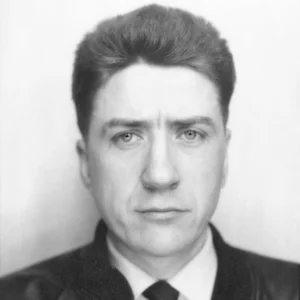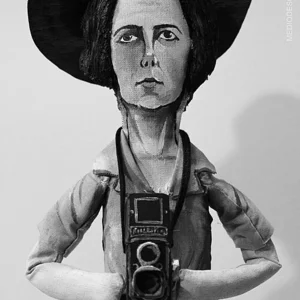

Vivian Maier was an American photographer who earned her living as a nanny in New York and Chicago while taking tens of thousands of street photographs that remained secret. Her body of work, discovered by chance shortly before her death, revealed her as a major figure in street photography.
Vivian Maier(1926 — 2009)
Vivian Maier
États-Unis, France
6 min read
Frequently asked questions
Key Facts
- Born in 1926 in New York, she spent part of her childhood in France
- Worked as a nanny in Chicago from the 1950s onward while photographing the street
- Took more than 150,000 photographs over the course of her life, never exhibited during her lifetime
- Her negatives were bought at auction in 2007 by John Maloof, who revealed her work
- Died in 2009 in Chicago, shortly before her work gained worldwide recognition
Works & Achievements
Series of self-portraits captured in shop windows, mirrors and shadows, which became the visual signature of her work.
Scenes of New York City life, candid portraits of passers-by, children and outsiders caught in the moment.
A vast documentation of the city of Chicago, its working-class neighborhoods and its inhabitants.
Short amateur films of street scenes that extended her photographer's eye into moving images.
The first posthumous collection of her prints, which revealed her to audiences worldwide.
A photographic record made during a solo trip around the world, from Asia to the Middle East and Europe.
Anecdotes
Vivian Maier worked for decades as a nanny for affluent families in the suburbs of Chicago, her Rolleiflex always hanging around her neck. The children she looked after remember that she took them into working-class neighborhoods and even to the slaughterhouses to photograph the street, without ever showing her images to anyone.
Her work was discovered by chance in 2007: a young Chicago real estate agent, John Maloof, bought a box of negatives at auction for about 380 dollars because the owner had failed to pay the rent on the storage locker. He had no idea who the photographer was.
When she died in 2009, Maier left behind more than 100,000 to 150,000 negatives, including thousands of rolls that had never been developed. During her lifetime she had printed only a tiny fraction of her work on paper and had never sought to exhibit or sell it.
Maier produced a great many self-portraits by capturing her reflection in shop windows, mirrors, and the shadows cast on the sidewalk. This visual signature has become one of the most recognizable hallmarks of her work.
Intensely private, she sometimes used false names (such as “V. Smith”) and gave deliberately vague details about her origins, even though she had been born in New York and had spent part of her childhood in France, in the Hautes-Alpes.
Primary Sources
The book gathers the first prints made from the negatives bought at auction in Chicago, introducing the public to a photographer who remained unknown during her lifetime.
The film collects the testimonies of the families and the children Maier looked after, portraying an enigmatic, cultured woman deeply attached to her camera.
The former children she cared for recount her long photographic walks and her refusal to let anyone enter her room, which was cluttered with boxes and newspapers.
Key Places
Vivian Maier's birthplace, where she began street photography in the early 1950s, roaming the working-class neighborhoods of Manhattan.
The city where Maier worked as a nanny for decades, photographed intensely, and died in obscurity in 2009.
A village in the French Alps tied to Maier's maternal family, where she spent part of her childhood and later returned to photograph.
An affluent suburb where Maier was employed by the Gensburg family, who took her in and supported her until the end of her life.
Liens externes & ressources
Références
Œuvres
Autoportraits dans les reflets
années 1950-1970
Photographies de rue de New York
années 1950
Photographies de rue de Chicago
années 1956-1970
Vivian Maier: Street Photographer (livre)
2011
Voyage autour du monde
1959-1960