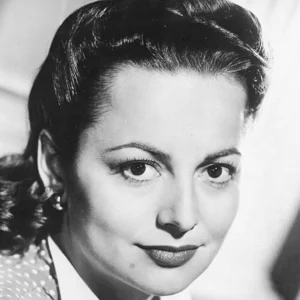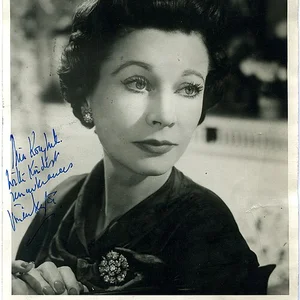

British actress born in 1913, Vivien Leigh is world-famous for her role as Scarlett O'Hara in Gone with the Wind (1939). A two-time Oscar winner, she embodied Hollywood glamour while also pursuing a demanding stage career in London.
Vivien Leigh(1913 — 1967)
Vivien Leigh
Royaume-Uni
7 min read
Frequently asked questions
Famous Quotes
« "I'm not a star. I'm an actress."»
Key Facts
- 1913: Born in Darjeeling, British India
- 1939: Role of Scarlett O'Hara in Gone with the Wind, first Academy Award for Best Actress
- 1951: Second Oscar for A Streetcar Named Desire, an adaptation of Tennessee Williams's play
- 1940–1960: Stage career in London's West End alongside her husband Laurence Olivier
- 1967: Died in London of tuberculosis at the age of 53
Works & Achievements
Victor Fleming's film in which Vivien Leigh plays Scarlett O'Hara, a role that earned her her first Academy Award and instant worldwide fame. Considered one of the greatest films in cinema history.
Elia Kazan's film adaptation of Tennessee Williams's play, in which Leigh portrays Blanche DuBois with shattering intensity, earning her second Academy Award for Best Actress.
Alexander Korda's British film in which Vivien Leigh plays Emma Hamilton opposite Laurence Olivier; a pro-British propaganda film that achieved great success during the war.
An adaptation of Tolstoy's novel in which Leigh portrays the tragic Russian heroine, confirming her ability to inhabit characters of great emotional complexity.
A romantic comedy directed by and starring Laurence Olivier, in which Vivien Leigh does not act but served as producer; it reveals her role behind the scenes of British cinema.
One of her final films, in which she portrays an aging woman with poignant clarity, celebrated as one of her finest performances in her later career.
Anecdotes
During the filming of Gone with the Wind in 1939, Vivien Leigh was chosen for the role of Scarlett O'Hara from over 1,400 candidates auditioned over two years. Producer David O. Selznick had never seen her perform when he met her on set the very night the burning of Atlanta was being filmed — he was immediately convinced she was the one.
Vivien Leigh suffered from bipolar disorder at a time when the condition was poorly understood and heavily stigmatized. Despite recurring episodes that disrupted her filming schedules and personal life, she often refused to stop working, honoring her professional commitments with remarkable determination.
Deeply devoted to classical theater, Vivien Leigh played Lady Macbeth and Cleopatra alongside her husband Laurence Olivier in the 1950s. Critics praised her stage commitment, even as she lived in the shadow of the Shakespearean giant that Olivier was — a comparison she carried with grace.
During World War II, Vivien Leigh and Laurence Olivier took part in tours to boost the morale of British troops. Despite the worldwide fame she had just gained through Hollywood, she remained deeply attached to her British identity and to her country's war effort.
Her performance in A Streetcar Named Desire (1951) earned her a second Academy Award, an exceptionally rare achievement for a British actress in Hollywood. Director Elia Kazan later recalled that she had immersed herself so deeply in the character of Blanche DuBois that the filming had worsened her mental fragility.
Primary Sources
I am Scarlett. I know you don't believe it yet, but when you see the film, you'll understand why this role could only ever belong to me.
I never wanted to be a movie star. I wanted to be an actress. Hollywood gave me fame, but the theatre gave me my soul.
Miss Leigh possesses a dramatic intensity and a beauty that transcend the screen. She IS Scarlett O'Hara, and there is no need to look any further.
Vivien carried within her a light and a darkness that very few actors ever know. Her illness was the cruel shadow side of her genius.
Key Places
Vivien Leigh's birthplace in 1913, then part of British India. Her Indian childhood shaped her cosmopolitan personality and lifelong fascination with the exotic.
A country estate acquired with Laurence Olivier in 1944, used as a retreat and a venue for lavish gatherings attended by the British cultural elite.
The legendary home of British theatre where Vivien Leigh performed the greatest classical roles, notably under Laurence Olivier's direction in the 1940s and 1950s.
The filming location for Gone with the Wind in 1939, where Vivien Leigh achieved worldwide stardom and became one of Hollywood's greatest stars.
Vivien Leigh's London residence in her final years, a prestigious address in the Belgravia district where she died in July 1967.
Typical Objects

A symbol of 1940s Hollywood glamour, this type of dress embodied the character of Scarlett O'Hara and the refined public image Vivien Leigh projected on every occasion.

Leigh worked her roles meticulously, covering her scripts with handwritten notes; her annotated copies bear witness to the rigor with which she approached every character.

A central fixture of any theatrical career, the dressing room mirror accompanied Vivien Leigh in her daily preparations on the stages of London's West End and Broadway.

Vivien Leigh won two Academy Awards for Best Actress — a remarkably rare distinction that symbolizes her double triumph in Hollywood, the first in 1940 and the second in 1952.

An iconic accessory of feminine elegance in the 1940s–1960s, frequently associated with Leigh's public image at social and high-society appearances.

An avid traveler, Leigh often accompanied Olivier on international tours; her personal journals reflect a life shared between London, Hollywood, and stages around the world.
School Curriculum
Vocabulary & Tags
Key Vocabulary
Tags
Daily Life
Morning
Vivien Leigh rose early, even during the most demanding shoots, spending an hour on her grooming and beauty routine with meticulous care. She read the London newspapers and answered her correspondence before leaving her room. Her sleep was often disrupted by episodes of bipolar disorder, which brought on nights of intense insomnia.
Afternoon
Afternoons were generally devoted to theatre rehearsals or filming, where Leigh was renowned for her professionalism and high standards. Between scenes, she would review her lines and discuss interpretation with fellow cast members or the director. She also found time to receive visitors in her dressing room, where she maintained a welcoming and cultured atmosphere.
Evening
Leigh's evenings were often social affairs: dinners out with figures from the arts world, theatre performances, or private screenings. At Notley Abbey, she hosted elaborate gatherings for the British intelligentsia, attended by writers, painters, and actors. During periods of solitude or crisis, she would spend her evenings reading classic plays or listening to music.
Food
Vivien Leigh ate very little, which frequently worried those around her, especially during intense periods of filming. She had a fondness for French cuisine and elaborate meals on social occasions, but in daily life she kept to a light diet. Her tuberculosis and chronic health problems had a strong influence on her eating habits.
Clothing
Vivien Leigh was considered one of the best-dressed women of her era, wearing creations by the greatest British and French couturiers, including Hardy Amies. On stage and on screen she wore elaborate period costumes, but in everyday life she favoured classic outfits of understated, refined elegance. Her eye for sartorial detail was legendary among her costume designers.
Housing
The Leigh-Olivier couple lived at Notley Abbey, a restored medieval abbey in Oxfordshire that stood as a symbol of their success and their place at the pinnacle of British culture. The interior blended antique furniture, Old Master paintings, and well-stocked bookshelves, reflecting Vivien Leigh's refined taste in the arts. After her divorce, she lived in an elegant flat on Eaton Square, in the fashionable Belgravia district of London.
Historical Timeline
Period Vocabulary
Visual Style
Le style visuel de Vivien Leigh associe le glamour Technicolor d'Hollywood à l'élégance classique du théâtre britannique, dominé par des tons profonds et des lumières dramatiques.
Sound Ambience
L'univers sonore de Vivien Leigh mêle le bourdonnement des plateaux hollywoodiens des années 1940 aux applaudissements des grandes scènes londoniennes du West End.
Liens externes & ressources
Références
Œuvres
Anna Karénine
1948