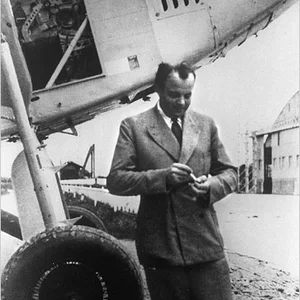

French writer and aviator (1900–1944), Antoine de Saint-Exupéry left a lasting mark on 20th-century literature through his poetic and philosophical works. Author of the celebrated The Little Prince, he also explored themes of commitment, friendship, and self-transcendence through his tales of aerial adventure.
Antoine de Saint-Exupéry(1900 — 1944)
Antoine de Saint-Exupéry
France
7 min read
Frequently asked questions
Famous Quotes
« It is only with the heart that one can see rightly; what is essential is invisible to the eye.»
« Love does not consist of gazing at each other, but in looking outward together in the same direction.»
« I am responsible for my rose.»
Key Facts
- 1926: Joins the Aéropostale, begins his career as a pilot
- 1931: Publication of Night Flight, a novel about the dangers of airmail transport
- 1943: Publication of The Little Prince, a philosophical allegory translated into more than 300 languages
- 1944: Disappears on an aerial mission over the Mediterranean during World War II
- Wrote several other major works: Southern Mail (1929), Wind, Sand and Stars (1939)
Works & Achievements
Saint-Exupéry's first novel, inspired by his experience as a pilot on the Toulouse-Dakar route. It already blends aerial adventure with meditation on the human condition.
A narrative dedicated to the Aéropostale's night flights in South America, with a preface by André Gide. Winner of the Prix Femina, it introduced Saint-Exupéry to the general public.
A collection of autobiographical accounts about aviation and the desert, awarded the Grand Prix du roman de l'Académie française. The work contains celebrated passages on human fellowship.
A testimony about a suicidal reconnaissance mission during the collapse of June 1940. Published in New York, the book was banned by Vichy and then by the German occupiers.
A philosophical tale illustrated by the author, published in New York. Translated into more than 300 languages, it is one of the most widely read works in the world, exploring friendship, love, and the meaning of life.
An unfinished work published after his death, a vast poetic and philosophical meditation in the form of parables. Saint-Exupéry worked on it during his final years.
Anecdotes
In December 1935, Saint-Exupéry and his mechanic André Prévot crashed in the middle of the Libyan desert during a Paris-Saigon raid. Lost without water for several days, they were saved in extremis by a Bedouin. This experience of thirst and mirages would directly inspire several passages of The Little Prince.
Saint-Exupéry was a passionate inventor who filed several patents, notably for an aircraft landing system and a navigation device. He constantly scribbled technical sketches on restaurant tablecloths, much to the dismay of the waiters.
During his stay in New York between 1941 and 1943, Saint-Exupéry wrote and illustrated The Little Prince himself using watercolors. He had been drawing the little blond character on all kinds of surfaces for years, long before turning it into a book. His friends recognized the character he doodled everywhere.
Saint-Exupéry was known for his card tricks and magic tricks, which he performed with remarkable skill. During stopovers in North Africa or South America, he would dazzle his fellow pilots by making objects disappear, creating a convivial atmosphere in often harsh conditions.
On July 31, 1944, Saint-Exupéry took off from Borgo in Corsica on a photographic reconnaissance mission over the Rhône Valley. He never returned. It was not until 2004 that the remains of his aircraft, a P-38 Lightning, were formally identified off the coast of Marseille.
Primary Sources
I hate my era with every fiber of my being. Man is dying of thirst in it. There is only one need, a single one: to learn once again to live together, to rediscover the sense of community.
The earth teaches us more about ourselves than all the books. Because it resists us. Man discovers himself when he measures himself against an obstacle.
Rivière, at his window, was watching the night. It no longer seemed empty to him, it no longer made him dizzy. He had sent his crews into the night like a shepherd who persists.
One sees clearly only with the heart. What is essential is invisible to the eyes. It is the time you have spent on your rose that makes your rose so important.
Key Places
Family home where Saint-Exupéry spent a happy childhood. This château and its grounds inspired the planet of the Little Prince and the memory of a lost paradise.
An isolated stopover on the edge of the Sahara where Saint-Exupéry served as airfield manager from 1927 to 1929. There he wrote Southern Mail and discovered the desert that permeates his entire body of work.
Departure point of the Latécoère route to Africa. It was here that Saint-Exupéry began his career as an Aéropostale pilot in 1926.
Saint-Exupéry directed Aeroposta Argentina from 1929 to 1931, overseeing postal routes in Patagonia. It was there that he met his wife Consuelo Suncín.
Exiled from 1941 to 1943, Saint-Exupéry wrote and published The Little Prince and Letter to a Hostage in an apartment on Central Park South.
Air base from which Saint-Exupéry took off on his final mission on July 31, 1944, at the controls of a P-38 Lightning reconnaissance aircraft.
Typical Objects

Saint-Exupéry drew constantly, notably the small blond character who would become the Little Prince. His notebooks blended flight notes, philosophical reflections, and watercolors.

An indispensable tool for Aéropostale pilots, these often rudimentary charts covered the routes across the Saharan desert and Patagonia.

Essential equipment for pilots of the 1920s–1940s, fur-lined to withstand the cold of open or poorly heated cockpits at high altitude.

During his final missions in 1944, Saint-Exupéry piloted a P-38 Lightning equipped with cameras to photograph enemy positions.

Saint-Exupéry wrote his manuscripts on a typewriter, endlessly reworking his texts. He often wrote at night, surrounded by crumpled sheets of paper.

An inseparable accessory for Saint-Exupéry, who had a passion for magic tricks that he performed with great dexterity to entertain his companions.
School Curriculum
Vocabulary & Tags
Key Vocabulary
Tags
Mouvement
Daily Life
Morning
Saint-Exupéry often woke up late, having written through much of the night. His mornings as a pilot were different: rising at dawn on the airfield, checking the weather and inspecting the aircraft before takeoff. At Cap Juby, he would watch the sun rise over the desert from his isolated barrack.
Afternoon
As an Aéropostale pilot, afternoons were devoted to flying or waiting for mail to relay. During his stopovers, he played chess, performed card tricks for his fellow airmen, or wrote in his notebooks. In Buenos Aires, he oversaw the organization of postal routes from his office.
Evening
Evenings were Saint-Exupéry's preferred time for writing. He worked late into the night, surrounded by handwritten pages, smoking cigarette after cigarette. In Paris or New York, he also enjoyed meeting friends at cafés and restaurants, where he would captivate his audience with his stories and magic tricks.
Food
Saint-Exupéry appreciated fine French cuisine and dinners with friends. On missions in the desert, food was frugal: canned goods, dates, and mint tea shared with the Moors. In New York, he frequented French restaurants and had a weakness for hot chocolate.
Clothing
In flight, Saint-Exupéry wore the regulation leather flight suit, with helmet, goggles, and lined gloves. On the ground, he dressed with the relaxed elegance typical of the French bourgeoisie: suit, shirt, and tie. His tall stature gave him a distinctive silhouette.
Housing
Saint-Exupéry never had a permanent home. He lived in the spartan barrack at Cap Juby, in apartments in Paris, Toulouse, and Buenos Aires, then in exile in New York in an apartment on Central Park South. He held a lasting nostalgia for the family château of Saint-Maurice-de-Rémens.
Historical Timeline
Period Vocabulary
Visual Style
Un style aquarelle poétique inspiré des illustrations de Saint-Exupéry lui-même, mêlant les teintes dorées du désert aux bleus profonds du ciel nocturne, avec une touche Art Déco évoquant l'âge d'or de l'aviation.
Sound Ambience
L'univers sonore de Saint-Exupéry mêle le vrombissement des moteurs d'avion, le souffle du vent saharien et le silence contemplatif des nuits d'écriture.
Liens externes & ressources
Références
Œuvres
Courrier Sud
1929
Vol de nuit
1931
Terre des hommes
1939
Pilote de guerre
1942
Le Petit Prince
1943
Citadelle
1948 (posthume)