
2004 Nobel Peace Prize, Green Belt Movement, Kenyan
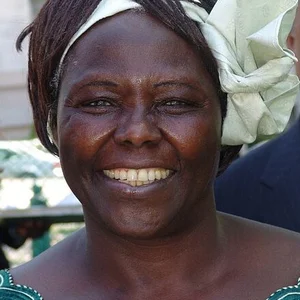
Wangari Maathai(1940 — 2011)
Wangari Maathai
Kenya
7 min read
Frequently asked questions
Key Facts
Works & Achievements
Founding of the environmental movement that planted more than 51 million trees in Kenya and East Africa. This initiative combines environmental protection with women's empowerment and the fight against desertification.
Successful opposition to a government plan to build a commercial complex in Karura Forest in Nairobi. This symbolic victory established Wangari Maathai as a leading figure of ecological resistance.
International recognition for her contribution to democracy, peace, and sustainable development. She was the first African woman to receive this prize for her environmental and political commitment.
A major essay in which she analyzes the challenges of African development by connecting environment, governance, and human rights. The book synthesizes her vision of a sustainable and democratic Africa.
Political engagement for the democratization of Kenya, including organizing demonstrations for civil liberties and an end to authoritarian rule. Her activism inspired regional social movements.
Creation of programs training Kenyan women in ecological entrepreneurship and environmental activism. This approach places gender equality at the heart of sustainable development.
Anecdotes
In 1977, Wangari Maathai planted the first tree of the Green Belt Movement in Nairobi's Karura Forest, accompanied only by her friends. This simple act marked the beginning of a movement that would go on to plant more than 51 million trees across Africa. She chose Karura Forest because it was under threat from real estate developers, and she was determined to protect it.
During a protest in 1989, Wangari Maathai and hundreds of women chained themselves to trees in Karura Forest to prevent them from being cut down. Faced with police, they refused to move, turning an environmental action into an act of civil disobedience. This victory saved the forest and inspired other environmental movements.
In 1992, Wangari Maathai was arrested and imprisoned for her environmental activism and human rights advocacy in Kenya. She continued her fight regardless, and in 2004 was awarded the Nobel Peace Prize, becoming the first African woman to receive it.
Wangari Maathai used the term 'Green Belt' to evoke the idea of trees forming a protective barrier around the land, inspired by the image of a safety belt. She drew a direct connection between forest protection, the fight against poverty, and the empowerment of Kenyan women.
In her Nobel Prize acceptance speech in 2004, Wangari Maathai spoke of 'democracy of the roots,' explaining that planting a tree is an act of participation in democracy and peace. She showed how every personal environmental action contributes to global peace and social justice.
Primary Sources
The Green Belt Movement was born from the belief that ordinary people could accomplish extraordinary things by working together to protect their environment and their livelihoods.
I realized that as long as we did not recognize that we could not live without trees, we would continue to destroy them. Trees taught me that real democracy begins at the grassroots.
As I receive this prize, I think of the millions of people around the world who work for peace and a healthy environment. We cannot separate peace, justice, and the environment.
The destruction of our environment is a symptom of a deeper moral and spiritual crisis. We must rediscover our sacred relationship with the earth.
Key Places
Forest where Wangari Maathai launched the Green Belt Movement in 1977 to plant trees and protect the environment. This site symbolizes the beginning of her fight against deforestation in Kenya.
Wangari Maathai's birthplace in 1940. This rural region of Kenya shaped her childhood and her deep connection to nature and the environment.
Kenya's capital, where Wangari Maathai developed the Green Belt Movement and led her environmental and political advocacy work. The center of her main activities.
The institution where Wangari Maathai taught as a professor of biology and raised students' awareness of environmental issues.
The city where Wangari Maathai received the Nobel Peace Prize in 2004 for her contribution to democracy, peace, and sustainable development in Africa.
Kenya's sacred mountain, symbolizing the natural environment that Wangari Maathai sought to protect through her ecological and political commitment.
Typical Objects

Central symbol of the Green Belt Movement founded by Wangari Maathai. Millions of trees planted in Kenya to combat deforestation and environmental degradation.

Award presented to Wangari Maathai in 2004 for her contribution to democracy, peace, and sustainable development. International recognition of her environmental commitment.

Tool used by Green Belt Movement activists to prepare the ground and plant trees. Symbol of the manual labor of reforestation.

Represents Wangari Maathai's original training in biology. She was a biologist and researcher, which shaped her scientific approach to conservation.

Garments bearing the colors of the Green Belt Movement (green, black, red, yellow). Symbol of Kenyan identity and the local roots of her work.

Petitions, manifestos, and protest letters against deforestation projects. Records of Wangari Maathai's political and ecological activism.

Wangari Maathai earned her doctorate in biology from the University of Nairobi. Her advanced education underpinned her scientific credibility and legitimacy.

Images documenting land reforested by the Green Belt Movement in Kenya. Visual evidence of the concrete impact of her environmental commitment on the landscape.
School Curriculum
Daily Life
Morning
Wangari Maathai starts her day early, often before dawn, to prepare before her commitments. She has a simple breakfast of tea and bread, then reviews her notes or correspondence related to Green Belt Movement activities. She plans her meetings with women's groups and the tree nurseries she oversees.
Afternoon
The afternoon is devoted to field visits at tree-planting sites across Kenya, where she meets directly with the women involved in the movement. She inspects nurseries, takes part in awareness sessions on the importance of reforestation, and discusses the challenges posed by deforestation. These visits often involve long drives through Nairobi and the surrounding regions.
Evening
In the evening, after her day's activities, she turns to correspondence, writing reports, or preparing speeches and advocacy materials for her causes. She shares a modest dinner with family or movement colleagues, discussing conservation strategies and the political obstacles they face. She ends her day reading or reflecting on environmental and social issues.
Food
Her diet reflects traditional Kenyan habits: ugali (maize porridge), beans, local vegetables, tropical fruits, and simple proteins. She regularly drinks tea, a central part of Kenyan culture. Her meals remain modest and suited to her demanding life as an activist.
Clothing
Wangari Maathai typically wears practical, simple clothing — often African dresses or skirts paired with shirts or blazers for official meetings. She is recognizable for her natural elegance and upright bearing, symbols of her moral authority. During field visits, she opts for comfortable, durable clothing suited to activist work.
Housing
She lives in Nairobi, Kenya's capital, in a modest home that reflects her commitment to simplicity and sustainability. Her residence also serves as a coordination hub for the Green Belt Movement, welcoming activists, journalists, and colleagues. The space combines private living and workspace, with a library, an office, and meeting rooms.
Historical Timeline
Period Vocabulary
Visual Style
Un style aquarelle tendre et engagé, mêlant l'art africain contemporain à l'illustration environnementale, avec des éléments botaniques fluides, des lumières chaleureuses évoquant les paysages kenyans, et une dimension humaniste et poétique reflétant l'activisme écologique et social de Wangari Maathai.
Sound Ambience
Une ambiance sonore immersive célébrant la lutte de Wangari Maathai pour la reforestation du Kenya, mêlant les sons apaisants de la nature africaine aux voix de femmes activistes plantant des arbres dans un esprit de paix et d'engagement social.
Liens externes & ressources
Références
Œuvres
Mouvement de la Ceinture verte (Green Belt Movement)
1977
Campagne pour la protection de la forêt de Karura
1989
Prix Nobel de la paix
2004
Ouvrage 'The Challenge for Africa'
2009
Promotion de la démocratie et des droits humains au Kenya
1990s-2000s
Initiative des femmes pour l'environnement et le développement
1980s-1990s