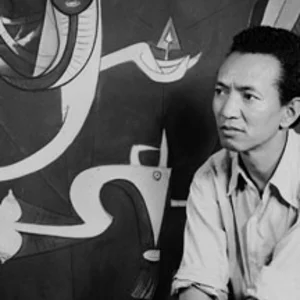

Wifredo Lam (1902-1982) was a Cuban painter and engraver, a major figure of modern art. Of mixed Afro-Cuban and Chinese heritage, he blended Surrealism, Cubism, and the Afro-Caribbean imagination — notably Santería — into a singular body of work embodied by his iconic painting The Jungle.
Wifredo Lam(1902 — 1982)
Wifredo Lam
France, Cuba
6 min read
Frequently asked questions
Key Facts
- Born in 1902 in Sagua la Grande (Cuba), to a Chinese father and an Afro-Cuban mother.
- Settled in Paris in 1938, where he befriended Pablo Picasso, who supported him.
- Joined the Surrealist movement and collaborated with André Breton (illustrations for Fata Morgana, 1940-1941).
- Painted his masterpiece The Jungle in 1943, now held at the MoMA in New York.
- Died in 1982 in Paris, recognized as a pioneer of non-Western modern art.
Works & Achievements
His absolute masterpiece, populated with hybrid figures among the sugar cane. Held at the MoMA in New York, it is regarded as a manifesto of Afro-modern art.
A series of drawings accompanying the poem by André Breton, created during his exile. The collection was censored by the Vichy regime.
A large composition in which totemic figures and vegetation intertwine. It extends the dreamlike world of The Jungle.
A teeming canvas blending symbols of Santería with Cubist forms. It illustrates the synthesis of European avant-garde and Caribbean imagination.
A work in which the first hybrid plant-and-animal figures appear. It heralds the visual language of The Jungle.
A reinterpretation of a Christian theme through the lens of Afro-Cuban cults. It reflects the religious syncretism so dear to Lam.
Anecdotes
Before becoming a painter, Wifredo Lam nearly died as a child: he fell seriously ill and was nursed back to health by his godmother Mantonica Wilson, a priestess of *santería*. This woman, initiated into Afro-Cuban cults, left a deep mark on his imagination, which he would later draw upon through Caribbean deities and symbols.
In **1938**, Lam arrived in Paris carrying a letter of recommendation for **Picasso**. The Spanish master welcomed him like a brother, introduced him to avant-garde circles, and organized an exhibition for him. Picasso is said to have remarked that Lam had “blood in his veins,” admiring the power of his forms.
In **1941**, fleeing the Nazi advance, Lam boarded a ship in Marseille alongside the Surrealist poet **André Breton** and the anthropologist **Claude Lévi-Strauss**. During the crossing, he illustrated Breton's poem *Fata Morgana*, which had been banned by the Vichy regime.
Returning to Cuba in **1941** after eighteen years away, Lam rediscovered the lush nature and Afro-Cuban culture of his island. This shock inspired his masterpiece *The Jungle* (**1943**), a canvas peopled with half-human, half-plant figures that caused a scandal when it was exhibited in New York.
Lam's maternal grandfather had been an African slave deported to Cuba, while his father, **Lam Yam**, was an educated Chinese immigrant who lived to the age of 108. This Afro-Chinese heritage nourished his entire body of work, where the cultures of the world intersect.
Primary Sources
I wanted to paint the drama of my country, but by fully expressing the Black spirit, the beauty of the visual art of Black people. In this way I could act as a Trojan horse from which would emerge hallucinatory figures.
Lam's art springs forth where the feeling of nature meets that of the supernatural, in the light that bathes the West Indies.
This morning the daughter of the mountain holds on her lap an accordion of white bats — a collection adorned with Lam's drawings made during his exile.
Key Places
Birthplace of Wifredo Lam, in the province of Villa Clara. He grew up there in a mixed Afro-Chinese family, steeped in the traditions of Santería.
The capital where Lam studied painting at the San Alejandro Academy. He returned there in 1941 and rediscovered the Afro-Caribbean inspiration behind *The Jungle*.
Lam trained as a painter here from 1923 and stayed for nearly fifteen years. He sided with the Republicans during the civil war.
Lam met Picasso and the Surrealists here in 1938. He lived here for much of his post-war life and died here in 1982.
A stop during his exile in 1941, where Lam met the poet Aimé Césaire, the theorist of négritude. This encounter strengthened his quest for an Afro-Caribbean identity.
Typical Objects

The painter's fundamental tools, with which Lam developed his ochre, green and earthy tones. He often worked by layering transparent glazes.

Lam was also a prolific printmaker, producing etchings and lithographs. The press allowed him to pull his prints in multiple copies.

Strings of colorful beads and ritual objects associated with the orishas, the Afro-Cuban deities. Lam drew on them to populate his canvases with sacred figures and symbols.

African ritual masks, rediscovered by the avant-gardes, structure the angular faces of his characters. They embody the ancestral heritage that Lam claimed as his own.

A recurring motif in Lam's work: a hybrid creature combining a female body with a horse's head, inspired by the possession trances of santería. She symbolizes the passage between the human world and that of the spirits.

A plant emblematic of Cuba's colonial economy, omnipresent in the island's landscapes. It appears stylized in The Jungle, evoking the forced labor of enslaved people.
School Curriculum
Vocabulary & Tags
Key Vocabulary
Daily Life
Morning
In his studio, Lam often began the day by observing his works in progress, letting the hybrid forms ripen. He prepared his backgrounds by applying diluted layers of earthy colors over large surfaces.
Afternoon
The afternoon was devoted to the intense work of painting, and sometimes to engraving on his press. Lam loved to receive fellow artists and poets to discuss art and politics.
Evening
In the evening, Lam frequented avant-garde circles, Parisian cafés, and Surrealist gatherings. There he discussed poetry, anthropology, and the cultures of the world that nourished his work.
Food
Traveling between Cuba, Europe, and the Caribbean, Lam sampled a wide variety of cuisines. The Cuban food of his childhood — rice, black beans, plantains, tropical fruits — remained for him a visceral link to his island.
Clothing
Lam adopted the understated elegance of twentieth-century artists: suits, shirts, and fitted jackets. Photographs often show him in neat urban attire, with an intense gaze.
Housing
Throughout his life as an exile and traveler, Lam lived in studios in Havana, Paris, and later in Albissola, Italy. His workspaces mingled canvases, engravings, and objects gathered over the course of his travels.
Historical Timeline
Period Vocabulary
Liens externes & ressources
Références
Œuvres
La Jungle (The Jungle)
1943
Illustrations de Fata Morgana
1941
La Réunion (The Reunion)
1945
Le Présent éternel (The Eternal Presence)
1944
Lumière de la forêt (Light of the Forest)
1942
Annonciation (The Annunciation)
1944