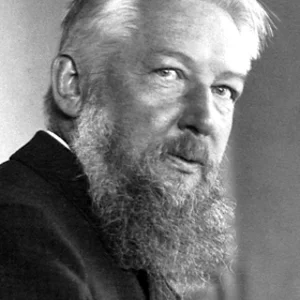

Wilhelm Ostwald was a Baltic German chemist, one of the founding fathers of physical chemistry. He received the Nobel Prize in Chemistry in 1909 for his work on catalysis, chemical equilibria and reaction rates.
Wilhelm Ostwald(1853 — 1932)
Wilhelm Ostwald
Allemagne, Empire russe
6 min read
Frequently asked questions
Key Facts
- Born in 1853 in Riga (then part of the Russian Empire), died in 1932 near Leipzig
- Co-founder of physical chemistry alongside van 't Hoff and Arrhenius in the 1880s
- Developed the Ostwald process (1902) for the industrial production of nitric acid from ammonia
- Received the Nobel Prize in Chemistry in 1909 for his work on catalysis
- Advocate of “energetics”, a philosophical doctrine that holds energy to be the fundamental reality
Works & Achievements
A foundational treatise that defined and organized physical chemistry as an independent discipline. A major reference for generations of chemists.
A mathematical relationship describing the dissociation of weak electrolytes in solution. A cornerstone of the emerging field of electrochemistry.
The modern definition of a catalyst as something that speeds up a reaction without being consumed. It earned Ostwald his Nobel Prize.
An industrial method for producing nitric acid by oxidizing ammonia. Still used today to make fertilizers and explosives.
The world's first scientific journal dedicated to physical chemistry, co-founded with van 't Hoff. It shaped the community around this new science.
A rational classification of colors based on measurable principles. It influenced designers and art theorists alike.
An award given for his work on catalysis, chemical equilibria, and reaction rates. The crowning recognition of physical chemistry.
Anecdotes
Ostwald was awarded the Nobel Prize in Chemistry in 1909 for his work on catalysis, but he nearly never became a chemist at all: a passionate painter, he once dreamed of being an artist. Later, he even founded a science of colors and invented a system to classify them, proving he had never truly set down his palette.
The “Ostwald process,” which he developed in 1902, makes it possible to manufacture nitric acid from ammonia. This process, still used today, serves to produce fertilizers that feed a large part of the planet.
Ostwald was for a long time a fierce opponent of the existence of atoms: he believed chemistry could be explained using energy alone, without these tiny invisible particles. He changed his mind around 1909, after Jean Perrin's experiments on Brownian motion proved that atoms really did exist.
Together with his Swedish friend Svante Arrhenius and the Dutchman Jacobus van 't Hoff, Ostwald formed a trio nicknamed the “Ionists” that founded an entirely new discipline: physical chemistry. Together, in 1887, they launched the first scientific journal devoted to the field.
Late in his life, withdrawn to his estate named “Energie” near Leipzig, Ostwald devoted a great deal of energy to promoting an international language (Ido) and to reforming the organization of science. He dreamed of a world where scholars from every country would understand one another instantly.
Primary Sources
Physical chemistry studies the general relationships between the physical properties and the chemical composition of substances.
A catalyst is a substance that alters the rate of a chemical reaction without itself appearing in the final products.
My entire scientific life has been governed by the conviction that energy is the fundamental reality of the world.
A process for producing nitric acid by the catalytic oxidation of ammonia over a platinum gauze.
Key Places
Baltic port city where Ostwald was born in 1853 into a Baltic German family. He spent his childhood there and developed his taste for experiments.
German-speaking university of the Russian Empire where Ostwald studied chemistry and defended his thesis. It was there that he met his first mentors.
Major German university where Ostwald was professor of physical chemistry from 1887 to 1906. His laboratory attracted students from all over the world.
Country estate near Leipzig where Ostwald retired after 1906. There he continued his research on colors and died in 1932.
It was in Stockholm that Ostwald received the Nobel Prize in Chemistry in 1909 from the Royal Swedish Academy of Sciences.
Typical Objects

A fine platinum mesh on which ammonia is oxidized to produce nitric acid. It is the heart of the Ostwald process, still used in the chemical industry today.

A graduated glass tube fitted with a stopcock, used to dispense a solution drop by drop. Ostwald used it to measure acid-base equilibria with precision.

A device that measures a solution's ability to conduct electric current. It allowed Ostwald to study the dissociation of ions and to formulate his dilution law.

A wheel of colors arranged according to a rational system invented by Ostwald. It illustrates his attempt to establish an exact science of color.

An imposing multi-volume treatise through which Ostwald shaped the new discipline of physical chemistry. It trained generations of students around the world.

A device that converts a chemical reaction into electric current. Ostwald saw in it the perfect illustration of the unity between energy and chemistry.
School Curriculum
Vocabulary & Tags
Key Vocabulary
Daily Life
Morning
A methodical early riser, Ostwald began his day at dawn with several hours of writing and reflection — his most productive time. He jotted his ideas in notebooks before heading to his university laboratory.
Afternoon
The afternoon was devoted to experiments, to mentoring his many doctoral students, and to lecturing. His Leipzig laboratory buzzed with students who had come from all over Europe and America.
Evening
In the evening, Ostwald corresponded with colleagues around the world and worked on his projects to reform science and create an international language. He also gladly devoted himself to painting, his lifelong passion.
Food
Like the German university bourgeoisie of his time, he ate hearty meals of bread, meats, potatoes, and Saxon beer. Coffee accompanied his long working sessions.
Clothing
In public, Ostwald wore the dark suit, the stiff-collared shirt, and the necktie of the late-nineteenth-century university professor. In the laboratory, he put on a lab coat to protect his clothes from chemicals.
Housing
In Leipzig, he lived in a comfortable bourgeois residence near the university. After his retirement, he settled at his country estate “Energie” in Großbothen, which combined a dwelling house, a private laboratory, and a painting studio.
Historical Timeline
Period Vocabulary
Liens externes & ressources
Références
Œuvres
Lehrbuch der allgemeinen Chemie (Manuel de chimie générale)
1885-1887
Loi de dilution d'Ostwald
1888
Théorie de la catalyse
1894
Procédé Ostwald
1902
Zeitschrift für physikalische Chemie (revue cofondée)
1887
Système des couleurs d'Ostwald (Farbenlehre)
1916-1923
Prix Nobel de chimie
1909