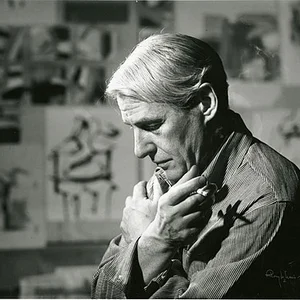

Willem de Kooning was an American painter of Dutch origin and a leading figure of abstract expressionism. He settled in the United States in 1926 and, alongside Jackson Pollock, became one of the leaders of the New York School. His “Women” series blends gestural abstraction with figuration.
Willem de Kooning(1904 — 1997)
Willem de Kooning
États-Unis, Royaume des Pays-Bas
6 min read
Frequently asked questions
Famous Quotes
« For me, art is not a way of making money; it is a way of life.»
Key Facts
- Born on April 24, 1904, in Rotterdam (Netherlands)
- Emigrated illegally to the United States in 1926
- Became a leading figure of abstract expressionism in the 1940s and 1950s
- Created his famous “Woman” series between 1950 and 1953
- Died on March 19, 1997, in East Hampton (New York)
Works & Achievements
A pivotal canvas where abstraction and pink female silhouettes begin to merge, foreshadowing his mature style.
A vast abstract composition in ochres and whites, considered one of his masterpieces; it was shown at the Venice Biennale.
The most famous work in the “Women” series, a violent and grotesque image that breaks with pure abstraction and caused a scandal.
Another major piece in the series, combining a grimacing female figure with unbridled gestural energy.
An urban abstract painting in which de Kooning incorporates transferred fragments of newspapers, evoking the chaos of the city.
An abstract canvas emblematic of his New York period, made famous by its record sale price.
A work from the period when the artist turned toward broad planes of color inspired by the Long Island landscape.
More fluid female figures painted after his move to East Hampton, reflecting the influence of the coastal light.
Anecdotes
In 1926, Willem de Kooning stowed away aboard a cargo ship, the SS Shelley, to reach the United States. He landed without proper papers and at first worked as a house painter and decorator to make a living in New York.
His “Women” series, begun in the early 1950s, sparked a scandal: while his fellow painters championed pure abstraction, de Kooning dared to reintroduce the human figure. These women with their grimacing teeth and distorted bodies shocked critics as much as they fascinated them.
In 1953, the artist Robert Rauschenberg asked de Kooning for one of his drawings for the sole purpose of erasing it to create a work titled “Erased de Kooning Drawing.” Amused but aware of what was at stake, de Kooning deliberately chose a drawing that would be hard to rub out.
Stricken with Alzheimer's disease in the 1980s, de Kooning nevertheless kept on painting. His final canvases, spare and luminous, still spark debate today over how much the artist and how much the illness shaped their creation.
In 1989 his painting “Interchange” (1955), and above all its resale in 2015 for roughly 300 million dollars, made it one of the most expensive works ever sold, cementing the posthumous value of abstract expressionism.
Primary Sources
“Flesh was the reason why oil painting was invented.”
“Beauty becomes petulant to me. I like the grotesque. It's more joyful.”
“Content, if you want, is a glimpse of something, an encounter, like a flash.”
Key Places
Birthplace of Willem de Kooning, where he began his artistic training and attended the Academy of Fine Arts in the evenings.
City where de Kooning settled after emigrating and became a central figure of the New York School and Abstract Expressionism.
Village where de Kooning set up the studio he designed himself and spent the final years of his life; he died there in 1997.
Museum that cemented de Kooning's reputation by exhibiting his works and organizing major retrospectives of his career.
Typical Objects

De Kooning often used wide decorator's brushes, inherited from his original trade, for his gestural and energetic brushstrokes. They allowed him to cover large surfaces with vehemence.

A flexible-bladed tool used to spread, scrape and scratch paint directly onto the canvas. De Kooning used it to layer the paint and bring buried layers back to the surface.

The artist's favourite medium, whose slow drying time he valued because it let him rework the paint at length. He sometimes mixed it with commercial pigments and water.

A large-scale support characteristic of Abstract Expressionism, which engages the painter's whole body. De Kooning spread his gestural compositions across it at the scale of a wall.

De Kooning cut out mouths from magazine advertisements and pasted them onto his “Women” canvases to start off the face. He also used tracing paper to transfer and shift motifs.

Drawing instruments that de Kooning used intensively, drawing and erasing endlessly in his search for form. Drawing remained the living skeleton of his painting.
School Curriculum
Vocabulary & Tags
Key Vocabulary
Tags
Daily Life
Morning
In the morning, de Kooning would head to his studio where the northern light reigned supreme. He often spent long moments studying an unfinished canvas before daring to make the first stroke, coffee in hand.
Afternoon
The afternoon was devoted to intense work on the material itself: he would apply, scrape away, then cover over the paint, endlessly reworking the same piece. He kept certain canvases wet for weeks so he could keep altering them.
Evening
In the evening, especially during his New York years, he frequented the Cedar Tavern, a bar in Greenwich Village where the painters of the New York School would gather. Discussions about art lasted there late into the night.
Food
His bohemian New York life was often marked by hardship, eating little and drinking a great deal. Once he settled in East Hampton, his diet became more regular, but alcohol long remained a troublesome companion.
Clothing
In his studio, de Kooning wore work clothes spattered with paint, echoing his youthful trade as a house painter. In public, he took greater care to present a simple, elegant look.
Housing
After years of modest lodgings in Manhattan, he had a bright, spacious studio-home built in Springs (East Hampton), conceived as a vessel devoted to painting, which he lived in until his death.
Historical Timeline
Period Vocabulary
Liens externes & ressources
Références
Œuvres
Pink Angels
vers 1945
Excavation
1950
Woman I
1950-1952
Woman and Bicycle
1952-1953
Interchange
1955
Door to the River
1960