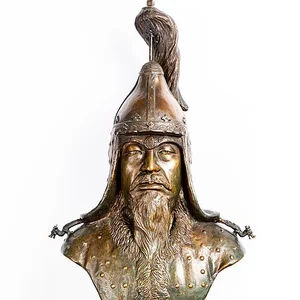

Korean admiral of the Joseon dynasty, regarded as one of the greatest naval strategists in history. He successfully defended Korea against the Japanese invasions of the late 16th century without ever losing a battle.
Yi Sun-sin(1545 — 1598)
Yi Sun-sin
période Joseon
6 min read
Frequently asked questions
Key Facts
- Born in 1545 in Seoul (kingdom of Joseon) and killed in action in 1598 at the Battle of Noryang
- Repels the Japanese invasions of Toyotomi Hideyoshi during the Imjin War (1592–1598)
- Uses turtle ships (geobukseon), armored vessels reputed to be nearly invulnerable
- Wins the Battle of Myeongnyang in 1597 with only 13 ships against a vastly superior Japanese fleet
- Remaining undefeated across all of his naval engagements, he is celebrated as a Korean national hero
Works & Achievements
Yi had this armored warship rebuilt and improved — a decisive weapon that threw the Japanese fleets into disarray.
Yi's first naval battle, in which he destroyed many Japanese ships without suffering any major losses.
A decisive victory thanks to the “crane wing” tactic, which broke the momentum of the Japanese invasion by sea.
With only 13 ships, Yi annihilated an overwhelming Japanese fleet by exploiting the currents of the strait.
The last great battle of the war, a Korean victory during which Yi was killed.
A detailed logbook, a major historical source and a national treasure of Korea.
Military reports written for King Seonjo, documenting the operations and the needs of the fleet.
Anecdotes
Before the Battle of Myeongnyang in 1597, Yi Sun-sin had only 13 ships left to face a Japanese fleet of more than 130 vessels. He is said to have written in his journal: “Those who seek death shall live, those who seek life shall die.” Taking advantage of the violent currents in the strait, he won one of the most lopsided naval victories in history.
Yi Sun-sin had the “turtle ship” (geobukseon) rebuilt and improved, an armored warship whose deck was covered with iron plates and spikes to prevent the enemy from boarding. Its dragon-head-shaped prow could belch smoke and fire cannons, terrifying the Japanese sailors.
Despite his victories, Yi fell victim to court intrigues: in 1597, he was dismissed, imprisoned and tortured, wrongly accused of disobedience. Demoted to a common soldier, he was urgently recalled after the rout of his replacement at the Battle of Chilcheollyang.
Yi Sun-sin died in battle at the Battle of Noryang in December 1598, struck by an arquebus bullet just as victory was secured. According to tradition, he ordered that his death be hidden from his men so as not to break their momentum: “The battle is at its height, do not announce my death.”
Throughout the war, Yi kept a detailed logbook, the Nanjung ilgi (“War Diary”), in which he recorded the battles, the supplies and his personal torments. This document is today an exceptional historical source on the Imjin War.
Primary Sources
Kept from 1592 to 1598, this personal diary records, day after day, the naval operations, the condition of the ships and the men, as well as the admiral's concerns.
A collection of the official memorials sent by Yi to King Seonjo to report on the battles and to request reinforcements and supplies.
Memoirs of a high-ranking Joseon minister and contemporary who describes the Imjin War and pays tribute to Yi Sun-sin's decisive role in the kingdom's defense.
Official court chronicles recording the appointments, the dismissal and later recall of Yi Sun-sin, and the accounts of the naval battles.
Key Places
Capital of the Joseon dynasty, where Yi Sun-sin was born in 1545.
A narrow channel with violent currents where Yi won his most famous victory in 1597 with only 13 ships.
Site of the great naval victory of 1592 and location of Yi's naval headquarters in southern Korea.
Site of the final battle of the Imjin War in 1598, where Yi Sun-sin was killed in combat.
Site of Yi's first naval victory in 1592, which revealed the tactical superiority of his fleet.
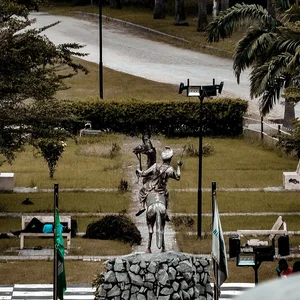
Commemorative shrine dedicated to Yi Sun-sin, erected near the region where he grew up and was buried.
Typical Objects

Korean warship with an armored deck bristling with iron spikes, featuring a dragon head at the prow and numerous cannons. Designed to break through enemy lines and resist boarding.

Large Korean warship with a raised deck serving as a platform for cannons and archers. It formed the backbone of Yi Sun-sin's fleet.

Korean bronze cannon firing cannonballs and large incendiary arrows from ships. Korean artillery power surpassed Japanese weaponry at sea.

A short, powerful bow made of horn, wood and sinew, the traditional weapon of Korean warriors. Yi and his men used it aboard ship for close combat.

Handwritten notebook in which Yi recorded battles, supplies and his thoughts. Written with brush and ink, it became a Korean national treasure.

Flags, drums and signals used to coordinate the fleet's maneuvers in the heat of battle. They allowed Yi to direct his ships from a distance.
School Curriculum
Vocabulary & Tags
Key Vocabulary
Daily Life
Morning
At dawn, Yi inspected his ships, checking the weaponry and the condition of his crews. He received scouts' reports on the movements of the Japanese fleet and held council with his officers.
Afternoon
The afternoon was devoted to training sailors and archers, to cannon-firing drills, and to overseeing the construction and repair of ships in the shipyards.
Evening
In the evening, by lamplight, Yi recorded the day's events in his diary, wrote his reports for the court, and pondered strategy. He often suffered from insomnia and illness.
Food
The diet was based on rice and barley, accompanied by soups, fermented vegetables (kimchi), dried fish, and seafood. On campaign, supplies were often scarce and were a constant worry for the admiral.
Clothing
On duty, Yi wore the uniform and armor of a Joseon officer: an official robe, lamellar or plate armor, and a helmet. For civil functions, he donned the silk attire of the scholar-officials.
Housing
Yi lived in the command quarters of his southern naval bases, such as Hansando, buildings of wood and tile near the shipyards. His family resided in a home in Asan, in Chungcheong Province.
Historical Timeline
Period Vocabulary
Liens externes & ressources
Références
Œuvres
Perfectionnement du bateau-tortue (geobukseon)
1592
Victoire d'Okpo
1592
Bataille de Hansando
1592
Bataille de Myeongnyang
1597
Bataille de Noryang
1598
Nanjung ilgi (Journal de guerre)
1592-1598